

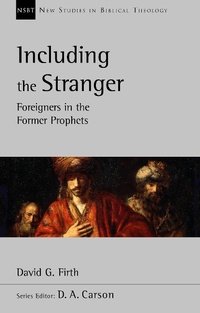
Including the Stranger
Description

The Old Testament, particularly the Former Prophets, has frequently been regarded as having a negative attitude towards foreigners. This has meant that these texts are often employed by those opposed to the Christian faith to attack the Bible; and such views can be echoed by Christians. While the story of David and Goliath is cherished, other episodes are seen to involve 'ethnic cleansing' or 'massacre' and are avoided.
David Firth's contention is that this view emerges from an established interpretation of the text, but not the text itself. He argues that the Former Prophets subvert the exclusivist approach in order to show that the people of God are not defined by ethnicity but rather by their willingness to commit themselves to the purposes of Yahweh. God's purposes are always wider than Israel alone, and Israel must therefore understand themselves as a people who welcome and include the foreigner.
Firth addresses contemporary concerns about the ongoing significance of the Old Testament for Christians, and shows how opponents of Christianity have misunderstood the Bible. His reading of the Former Prophets also has significant ethical implications for Christians today as they wrestle with the issues of migration and what it means to be the people of God.
More details
Other editions
Additional editions
Person
Tutor in Old Testament, Trinity College, Bristol, UK, and research fellow of the University of the Free State. Author of 1 & 2 Samuel (AOTC), The Message of Esther (BST), The Message of Joshua (BST). Co-editor of Interpreting the Psalms, Interpreting Deuteronomy, Interpreting Isaiah, Words and the Word, Exploring Old Testament Wisdom and Presence, Power and Promise (all Apollos). TOTC Series Editor.
Content
- Intro
- Series preface
- Author's preface
- Abbreviations
- Chapter One
- Concerning foreigners and the Former Prophets
- Being a foreigner and reading the Bible
- Why the Former Prophets?
- Towards an ethical and theological reading of the Former Prophets
- Chapter Two
- The book of Joshua: the identity of the people of God
- Initial observations: the genre and language of Joshua
- Rahab and the initial entry into the land (Josh. 1 - 6)
- Achan (Josh. 7:1 - 8:29)
- The altar on Mount Ebal and the Gibeonites (Josh. 8:30 - 12:24)
- Caleb, the surviving Canaanites and the cities of refuge (Josh. 13 - 21)
- The altar on the Jordan (Josh. 22)
- The threat of all and an invitation to all (Josh. 23 - 24)
- Conclusions: Joshua as the formation of the people of God
- Chapter Three
- The book of Judges: the people through whom Yahweh works
- Initial orientation
- After Joshua: Judges 1:1 - 3:6
- The stories of the judges: Judges 3:7 - 16:31
- When there was no king: Judges 17 - 21
- Conclusions on Judges: the people through whom Yahweh works
- Chapter Four
- The books of Samuel: foreigners as the means of assessing Israel
- Initial orientation
- Samuel: 1 Samuel 1 - 12
- Saul: 1 Samuel 13 - 15
- Saul and David, Ish-bosheth and David: 1 Samuel 16:1 - 2 Samuel 5:16
- David as king: 2 Samuel 5:17 - 24:25
- Conclusions: Samuel and understanding the people of God
- Chapter Five
- The books of Kings: foreigners beyond the borders of Israel
- Initial orientation
- Solomon: 1 Kings 1 - 11
- Two kingdoms: 1 Kings 12 - 2 Kings 13
- The fall of the kingdoms: 2 Kings 14 - 25
- Conclusions: kings and foreigners beyond the borders of Israel
- Chapter Six
- Foreigners and the people of God
- Initial orientation: key themes from the Former Prophets
- Echoes in the Old Testament
- Echoes in the New Testament
- Pointers for an ethic towards foreigners
- Bibliography
- Notes
- Search names for authors
- Search items for Scripture references
- Search items for ancient sources
- Titles in this series:
