

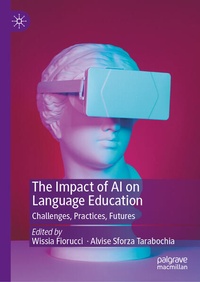
The Impact of AI on Language Education
Description

This book explores how Artificial Intelligence is reshaping language education, acknowledging both its pedagogical potential and the challenges it introduces. It examines teacher cognition, assessment, feedback, and intercultural training alongside concerns about ethics, bias, and hallucinated content. Together, these discussions reflect on what responsible and well-informed use of AI in Higher Education should entail.
Through case studies, exploratory investigations, and reflective analyses, contributors present practical approaches to classroom integration. Drawing on a range of institutional and linguistic contexts, the volume traces the evolving professional role of language teachers, showing that human judgement and disciplinary expertise remain essential even as AI becomes more prominent in educational ecosystems.
The collection supports educators, researchers, and practitioners navigating a rapidly changing landscape. Distinct from much current literature, it brings together perspectives from multiple countries and linguistic traditions, positioning the volume as an invaluable resource for those working across diverse educational settings worldwide.
More details
Other editions
Additional editions
Persons
Wissia Fiorucci is Reader in Education and Language Centre Director at the University of Kent, UK. She serves as Honorary Secretary for the University Council for Languages and is co-founder and convenor of the Modern Languages Teaching Forum. Her edited collection Language Education During the Pandemic (2023) examined pedagogical responses to crisis and rapid technological change. Her teaching and research focus on language education practices, intercultural communication, and assessment in Higher Education, with particular interest in how learning environments respond to social and technological evolution.
Alvise Sforza Tarabochia is Senior Lecturer in Italian and Director of Education at the University of Kent, UK. He co-founded and convenes the Modern Languages Teaching Forum and serves as Italian Studies Representative in the University Council for Languages. His teaching covers Italian language, visual culture, intercultural communication, and language for professional contexts. His recent book, Making Madness Visible: A Cultural History of How Mental Disorder is Visualised (2026), investigates the shifting representation of mental disorder across history, language, and media.
Content
Chapter 1. Introduction: A Sector At A Crossroads ( Wissia Fiorucci, Alvise Sforza Tarabochia, Rosangela Misciagna ).- Part I: From Concept to Classroom: On AI Cognition, Competencies, and Implementation.- Chapter 2. L2 Italian Language Teachers' Cognitions In Using Chatgpt: An Exploratory Study ( Alessandro Puglisi ).- Chapter 3. Empowering Educators: AI Integration and Professional Development in Language Education ( Ana Niño Alonso ).- Chapter 4. Artificial Intelligence Or Artificial Imitation? I Must Be Hallucinating! A Practice Design Case Study: AI-Scaffolded Portfolio For B1 German ( Hanna Magedera-Hofhansl AI ).- Part II: Ethical Concerns And Implications In The Use Of Ai In Language Education.- Chapter 5. Like a Slot Machine: AI, Representation and the Challenges of Language Diversity ( Katrin Engelmayr-Hofmann, Matthias Leichtfried ).- Chapter 6. Assessing The Ethical Landscape: A Review Of Genai-Supported Language Learning With Chatgpt ( Weiming Liu ).- Chapter 7. Automated Written Corrective Feedback (AWCF) In English L2 Classes: A Case Study On Challenges, Opportunities And Ethics In Students' Perception ( Antonella Giacosa, Nesrine Triki ).- Part III: ChatGPT: Intercultural Communication and Pragmatic Competence in the Language Classroom.- Chapter 8. The Use Of Chatgpt To Boost Foreign Language Learners' Pragmatic Competence: The Art Of Complaining ( Patricia Díaz-Muñoz, Laura Stecca ).- Chapter 9. Chatgpt-4o As An Intelligent Dialogue-Based Tutoring System (IDTS) For Idiom Acquisition: A Case Study On Italian And Mandarin As Foreign Languages Across Proficiency Levels ( Rosangela Misciagna, Jingshi Jian ).- Chapter 10. Intercultural Communicative Competence in the Language Curriculum: AI-assisted Approaches ( Wissia Fiorucci ).- Chapter 11. A Brief Concluding Remark: Technology, Pedagogy, and the Society that Makes Them ( Wissia Fiorucci, Alvise Sforza Tarabochia ).
