

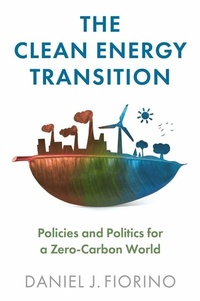
The Clean Energy Transition
Description

Is the goal of a transition to clean energy at all realistic? If so, how could it be accomplished? Climate change poses a formidable challenge for twenty-first-century governments. Unless they can move to a clean energy system built on efficiency, renewables, electrification, and possibly complementary technologies like nuclear energy and carbon capture and storage, it will be all but impossible to avoid the worst impacts of climate change.
In this book, Daniel Fiorino provides a comprehensive introduction to the politics and policies of a clean energy transition and how it may unfold nationally and globally. Across its nine chapters, he explores the current energy landscape and the different pathways and pitfalls on the road to decarbonization. All scenarios for decarbonizing, he argues, rely on aggressive efficiency, the rapid scale-up of renewables, and the electrification of most of what is left. Yet this transition has to be accelerated and done effectively. There is little time left for second chances if we are to decarbonize later this century.
The Clean Energy Transition will be an indispensable resource for students of energy politics, environmental studies, and public policy, as well as anyone interested in the energy issues of the day.
Daniel J. Fiorino is the Director of the Center for Environmental Policy and Distinguished Executive in Residence in the School of Public Affairs at American University.
More details
Other editions
Additional editions
Person
Content
Preface
Chapter 1: The Energy Landscape
Chapter 2: Why Clean Energy Matters
Chapter 3: Getting the Carbon Out: Pathways to Decarbonization
Chapter 4: The Invisible Resource: Energy Efficiency
Chapter 5: Endless Flows: Renewable Energy
Chapter 6: Electrify Everything
Chapter 7: Hard Choices and an Opportunity: Nuclear, Carbon Capture, and Green Hydrogen
Chapter 8: Accelerating the Energy Transition
Chapter 9: The Clean Energy Future
Glossary
Notes
Index
1
The Energy Landscape
In September 2020, Ursula von der Leyen, President of the European Commission, announced the European Green Deal, committing the European Union to reducing carbon emissions by "at least 55%" by 2030. By 2050, Europe plans to be the world's first "climate-neutral continent" in the fight against the existential threat of climate change. Failing to act, the announcement stated, will not only exacerbate climate change, it could lead to over 400,000 deaths from air pollution and 90,000 from heat waves annually. "The longer we wait," the EC warned, "the harder it becomes to reach low-temperature targets and the more expensive the necessary efforts will become."1
That same month, President Xi Jinping of China announced that the country with the largest climate-related emissions in the world aimed to be "carbon neutral" within the next forty years.2 Over the next decade, China would begin reducing emissions, which would begin to fall "steeply" after 2035, with carbon neutrality achieved by 2060 (when remaining emissions will be balanced out by carbon removal). This is ambitious for a country that in 2020 was generating two-thirds of its electricity from coal plants and had another 200 such plants planned or under construction. According to one projection, however, even in 2060 fossil fuels (coal, natural gas, and oil) would still make up 16% of the energy system, which would be rendered carbon neutral by carbon capture and storage (CCS) technology and natural sinks like forests.3 Many experts thought this was doable, but that it would require a doubling of electricity generation with renewables and a major expansion in solar, wind, and nuclear power. One model foresaw an electricity mix for China of 28% nuclear, 21% wind, 17% solar, 14% hydropower, 8% biomass, and the rest from coal and gas using CCS.
Europe and China are not alone in this quest to get carbon out of their economies. According to the World Resources Institute (WRI), by the close of the 26th Conference of the Parties held in Glasgow, Scotland, in November 2021, seventy-four countries had adopted a national net-zero target as policy, although well over half of them had yet to enshrine it in law.4 Even the United States belatedly got in on the act. President Joe Biden announced a goal of using only renewables for electricity by 2035 and achieving carbon neutrality by 2050.5 Many US states, including California, New York, and Washington, have set mid-century net-zero carbon targets in law.6 Of course, setting a goal is not the same as meeting it, and emissions have to start falling well before 2050.
Why are so many countries promising to get rid of carbon? Could clean energy sources alone - wind, sun, water, biomass, geothermal, and nuclear - do what coal, oil, and natural gas have been doing for well over a century? Is the goal of decarbonizing the global energy system this century at all realistic? And why are so many countries wanting to achieve that goal?
The why part of this commitment is straightforward: The planet is warming due to the accumulation of carbon dioxide and other greenhouse gases in the atmosphere. There is now a global consensus that the world is on its way to suffering harsh and unmanageable effects from this warming, including perhaps runaway climate change that would prove to be more disruptive and harmful than anything that has occurred in human history. At the same time, the range of clean energy technology options has expanded, with wind and solar prices falling and their capacities growing. The focus of this movement is on energy. Much also has to happen, of course, in agriculture, forestry, land use, and elsewhere - but global energy accounts for most emissions. If a transition to clean (zero or low-carbon) energy is not achieved, the battle to stabilize the climate will be lost.
If the why of this transition is clear, the questions of whether it will occur and how are less so. If the goal is to eliminate carbon emissions sometime in mid-century, or get them so low that remaining emissions can be offset by technological or natural means of carbon removal (hence the carbon neutrality), then this is a tall order, given that fossil fuels have made up over 80% of global energy for decades. Although countries are making progress on cleaning up their electricity sectors, nearly all of transport and much of industry still rely on fossil fuels. The outlines of a transition have taken shape, as we will see in this book, but the specifics are open to debate.
The Clean Energy Transition
The global transition to clean energy must occur because the energy system accounts for three-fourths of the greenhouse gas emissions that cause climate change. It also is the leading cause of health-damaging air pollution and many forms of ecological degradation. The transition will occur because it now is underway, and the forces driving it are compelling. The question is whether it will occur fast enough and in ways that meet social and economic goals.
It is not currently happening fast enough. Over four-fifths of the global energy system relies on fossil fuels like coal, oil, and natural gas. This has changed only marginally in decades, despite the threat of climate change. Moving to clean energy will require greater use of renewable sources - solar, onshore and offshore wind, geothermal, beneficial biomass, tidal, and wave - as well as major improvements in the efficiency and use of distributed sources like community or residential solar. It also means applying the fruits of modern technology to every aspect of the energy system: production and generation, distribution networks, storage, mobility, transport, industry processes, and electricity grids. All this will involve changing product designs, service delivery, business models, land-use practices, economic policy, and consumer behavior.
Because the transition is underway, there is room for optimism. Because there is so far to go, there is just as much room for pessimism. Indeed, energy offers a good news/bad news story. First, the good news:
- Between 2018 and 2050, capacities for generating electricity with solar photovoltaic (PV) sources could increase by a factor of twenty, while onshore wind may grow ten-fold.7
- The energy intensity (i.e. the energy needed to produce a dollar of economic output) of the global economy has improved by an average of 1.7% annually over the last two decades and is forecast to get even better over the next thirty years, with an average gain of 2.3% each year.8
- Solar PV and wind sources could be producing 62% of the world's electricity by 2050.9
- The costs of generating electricity from floating offshore wind platforms may fall by nearly 40% between 2019 and 2050.10
- The International Energy Agency (IEA) believes that "All the technologies needed to achieve the necessary deep cuts in global emissions by 2030 already exist."11
Then there is the bad news:
- By 2050, the world is likely to see population growth of 23% and average per capita income gains of 63%. Both types of increase have historically led to higher energy use.12 Although good news for developing countries, this is bad news for the climate, health, and the environment.
- Despite the rapid growth of wind and solar, the International Renewable Energy Agency reports that "Energy-related CO2 emissions have risen by 1% per year over the last decade."13 This was pre-pandemic, through 2019, but those growth rates will return.
- Despite the recent progress in renewables, the world is not on track to meet the goals set out in the 2015 Paris Agreement (discussed in Chapter 3).14
- To decarbonize global energy by 2050, annual investment should average at least $3.2 trillion a year to 2050; the recent average (2014 to 2018) was $1.8 trillion.15
- Vehicles have become more efficient, but gains "have largely been offset by trends toward larger vehicles."16
The Latest But Different Energy Transition
Energy is essential to the world as we know it. Prosperity only became possible almost two centuries ago because people learned to harness forces other than human or animal muscle for work.17 Until the early 1800s and the dawn of the industrial revolution, humans relied on wood as their primary energy source, supplemented by wind and water. Early technologies like the steam engine, combined with the availability of coal as a fuel source, changed all that. Great Britain became the first industrial nation because it had coal, technical ingenuity, and an economy suited to applying energy to industry. The transition from wood to coal constituted an early energy transition. Since then, there have been transitions to oil, natural gas, nuclear, and now modern renewables like wind and solar. The long-term trends making up major European energy transitions are given in Figure 1.1.
Figure 1.1: Share of Total Energy in Europe Since 1800
Source: Roger Fouquet, "Historical Energy Transitions, Speed, Prices, and System Transformation," Energy Research and Social Science 22 (2016).
For 200 years, energy transitions resulted from considerations of efficiency, cost, convenience, and need. Coal is a dense source of energy and is available in much...
