

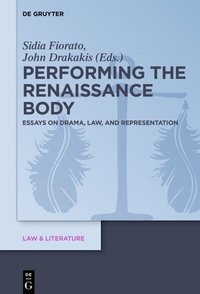
Performing the Renaissance Body
Description

In the Renaissance period the body emerges as the repository of social and cultural forces and a privileged metaphor for political practices and legal codification. Due to its ambivalent expressive force, it represents the seat and the means for the performance of normative identity and at the same time of alterity. The essays of the collection address the manifold articulations of this topic, demonstrating how the inscription of the body within the discursive spheres of gender identity, sexuality, law, and politics align its materiality with discourses whose effects are themselves material. The aesthetic and performative dimension of law inform the debates on the juridical constitution of authority, as well as its reflection on the formation and the moulding of individual subjectivity. Moreover, the inherently theatrical elements of the law find an analogy in the popular theatre, where juridical practices are represented, challenged, occasionally subverted or created. The works analyzed in the volume, in their ample spectre of topics and contexts aim at demonstrating how in the Renaissance period the body was the privileged focus of the social, legal and cultural imagination.
More details
Other editions
Additional editions
Persons
Content
- Intro
- Table of Contents
- Foreword
- Introduction. Performances, Regulations and Negotiations of the Renaissance Body. Legal and Social Perspectives
- I. Trying "Other" Bodies: The Witch, the Black and the Old
- (Disciplining) Monstrous Renaissance Bodies: Staging the Witch
- ".Languished., and then died": Courtroom Drama and the Bodies of the Victims in Thomas Pott's The Wonderfull Discoverie of Witches (1612)
- Constructing Alterity: Race, Gender, and the Body in Shakespeare's Othello
- Staged and Staging Bodies as Legal and Medical sites in Volpone
- II Codification of the Body Politic and Common Law Jurisprudence
- Representing the Body of Law in Early Modern England
- The Image of Power: Shakespeare's Lord Chief Justice
- With Teeth and Nails: The Embodied Inservitude of Étienne de La Boétie
- III. Liminal Bodies: The Life/Death Edge on Stage and in the Body Politic
- The Funeral Oration over Caesar's Body: Techniques of Mass Communication
- Motionless Bodies: Shakespeare's Songs for Sleep and Death
- IV. Staging the Queenly Body: The Performance of a Female Body Politic
- Katechontic Elizabeth: The Physical Repository of Sovereignty through Law, Literature and Iconography
- Anna of Denmark and the Performance of the Queen Consort's Sovereignty
- The Body Politic, Female Transgression and Punishment in Jacobean Tragedy
- Index
