

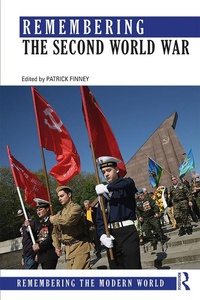
Remembering the Second World War
Published on 14. July 2017
280 pages
978-1-351-71475-4 (ISBN)
Description

Remembering the Second World War brings together an international and interdisciplinary cast of leading scholars to explore the remembrance of this conflict on a global scale. Conceptually, it is premised on the need to challenge nation-centric approaches in memory studies, drawing strength from recent transcultural, affective and multidirectional turns.
Divided into four thematic parts, this book largely focuses on the post-Cold War period, which has seen a notable upsurge in commemorative activity relating to the Second World War and significant qualitative changes in its character. The first part explores the enduring utility and the limitations of the national frame in France, Germany and China. The second explores transnational transactions in remembrance, looking at memories of the British Empire at war, contested memories in East-Central Europe and the transnational campaign on behalf of Japan's former 'comfort women'. A third section considers local and sectional memories of the war and the fourth analyses innovative practices of memory, including re-enactment, video gaming and Holocaust tourism.
Offering insightful contributions on intriguing topics and illuminating the current state of the art in this growing field, this book will be essential reading for all students and scholars of the history and memory of the Second World War.
Divided into four thematic parts, this book largely focuses on the post-Cold War period, which has seen a notable upsurge in commemorative activity relating to the Second World War and significant qualitative changes in its character. The first part explores the enduring utility and the limitations of the national frame in France, Germany and China. The second explores transnational transactions in remembrance, looking at memories of the British Empire at war, contested memories in East-Central Europe and the transnational campaign on behalf of Japan's former 'comfort women'. A third section considers local and sectional memories of the war and the fourth analyses innovative practices of memory, including re-enactment, video gaming and Holocaust tourism.
Offering insightful contributions on intriguing topics and illuminating the current state of the art in this growing field, this book will be essential reading for all students and scholars of the history and memory of the Second World War.
Reviews / Votes
"The traumas of the second World War and the Holocaust were a global phenomenon whose legacies are fundamentally embedded in present-day cultures and societies. As the participant generations' memories are reduced by aging and death, the war's fascination for subsequent generations only seems to grow. This timely collection addresses the transnational, transcultural, multidirectional, and migratory nature of those memories in highly accessible and intriguing case studies."Susan Crane, University of Arizona, USA
"This timely volume presents critical insights into the transformation of the Second World War in memory and the transformation of the field of memory studies itself. It is particularly valuable for its range of national and transnational perspectives, providing a sound basis for comparative engagement. Both for its component parts and for its overall message, this book is a welcome addition to scholarship on war and memory."
Beatrice Trefalt, Monash University, Australia
"This richly fascinating book draws upon transnational and comparative perspectives to provide a critical examination of the memory of the Second World War, spanning many continents. Engaging with the latest theoretical debates on memory, it reflects upon new modes of remembrance and their impact on global memorialisation of the Second World War. It highlights how, as the Second World War moves beyond living memory, its remembrance is being continually renegotiated and reshaped within shifting global and transcultural contexts. It is a welcome addition to international scholarship on war and memory."
Wendy Ugolini, University of Edinburgh, UK "The traumas of the second World War and the Holocaust were a global phenomenon whose legacies are fundamentally embedded in present-day cultures and societies. As the participant generations' memories are reduced by aging and death, the war's fascination for subsequent generations only seems to grow. This timely collection addresses the transnational, transcultural, multidirectional, and migratory nature of those memories in highly accessible and intriguing case studies."
Susan Crane, University of Arizona, USA
"This timely volume presents critical insights into the transformation of the Second World War in memory and the transformation of the field of memory studies itself. It is particularly valuable for its range of national and transnational perspectives, providing a sound basis for comparative engagement. Both for its component parts and for its overall message, this book is a welcome addition to scholarship on war and memory."
Beatrice Trefalt, Monash University, Australia
"This richly fascinating book draws upon transnational and comparative perspectives to provide a critical examination of the memory of the Second World War, spanning many continents. Engaging with the latest theoretical debates on memory, it reflects upon new modes of remembrance and their impact on global memorialisation of the Second World War. It highlights how, as the Second World War moves beyond living memory, its remembrance is being continually renegotiated and reshaped within shifting global and transcultural contexts. It is a welcome addition to international scholarship on war and memory."
Wendy Ugolini, University of Edinburgh, UK
More details
Series
Language
English
Place of publication
London
United Kingdom
Publishing group
Taylor & Francis Ltd
Target group
College/higher education
Illustrations
15 s/w Abbildungen
15 Illustrations, black and white
File size
31,56 MB
ISBN-13
978-1-351-71475-4 (9781351714754)
Copyright in bibliographic data and cover images is held by Nielsen Book Services Limited or by the publishers or by their respective licensors: all rights reserved.
Schweitzer Classification
Other editions
Additional editions
Patrick Finney
Remembering the Second World War
Book
06/2017
1st Edition
Routledge
€56.00
Shipment within 10-20 days
Patrick Finney
Remembering the Second World War
Book
06/2017
1st Edition
Routledge
€215.77
Shipment within 10-20 days
Person
Patrick Finney teaches in the Department of International Politics at Aberystwyth University. He has published widely on collective memory, especially in relation to the Second World War, and on the international history of the twentieth century, especially in relation to the inter-war period. He is currently writing a book entitled How the Second World War Still Shapes Our Lives.
Content
List of figures
List of contributors
Acknowledgements
Introduction
Patrick Finney
PART ONE: National Memory Cultures?
1. A Nation United? The Impossible Memory of War and Occupation in France
Margaret Atack
2. Generation War and Post-Didactic Memory: The Nazi Past in Contemporary Germany
Bill Niven
3. Remembering and Forgetting War and Occupation in the People's Republic of China, Hong Kong and Taiwan
Edward Vickers
PART TWO: Transnational Transactions
4. Isaac Fadoyebo's Journey: Remembering the British Empire's Second World War
Patrick Finney
5. The Soviet War Memorial in Vienna: Geopolitics of Memory and the New Russian Diaspora in Post-Cold War Europe
Tatiana Zhurzhenko
6. Abolitionism in the History of the Transnational 'Justice for Comfort Women' Movement in Japan and South Korea
Caroline Norma
PART THREE: Local and Sectional Memories
7. The Treachery of Memorials: Beyond War Remembrance in Contemporary Okinawa
Gerald Figal
8. The Yokohama War Cemetery, Japan: Imperial, National and Local Remembrance
Joan Beaumont
9. The Memory of the Joop Westerweel Resistance Movement in Israel and the Netherlands
Joyce van de Bildt
PART FOUR: Practices of Remembrance
10. A Holy Relic of War: The Soviet Victory Banner as Artefact
Jeremy Hicks
11. Experiencing and Performing Memory: Second World War Videogames as a Practice of Remembrance
Eva Kingsepp
12. Touching Landscapes? Embodied Experiences of Holocaust Tourism and Memory
Tim Cole
Afterword: Entangled Memories of the Second World War
Jie-Hyun Lim
Index
List of contributors
Acknowledgements
Introduction
Patrick Finney
PART ONE: National Memory Cultures?
1. A Nation United? The Impossible Memory of War and Occupation in France
Margaret Atack
2. Generation War and Post-Didactic Memory: The Nazi Past in Contemporary Germany
Bill Niven
3. Remembering and Forgetting War and Occupation in the People's Republic of China, Hong Kong and Taiwan
Edward Vickers
PART TWO: Transnational Transactions
4. Isaac Fadoyebo's Journey: Remembering the British Empire's Second World War
Patrick Finney
5. The Soviet War Memorial in Vienna: Geopolitics of Memory and the New Russian Diaspora in Post-Cold War Europe
Tatiana Zhurzhenko
6. Abolitionism in the History of the Transnational 'Justice for Comfort Women' Movement in Japan and South Korea
Caroline Norma
PART THREE: Local and Sectional Memories
7. The Treachery of Memorials: Beyond War Remembrance in Contemporary Okinawa
Gerald Figal
8. The Yokohama War Cemetery, Japan: Imperial, National and Local Remembrance
Joan Beaumont
9. The Memory of the Joop Westerweel Resistance Movement in Israel and the Netherlands
Joyce van de Bildt
PART FOUR: Practices of Remembrance
10. A Holy Relic of War: The Soviet Victory Banner as Artefact
Jeremy Hicks
11. Experiencing and Performing Memory: Second World War Videogames as a Practice of Remembrance
Eva Kingsepp
12. Touching Landscapes? Embodied Experiences of Holocaust Tourism and Memory
Tim Cole
Afterword: Entangled Memories of the Second World War
Jie-Hyun Lim
Index
