

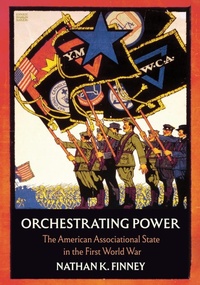
Orchestrating Power
Description

Orchestrating Power explores how the expansion of the American state for the First World War reshaped the nature of governance. This wartime state expansion is examined through the creation, structure, activities, and impact of the Council of Defense system on the ability of the United States to mobilize for a significant conflict in a foreign land.
Nathan K. Finney focuses on North Carolina's Council of Defense to describe how the council was mediated by specific people at various levels of society and the results of their decisions. The result is a compelling story about how individuals drove dynamic and compelling regional and national events that propelled a massive national wartime mobilization.
Positioned between the national government and the people of North Carolina, the Council of Defense mediated the activities of public, private, and individual efforts in support of mobilization activities. Because of this intermediary positioning, the council was instrumental in expanding state capacity and capability for military and resource mobilization and supporting an increase in the nation's ability to mobilize for the war.
The council's intermediary role, however, also allowed those managing the state mobilization to prevent any significant challenge to the state's social and political structures, despite the dynamic changes wrought by the need to mobilize the nation for war. As a result, Orchestrating Power helps us understand the crucial decisions and developments of early twentieth-century America, showing why the country mobilized for war in the specific ways that it did.
More details
Other editions
Additional editions
Person
Nathan K. Finney is a fellow at the Atlantic Council's Indo-Pacific Security Initiative, a managing editor of the British Journal for Military History, and a board member of the Journal of Military History. He earned a PhD in history at Duke University.
