

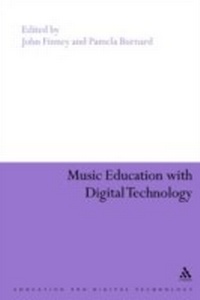
Music Education with Digital Technology
1st Edition
Published on 13. September 2007
240 pages
978-1-4411-8653-9 (ISBN)
Description

This book draws together a range of innovative practices, underpinned by theoretical insight, to clarify musical practices of relevance to the changing nature of schooling and the transformation of music education and addresses a pressing need to provide new ways of thinking about the application of music and technology in schools. The contributors covers a diverse and wide-range of technology, environments and contexts on topics that demonstrate and recognize new possibilities for innovative work in education, exploring teaching strategies and approaches that stimulate different forms of musical experience, meaningful engagement, musical learning, creativity and teacher-learner interactions, responses, monitoring and assessment.
Reviews / Votes
'A welcome addition to the literature on digital technology and music education. For those studying to be teachers, or researching music education at university, it will serve as an important reference work. I would also like to hope that it could influence classroom practice.' Bill Crow in Music Education Research 'What John Finney and Pamela Burnard have managed to achieve is perhaps the first truly unique contribution to the challenges, changes and innovations that digital technology presents to the music curricula for teachers in schools today...this book is certainly useful and thought provoking, and is a welcome addition to the literature in the field of music education.' Andrew King in the Journal of Music, Technology and Education 'The editors have assembled an impressive list of contributors - 17 academics, teachers, researchers and musicians, who are mainly from the UK but also from Ireland, Australia, Hong Kong and the USA... [This book] explores a wide range of digital technologies, including iPods, ring tones, DJ mixing, MIDI workstations, sound synthesis, recording, sequencing and score writing software, and the affordances of Web 2.0, including blogs, podcasts, wikis and social networking sites.' British Journal of Music EducationMore details
Series
Edition
1. Auflage
Language
English
Place of publication
New York
United States
Target group
Professional and scholarly
ISBN-13
978-1-4411-8653-9 (9781441186539)
Copyright in bibliographic data and cover images is held by Nielsen Book Services Limited or by the publishers or by their respective licensors: all rights reserved.
Schweitzer Classification
Other editions
Additional editions
John Finney | Pamela Burnard
Music Education with Digital Technology
Book
05/2010
Continuum International Publishing Group Ltd.
€83.90
Shipment within 15-20 days
Persons
John Finney is Senior Lecturer in Music Education at the Faculty of Education, University of Cambridge, UK. Pamela Burnard is Professor of Arts, Creativites and Education at the University of Cambridge, UK. Recent publications include Musical Creativities in Practice (2012), Teaching Music Creatively (with Regina Murphy, 2013) and Developing Creativities in Higher Music Education (2013). Sue Brindley is Senior Lecturer in Education at the University of Cambridge, UK. Anthony Adams was formally lecturer in English and Education at the School of Education in the University of Cambridge.
Content
Series Foreword \ Acknowledgements \ Introduction
\ Part I: Changing Identities \ 1. Music Education as Identity Project in a
World of Electronic Desires John Finney \ 2. Perspectives from a New Generation
Secondary School Music Teacher Hannah Quinn \ 3. The Gender Factor: Teaching
Composition in Music Technology Lessons to Boys and Girls in Year 9 Louise Cooper
\ 4. Finding Flow through Music Technology Serena Croft \ 5. The Mobile Phone
and Class Music: A Teacher's Perspective Alex Baxter \ Part II: Researching
Digital Classrooms \ 6. The DJ Factor: Teaching Performance and Composition
from Back to Front Mike Challis \ 7. Composing with Graphical Technologies:
Representations, Manipulations and Affordances Kevin Jennings \ 8. Networked
Improvisational Musical Environments: Learning through On-line Collaborative
Music Making Andrew R. Brown and Steven Dillon \ 9. Music e-Learning
Environments: Young People, Composing and the Internet Frederick A. Seddon \ 10.
Current and Future Practices: Embedding Collaborative Music Technologies in Secondary
Schools Teresa Dillon \ Part III: Strategies for Change \ 11. Strategies for
Supporting Music Learning through On-line Collaborative Technologies S. Alex
Ruthmann \ 12. Pedagogical Strategies for Change Jonathan Savage \ 13. New
Forms of Composition, and How to Enable Them Ambrose Field \ 14. Music
Education and Training: ICT, Innovation and Curriculum Reform Richard Hodges \ 15.
Strategies for Enabling Curriculum Reform: Lessons from Australia, Singapore
and Hong Kong Samuel Leong \ 16. Creativity and Technology: Critical Agents of
Change in the Work and Lives of Music Teachers Pamela Burnard \ Contributors \
Glossary \ Index
\ Part I: Changing Identities \ 1. Music Education as Identity Project in a
World of Electronic Desires John Finney \ 2. Perspectives from a New Generation
Secondary School Music Teacher Hannah Quinn \ 3. The Gender Factor: Teaching
Composition in Music Technology Lessons to Boys and Girls in Year 9 Louise Cooper
\ 4. Finding Flow through Music Technology Serena Croft \ 5. The Mobile Phone
and Class Music: A Teacher's Perspective Alex Baxter \ Part II: Researching
Digital Classrooms \ 6. The DJ Factor: Teaching Performance and Composition
from Back to Front Mike Challis \ 7. Composing with Graphical Technologies:
Representations, Manipulations and Affordances Kevin Jennings \ 8. Networked
Improvisational Musical Environments: Learning through On-line Collaborative
Music Making Andrew R. Brown and Steven Dillon \ 9. Music e-Learning
Environments: Young People, Composing and the Internet Frederick A. Seddon \ 10.
Current and Future Practices: Embedding Collaborative Music Technologies in Secondary
Schools Teresa Dillon \ Part III: Strategies for Change \ 11. Strategies for
Supporting Music Learning through On-line Collaborative Technologies S. Alex
Ruthmann \ 12. Pedagogical Strategies for Change Jonathan Savage \ 13. New
Forms of Composition, and How to Enable Them Ambrose Field \ 14. Music
Education and Training: ICT, Innovation and Curriculum Reform Richard Hodges \ 15.
Strategies for Enabling Curriculum Reform: Lessons from Australia, Singapore
and Hong Kong Samuel Leong \ 16. Creativity and Technology: Critical Agents of
Change in the Work and Lives of Music Teachers Pamela Burnard \ Contributors \
Glossary \ Index
