

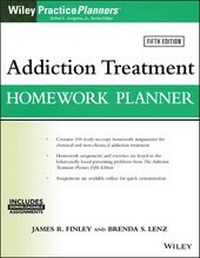
Addiction Treatment Homework Planner
Description

More details
Other editions
New editions
Additional editions
Persons
Content
Wiley PracticePlanners® Series Preface xv
Preface xvii
Section 1: Adult-Child-of-an-Alcoholic (ACA) Traits 1
Exercise 1.A Addressing ACA Traits in Recovery 2
Exercise 1.B Understanding Family History 6
Section 2: Anger 8
Exercise 2.A Is My Anger Due to Feeling Threatened? 9
Exercise 2.B Is My Anger Due to Unmet Expectations? 14
Section 3: Antisocial Behavior 17
Exercise 3.A Benefits of Helping Others 18
Exercise 3.B Taking Inventory of Destructive Behaviors 22
Section 4: Anxiety 24
Exercise 4.A Anxiety Triggers and Warning Signs 25
Exercise 4.B Coping With Stress 29
Section 5: Attention-Deficit/Hyperactivity Disorder (ADHD)-Adolescent 32
Exercise 5.A Developing a Recovery Program 33
Exercise 5.B Staying Attentive and Other Negotiating Skills 37
Section 6: Attention-Deficit/Hyperactivity Disorder (ADHD)-Adult 40
Exercise 6.A From Recklessness to Calculated Risks 41
Exercise 6.B Getting Organized 44
Exercise 6.C Self-Soothing: Calm Down, Slow Down 47
Section 7: Bipolar Disorder 49
Exercise 7.A Early Warning Signs of Mania/Hypomania 50
Exercise 7.B Mania, Addiction, and Recovery 53
Section 8: Borderline Traits 55
Exercise 8.A Forming Stable Relationships 56
Exercise 8.B Seeing That We're All Just Human 60
Section 9: Childhood Trauma 62
Exercise 9.A Corresponding With My Childhood Self 63
Exercise 9.B Setting and Maintaining Boundaries 66
Section 10: Chronic Pain 68
Exercise 10.A Coping With Addiction and Chronic Pain 69
Exercise 10.B Managing Pain Without Addictive Drugs 72
Section 11: Conduct Disorder/Delinquency 75
Exercise 11.A How Do You Do That? 76
Exercise 11.B Trading Places 80
Section 12: Dangerousness/Lethality 83
Exercise 12.A Anger as a Drug 84
Exercise 12.B Managing Risk 87
Section 13: Dependent Traits 89
Exercise 13.A Building My Support Network 90
Exercise 13.B How Interdependent Am I? 94
Section 14: Eating Disorders and Obesity 97
Exercise 14.A Creating a Preliminary Eating and Health Plan 98
Exercise 14.B Eating Patterns Self-Assessment 102
Section 15: Family Conflicts 104
Exercise 15.A Creating Positive Family Rituals 105
Exercise 15.B Identifying Conflict Themes 108
Section 16: Gambling 110
Exercise 16.A Consequences and Benefits 111
Exercise 16.B Understanding Nonchemical Addictions 114
Section 17: Grief/Loss Unresolved 116
Exercise 17.A Am I Having Difficulty Letting Go? 117
Exercise 17.B Moving on After Loss 120
Exercise 17.C What Would They Want for Me? 124
Section 18: Impulsivity 126
Exercise 18.A Handling Crisis Without Impulsivity 127
Exercise 18.B Learning to Think Things Through 130
Section 19: Legal Problems 132
Exercise 19.A Handling Tough Situations in a Healthy Way 133
Exercise 19.B What's Addiction Got to Do With My Problems? 137
Section 20: Living Environment Deficiency 140
Exercise 20.A Assessing My Environment 141
Exercise 20.B What Would My Ideal Life Look Like? 144
Section 21: Medical Issues 147
Exercise 21.A Coping With Addiction and Other Medical Problems 148
Exercise 21.B Physical and Emotional Self-Care 152
Section 22: Narcissistic Traits 154
Exercise 22.A Being Genuinely Unselfish 155
Exercise 22.B Getting Out of Myself 158
Section 23: Nicotine Use/Dependence 160
Exercise 23.A Assessing Readiness and Preparing to Quit 161
Exercise 23.B Addressing Relapse Triggers 164
Exercise 23.C Use of Affirmations for Change 167
Section 24: Obsessive-Compulsive Disorder (OCD) 170
Exercise 24.A Interrupting Compulsive Thoughts and Urges 172
Exercise 24.B Reducing Compulsive Behaviors 177
Section 25: Occupational Problems 180
Exercise 25.A Interest and Skill Self-Assessment 181
Exercise 25.B Workplace Problems and Solutions 185
Section 26: Oppositional Defiant Behavior 187
Exercise 26.A Analyzing Acting-Out Behavior 188
Exercise 26.B Learning to Ask Instead of Demand 191
Section 27: Parent-Child Relational Problem 194
Exercise 27.A Am I Teaching My Child Addictive Patterns? 195
Exercise 27.B What Do I Want for My Children? 198
Section 28: Partner Relational Conflicts 201
Exercise 28.A Communication Skills 202
Exercise 28.B Relationship Assessment 207
Section 29: Peer Group Negativity 209
Exercise 29.A Creating Recovery Peer Support 210
Exercise 29.B What Do I Need and How Do I Get It? 213
Section 30: Posttraumatic Stress Disorder (PTSD) 215
Exercise 30.A Coping With Addiction and PTSD or Other Anxiety Disorders 216
Exercise 30.B Safe and Peaceful Place Meditation 220
Section 31: Psychosis 222
Exercise 31.A Coping With Addiction and Schizophrenia Spectrum Disorders 223
Exercise 31.B Planning a Stable Life 227
Section 32: Relapse Proneness 229
Exercise 32.A Early Warning Signs of Relapse 230
Exercise 32.B Identifying Relapse Triggers and Cues 233
Exercise 32.C Relapse Prevention Planning 237
Section 33: Self-Care Deficit as a Primary Problem 240
Exercise 33.A Assessing Self-Care Deficits 241
Exercise 33.B Relating Self-Care Deficits to My Addiction 245
Section 34: Self-Care Deficit as a Secondary Problem 247
Exercise 34.A Filling in Self-Care Gaps 248
Exercise 34.B Working Toward Interdependence 251
Section 35: Self-Harm 253
Exercise 35.A Understanding Self-Harm and Addiction 254
Exercise 35.B Self-Harm Risk Factors, Triggers, and Early Warning Signs 257
Section 36: Sexual Abuse 259
Exercise 36.A It Wasn't My Fault 261
Exercise 36.B Internal and External Resources for Safety 265
Section 37: Sexual Promiscuity 267
Exercise 37.A Is It Romance or Is It Fear? 268
Exercise 37.B Working Through Shame 272
Section 38: Sleep Disturbance 274
Exercise 38.A Assessing Sleep Problems 275
Exercise 38.B Improving Sleep Hygiene 278
Section 39: Social Anxiety 279
Exercise 39.A Understanding Thoughts, Worries, and Fears 281
Exercise 39.B Action Plan to Address Social Anxiety 285
Section 40: Spiritual Confusion 288
Exercise 40.A Understanding Spirituality 289
Exercise 40.B Finding a Higher Power That Makes Sense 292
Section 41: Substance-Induced Disorders 294
Exercise 41.A Using My Support Network 296
Exercise 41.B Exploring Treatment and Recovery Options 299
Section 42: Substance Intoxication/Withdrawal 301
Exercise 42.A Coping With Post-Acute Withdrawal (PAW) 302
Exercise 42.B Using Books and Other Media Resources 305
Section 43: Substance Use Disorders 307
Exercise 43.A Consequences of Continuing Addictive Lifestyles 308
Exercise 43.B Alternatives to Addictive Behavior 311
Exercise 43.C Personal Recovery Planning 314
Exercise 43.D Taking Daily Inventory 319
Exercise 43.E Making Change Happen 322
Exercise 43.F Balancing Recovery, Family, and Work 326
Section 44: Suicidal Ideation 329
Exercise 44.A Problem Solving and Safety Planning 330
Exercise 44.B Why Do I Matter and Who Cares? 334
Section 45: Treatment Resistance 336
Exercise 45.A Addressing Readiness and Motivation 337
Exercise 45.B Problem Identification: Is It Addiction? 340
Section 46: Unipolar Depression 343
Exercise 46.A Correcting Distorted Thinking 344
Exercise 46.B Gratitude 348
Appendix A: Alternate Assignments for Presenting Problems 350
Appendix B: Suggested Bibliotherapy 371
Appendix C: Alphabetical Index of Exercises 384
About the Authors 387
About the Downloadable Assignments 388
SECTION 1:
ADULT-CHILD-OF-AN-ALCOHOLIC (ACA) TRAITS
Therapist's Overview
ADDRESSING ACA TRAITS IN RECOVERY
GOALS OF THE EXERCISE
- Implement a plan for recovery from addiction that reduces the impact of adult-child-of-an-alcoholic (ACA) traits on sobriety.
- Decrease dependence on relationships while beginning to meet one's own needs.
- Reduce the frequency of behaviors that are exclusively designed to please others.
- Choose partners and friends who are responsible, respectful, and reliable.
- Overcome fears of abandonment, loss, and neglect.
- Understand the feelings that resulted from being raised in an addictive environment and reduce feelings of alienation by seeing similarities to others raised in non-addictive homes.
ADDITIONAL PROBLEMS FOR WHICH THIS EXERCISE MAY BE USEFUL
- Borderline Traits
- Dependent Traits
- Partner Relationship Conflicts
- Sexual Promiscuity
SUGGESTIONS FOR PROCESSING THIS EXERCISE WITH THE CLIENT
The "Addressing ACA Traits in Recovery" activity is for clients with patterns of co-dependent relationships, enmeshment, boundary issues, and burnout in love, friendship, and workplace relationships. It teaches clients about addictive relationship dynamics, then heightens motivation by focusing on the threat this poses to recovery, ending by directing clients to further exploration of issues of codependency. Follow-up may include discussing the issue with the therapist, group, and sponsor; support group referrals; bibliotherapy; and videotherapy (e.g., Rent Two Films and Let's Talk in the Morning by John W. Hesley and Jan G. Hesley, also published by Wiley).
EXERCISE 1.A
ADDRESSING ACA TRAITS IN RECOVERY
Adult children of alcoholics, or ACAs, are adults who grew up in families where one or both parents chronically abused alcohol and/or other drugs, suffered from other mental illness, or had other problems that made them unable to meet their children's needs. When those children become adults, they may have feelings and behavior patterns that resemble those of their parents, especially in relationships. This can happen whether or not they abuse alcohol or other drugs-ACAs often become "addicted" to unhealthy patterns and people in their love, friendship, and work relationships. They are drawn to situations that feel in some ways like their childhood family life, and to people who treat them in ways similar to the ways their parents treated them and others. ACAs often fall into the trap of trying to please, "fix," or "save" others, and their own lives are left in turmoil. Their motives are caring, but their efforts to please or rescue others seldom work. The results cause these ACAs great emotional pain and may put them in dangerous situations or lead to a work-related cycle of starting new jobs with great hope and energy but ending up burning out on those jobs or careers. No one can really control anyone else; other people's troubles are mostly caused by patterns only they can change, so trying to change them leads to one painful disappointment after another. As part of your recovery, this activity will help you learn to recognize and change these patterns, which are also often called codependency.
- There are reasons we're drawn to relationships in which we try harder to solve other people's problems than they do. If we are ACAs, these patterns often echo those we experienced in our families as children. It's as if we're trying to replay the same story and get it to have a happy ending. Have any of the feelings listed here drawn you into painful relationships or situations in love, friendship, and/or workplace situations?
_____ You felt sure that if you tried hard enough, you could win approval.
_____ You felt needed.
_____ It was intense and exciting from the start.
_____ You felt intensely and magnetically drawn to the other person.
_____ They made you feel strong, smart, and capable.
_____ The sex was incredible.
_____ You identified with the hardships they'd suffered.
_____ You felt that you could help them and change their lives.
- Here are signs of this kind of relationship. Please check off any you've experienced:
_____ Manipulation and mind games take up a lot of time and energy.
_____ You're held responsible (by others or yourself) for things you can't control.
_____ You see that you keep getting into high-risk or no-win situations, but you can't help finding those are the only ones that attract you-safe people and jobs bore you.
_____ You're often worried that the relationship will fall apart, feeling you can keep the peace if you just say and do only the right things.
_____ You keep your partner away from your other friends and family because they don't get along, or you don't think they would.
_____ You spend a lot of time and energy solving other people's problems, over and over, often with little or no appreciation or recognition.
_____ You try hard to impress your partner and keep secrets; you fear that your partner would reject you if they knew about parts of your life or past.
_____ You get in heated arguments that don't make sense to either of you.
_____ The relationship became very intense very fast when you first got together.
_____ One or both of you feel a lot of jealousy and insecurity.
_____ The relationship is never boring, but it's usually stressful.
_____ You go back and forth between feeling abandoned and feeling smothered.
-
How does this relate to getting and staying clean and sober? Well, common sense tells us there's a strong connection between stress and relapse, and research confirms that link. Looking at the items you checked for question 2, think about how stressful those relationships were or are. How could these stresses lead you to relapse, and how do you feel about that risk?
-
Most people who get into addictive relationships don't just do so once. What unhealthy patterns do you see in the people you find attractive?
-
Consider participating in 12-step recovery programs specifically for ACAs. Identify three reasons this could be beneficial to you.
Be sure to bring this handout back to your next session with your therapist, and be prepared to talk about your thoughts and feelings about the exercise.
Therapist's Overview
UNDERSTANDING FAMILY HISTORY
GOALS OF THE EXERCISE
- Implement a plan for recovery from addiction that reduces the impact of adult-child-of-an-alcoholic (ACA) traits on sobriety.
- Reduce the frequency of behaviors that are exclusively designed to please others.
- Eliminate behaviors that are dangerous to self or others.
- Eliminate self-defeating interpersonal patterns in occupational and social settings.
- Choose partners and friends who are responsible, respectful, and reliable.
- Understand the feelings that resulted from being raised in an addictive environment and reduce feelings of inferiority and/or alienation from others who were raised in nonaddictive homes.
- Obtain emotional support for recovery from family members.
ADDITIONAL PROBLEMS FOR WHICH THIS EXERCISE MAY BE USEFUL
- Borderline Traits
- Childhood Trauma
- Family Conflicts
- Parent-Child Relational Problem
- Partner Relational Conflicts
SUGGESTIONS FOR PROCESSING THIS EXERCISE WITH THE CLIENT
The "Understanding Family History" activity may be used effectively with clients who are experiencing shame, confusion, or anxiety as a result of seeing themselves repeat negative behaviors seen in childhood caretakers. It may be useful in couples therapy, because many ACA individuals form relationships with partners with similar backgrounds. For clients struggling with acceptance and forgiveness of their parents or of themselves, this activity may help in understanding the roles of addiction and powerlessness in distorting values and behaviors. It may also be useful for clients who have parenting issues in recovery to understand the roots of their children's behaviors.
EXERCISE 1.B
UNDERSTANDING FAMILY HISTORY
It's important to understand the role of family history in addictions-not to blame those who raised us, but for our own recovery and our families' futures. This exercise looks at how family history affects us.
-
As a child, what did you learn about drinking, drug use, or other addictions in your family?
-
What problems, if any, did your family have because of these behaviors (e.g., violence, divorce, financial problems, dangerous or illegal activities, or other worries)?
-
Please describe the typical atmosphere in your family when someone was drinking, using drugs, or engaging in other addictive patterns, and its effects on you then and now.
- Below are some common patterns in families struggling with addictions, related to the unspoken rule "Don't talk, don't trust, don't feel" that develops as other family members try to avoid confrontations or disappointment caused by the inability of addicted adults to be...
