

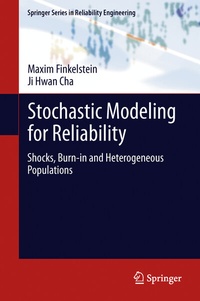
Stochastic Modeling for Reliability
Description

Focusing on shocks modeling, burn-in and heterogeneous populations, Stochastic Modeling for Reliability naturally combines these three topics in the unified stochastic framework and presents numerous practical examples that illustrate recent theoretical findings of the authors.
The populations of manufactured items in industry are usually heterogeneous. However, the conventional reliability analysis is performed under the implicit assumption of homogeneity, which can result in distortion of the corresponding reliability indices and various misconceptions. Stochastic Modeling for Reliability fills this gap and presents the basics and further developments of reliability theory for heterogeneous populations. Specifically, the authors consider burn-in as a method of elimination of 'weak' items from heterogeneous populations. The real life objects are operating in a changing environment. One of the ways to model an impact of this environment is via the external shocks occurring in accordance with some stochastic point processes. The basic theory for Poisson shock processes is developed and also shocks as a method of burn-in and of the environmental stress screening for manufactured items areconsidered.
Stochastic Modeling for Reliability introduces and explores the concept of burn-in in heterogeneous populations and its recent development, providing a sound reference for reliability engineers, applied mathematicians, product managers and manufacturers alike.
Reviews / Votes
From the reviews:
"This book is a major work for studying and learning reliability theory. . The book is aimed at graduate students or researchers in reliability or applied probability, engineering, mathematics, and statistics. . this book is an extremely valuable contribution to the literature on reliability. It is very well written, and will have a major impact on future research in reliability. It is up-to-date and gives the reader excellent insight into important areas." (Myron Hlynka, Mathematical Reviews, January, 2014)
"In the framework of stochastic modeling for reliability a combination of the three areas shock models, burn-in and stochastic modeling in heterogeneous populations is presented. . The book can be recommended for reliability engineers, statisticians working in reliability engineering, as well as for courses in advanced methods for reliability models and methods." (Kurt Marti, zbMATH, Vol. 1271, 2013)More details
Other editions
Additional editions
Persons
Content
1.Introduction.- 2.Basic Stochastics for Reliability Analysis.- 3.Shocks and Degradation.- 4.Advanced Theory for Poisson Shock Models.- 5.Heterogeneous Populations.- 6.The basics of Burn-in.- 7.Burn-in for Repairable Systems.- 8.Burn-in for Heterogeneous Populations.- 9.Shocks as Burn-in.- 10.Stochastic Models for Environmental Stress Screening.
