

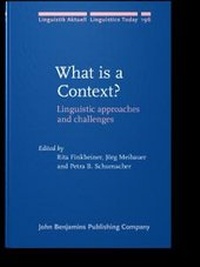
What is a Context?
Linguistic approaches and challenges
1st Edition
Published on 23. October 2012
VII, 253 pages
978-90-272-7321-5 (ISBN)
Description

Context is a core notion of linguistic theory. However, while there are numerous attempts at explaining single aspects of the notion of context, these attempts are rather diverse and do not easily converge to a unified theory of context. The present multi-faceted collection of papers reconsiders the notion of context and its challenges for linguistics from different theoretical and empirical angles. Part I offers insights into a wide range of current approaches to context, including theoretical pragmatics, neurolinguistics, clinical pragmatics, interactional linguistics, and psycholinguistics. Part II presents new empirical findings on the role of context from case studies on idioms, unarticulated constituents, argument linking, and numerically-quantified expressions. Bringing together different theoretical frameworks, the volume provides thought-provoking discussions of how the notion of context can be understood, modeled, and implemented in linguistics. It is essential for researchers interested in theoretical and applied linguistics, the semantics/pragmatics interface, and experimental pragmatics.
More details
Other editions
Additional editions
Rita Finkbeiner | Joerg Meibauer | Petra B. Schumacher
What is a Context?
Linguistic approaches and challenges
Book
10/2012
John Benjamins Publishing Co
€104.94
Shipment within 10-15 days
Persons
Content
- What is a Context?
- Editorial page
- Title page
- LCC data
- Table of contents
- Preface
- Introduction
- References
- Part I. Linguistic perspectives on context
- What is a context?
- 1. Introduction
- 2. Some classical approaches to the notion of context
- 3. Context in the minimalism-contextualism debate
- 4. Context in experimental pragmatics (psycholinguistics)
- 5. Conclusions
- References
- Context in neurolinguistics
- 1. Introduction
- 2. Context in time: Electrophysiological findings
- 2.1 The predictive potential of context: N400 findings
- 2.2 Discourse representational consequences of context: Late Positivity findings
- 3. Context in the language architecture
- References
- Theorising context
- 1. Introduction
- 2. Context in pragmatics
- 3. Context in clinical pragmatics
- 4. Clinical conceptions of context
- 5. Theoretical reflections on context
- References
- Context
- 1. Objectives: In search for "context for truth conditions"
- 2. Context: Its semantics, metaphysics, and epistemology
- 3. Context in contextualism vis-à-vis contextual parameters
- 4. Context selection: Whose meaning?
- 5. Content and context in default semantics
- 6. Dénouement
- References
- Contexts in interaction
- 1. Introduction
- 2. Context and contexts: A mixed bag
- 2.1 Context as participant construct
- 2.2 Context as analyst construct
- 3. Conceptualizing context: A relational frame of reference
- References
- What's non-linguistic visual context?
- 1. Introduction
- 2. Visual context effects: When language is about visual context
- 2.1 Beyond word-object reference: Clipart and real-world action events
- 2.2 Recent visual contexts: Clipart objects and action events in working memory
- 2.3 The speaker as visual context: Gaze and gestures
- 3. Summary
- 4. Visual context effects: Beyond simple associations and towards abstract language comprehension
- 4.1 Beyond reference and simple associations: evidence from response times
- 4.2 Visual context and abstract language processing: Evidence from eye tracking
- 5. Conclusions
- References
- Part II. Case studies on context
- Emergent contexts
- 1. Introduction
- 2. Theoretical assumptions
- 2.1 What is a context?
- 2.2 Utterance meaning
- 2.3 Co-textual features
- 2.4 Figurative Language Theory
- 2.5 Emergent meaning
- 2.6 A new approach
- 3. Experimental study
- 3.1 Pretest on familiarity
- 3.2 Preparation of items
- 3.3 Procedure
- 3.4 Experimental hypotheses
- 3.5 Results
- 3.6 Discussion
- 4. Summary
- References
- Appendix: Context Pairs
- The role of context in interpreting implicit meaning aspects
- 1. Introduction
- 2. Conceptual frames and context
- 3. Theoretical approaches to IMAs
- 4. Empirical data concerning IMAs
- 5. Context and the interpretation of implicit meaning aspects
- 5.1 The role of frames in discourse interpretation
- 5.2 The role of frames in the interpretation of IMAs
- 6. Conclusion
- References
- Contextually enriched argument linking
- 1. Introduction
- 2. Contextually enriched argument linking
- 3. Semantic composition with referent systems
- 3.1 The basic idea
- 3.2 Semantic composition and construal
- 3.3 Semantic composition via referent systems
- 4. Contextual enrichment via abduction
- 5. Conclusion
- References
- A Referent systems
- Modelling context within a constraint-based account of quantifier usage
- 1. Introduction
- 2. Context-referring and context-independent constraints
- 3. Constraints proposed to model context
- 3.1. Comparative quantifier implicatures and priming effects
- 3.2 Use of comparative quantifiers with non-round numerals
- 3.3 Non-isomorphic readings of quantifiers
- 4. Alternative context-referring constraints
- 4.1 Question under discussion
- 4.2 Speaker's communicative intention
- 4.3 Hearer's knowledge state
- 5. Constraints and a definition of "relevant context"
- 5.1 Constraint violations and irrelevant contextual information
- 5.2 Applicability to other formalisms
- 5.3 Interim summary
- 6. Context furnished by the hearer
- 7. Discussion and conclusions
- References
- Subject and name index
