

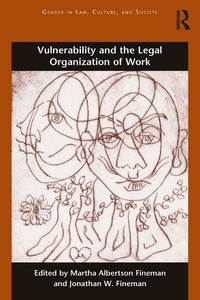
Vulnerability and the Legal Organization of Work
1st Edition
Published on 6. July 2017
414 pages
978-1-315-51856-5 (ISBN)
Description

This book uses the concepts of vulnerability and resilience to analyze the situation of individuals and institutions in the context of the employment relationship. It is based on the premise that both employer and employee are vulnerable to various social, economic, and political forces, although differently so. It demonstrates how in responding to those complementary institutional relationships of employer and employee the state unequally and inequitably favors employers over employees.
Several chapters included in this collection also consider how the state shapes, creates and maintains through law the social identities of employer and employee and how that legal regime operates as the allocation of power and privilege. This unique and fundamental role of the state in defining the employment relationship profoundly affects the respective abilities and degree of resiliency of actual employers and employees.
Other chapters explore how attention to the respective vulnerability and resilience of those who do and those who direct work in assessing the employment relationship can raise fundamental questions of social justice and suggest new avenues for critical engagement with labor and employment law. Collectively, these pieces articulate a framework for imaging what would constitute an appropriately "Responsive State" in the employment context and how those interested in social justice might begin to use the concepts of vulnerability and resilience in their arguments.
Several chapters included in this collection also consider how the state shapes, creates and maintains through law the social identities of employer and employee and how that legal regime operates as the allocation of power and privilege. This unique and fundamental role of the state in defining the employment relationship profoundly affects the respective abilities and degree of resiliency of actual employers and employees.
Other chapters explore how attention to the respective vulnerability and resilience of those who do and those who direct work in assessing the employment relationship can raise fundamental questions of social justice and suggest new avenues for critical engagement with labor and employment law. Collectively, these pieces articulate a framework for imaging what would constitute an appropriately "Responsive State" in the employment context and how those interested in social justice might begin to use the concepts of vulnerability and resilience in their arguments.
More details
Series
Edition
1. Auflage
Language
English
Place of publication
London
United Kingdom
Publishing group
Taylor & Francis Ltd
Target group
College/higher education
Illustrations
2 s/w Abbildungen, 6 s/w Tabellen
6 Tables, black and white; 2 Illustrations, black and white
File size
2,78 MB
ISBN-13
978-1-315-51856-5 (9781315518565)
Copyright in bibliographic data and cover images is held by Nielsen Book Services Limited or by the publishers or by their respective licensors: all rights reserved.
Schweitzer Classification
Other editions
Additional editions
Martha Albertson Fineman | Jonathan W. Fineman
Vulnerability and the Legal Organization of Work
Book
06/2017
1st Edition
Routledge
€215.41
Shipment within 10-20 days
Martha Albertson Fineman | Jonathan W. Fineman
Vulnerability and the Legal Organization of Work
Book
06/2017
1st Edition
Routledge
€87.80
Shipment within 10-20 days
Persons
Martha Albertson Fineman is Robert W. Woodruff Professor of Law at Emory University. A leading authority on family law and feminist jurisprudence, Fineman is the founding director of the Feminism and Legal Theory Project, an interdisciplinary scholarly project she began at the University of Wisconsin in 1984. Since 2007, she also directs Emory's Vulnerability and the Human Condition Initiative, an interdisciplinary project housed in the Laney Graduate School. Her scholarly work focuses on various aspects of the legal regulation of intimacy and on the social, cultural, and legal implications of human dependency and vulnerability and includes The Neutered Mother, The Sexual Family and Other Twentieth Century Tragedies (1995) and The Autonomy Myth: A Theory of Dependency (2004).
Jonathan W. Fineman is an Associate Professor at Florida Agricultural and Mechanical University's College of Law. After earning his JD from Columbia University, he practiced law as a business litigator in San Francisco. He writes about employment law and the workplace, focusing on private ordering and contract. He also publishes and speaks about vulnerability theory.
Jonathan W. Fineman is an Associate Professor at Florida Agricultural and Mechanical University's College of Law. After earning his JD from Columbia University, he practiced law as a business litigator in San Francisco. He writes about employment law and the workplace, focusing on private ordering and contract. He also publishes and speaks about vulnerability theory.
Content
Introducing Vulnerability - Martha Albertson Fineman
Part I. Law and Vulnerability
Chapter 1: A Vulnerability Approach to Private Ordering of Employment - Jonathan W. Fineman
Chapter 2: Green Shoots in the Labor Market: A Cornucopia of Social Experiments - Katherine Van Wezel Stone
Chapter 3: The Constitutional Right to Organize - Rebecca E. Zietlow
Chapter 4: Labour Rights as Natural Rights - Sean Coyle
Part II. Work and Social Welfare
Chapter 5: Paid Care Work, Gendered Labour Law and the Vulnerability of Community - LJB Hayes
Chapter 6: Vulnerability, Workfare Law and Resilient Social Justice - Camilla Sabroe Jydebjerg
Chapter 7: Contract as Public Law: The Public Nature of Collective Bargaining Agreements - Risa L. Lieberwitz
Chapter 8: Acknowledging but Transcending Gender at Work: Applying the Model of Lifetime Disadvantage and Vulnerability Theory to Women's Poverty in Retirement - Susan Bisom-Rapp and Malcolm Sargeant
Chapter 9: Laboring Freedom: Neoliberalism, the Jurisprudence of Obamacare, and the Welfare-State Left - Jack Jackson
Part III. Marginalized Workers
Chapter 10: A Desired Composition: Regulating Vulnerability Through Immigration Law - Silas W. Allard
Chapter 11: The Wages of Human Trafficking - Rana M. Jaleel
Chapter 12: Migrant Domestic Workers in the UK: Enacting Exclusions, Exemptions and Rights - Siobhan Mullally and Cliodhna Murphy
Chapter 13: Bad Jobs and Good Workers: The Hiring of Ex-Prisoners in a Segmented Economy - Kristin Bumiller
Chapter 14: We Are All Contingent: Fighting Vulnerability in the U.S. Workforce - Ann C. McGinley and David McClure
Part IV. Limits of Law
Chapter 15: Equal by What Measure? The Lost Struggle for Universal State Protective Labor Standards - Deborah Dinner
Chapter 16: Improving Job Quality for Low-Wage Women Workers: A 21st Century Movement - Elizabeth Ben-Ishai
Chapter 17: A Right to Request Flexible Working: What Can the UK Teach Us? - K. Lee Adams
Chapter 18: Vulnerable Communities: Proposing Community Syndicalism for Distressed Localities - Kenneth M. Casebeer
Bibliography
Index
Part I. Law and Vulnerability
Chapter 1: A Vulnerability Approach to Private Ordering of Employment - Jonathan W. Fineman
Chapter 2: Green Shoots in the Labor Market: A Cornucopia of Social Experiments - Katherine Van Wezel Stone
Chapter 3: The Constitutional Right to Organize - Rebecca E. Zietlow
Chapter 4: Labour Rights as Natural Rights - Sean Coyle
Part II. Work and Social Welfare
Chapter 5: Paid Care Work, Gendered Labour Law and the Vulnerability of Community - LJB Hayes
Chapter 6: Vulnerability, Workfare Law and Resilient Social Justice - Camilla Sabroe Jydebjerg
Chapter 7: Contract as Public Law: The Public Nature of Collective Bargaining Agreements - Risa L. Lieberwitz
Chapter 8: Acknowledging but Transcending Gender at Work: Applying the Model of Lifetime Disadvantage and Vulnerability Theory to Women's Poverty in Retirement - Susan Bisom-Rapp and Malcolm Sargeant
Chapter 9: Laboring Freedom: Neoliberalism, the Jurisprudence of Obamacare, and the Welfare-State Left - Jack Jackson
Part III. Marginalized Workers
Chapter 10: A Desired Composition: Regulating Vulnerability Through Immigration Law - Silas W. Allard
Chapter 11: The Wages of Human Trafficking - Rana M. Jaleel
Chapter 12: Migrant Domestic Workers in the UK: Enacting Exclusions, Exemptions and Rights - Siobhan Mullally and Cliodhna Murphy
Chapter 13: Bad Jobs and Good Workers: The Hiring of Ex-Prisoners in a Segmented Economy - Kristin Bumiller
Chapter 14: We Are All Contingent: Fighting Vulnerability in the U.S. Workforce - Ann C. McGinley and David McClure
Part IV. Limits of Law
Chapter 15: Equal by What Measure? The Lost Struggle for Universal State Protective Labor Standards - Deborah Dinner
Chapter 16: Improving Job Quality for Low-Wage Women Workers: A 21st Century Movement - Elizabeth Ben-Ishai
Chapter 17: A Right to Request Flexible Working: What Can the UK Teach Us? - K. Lee Adams
Chapter 18: Vulnerable Communities: Proposing Community Syndicalism for Distressed Localities - Kenneth M. Casebeer
Bibliography
Index
