

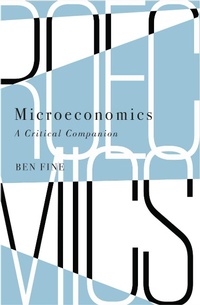
Microeconomics
A Critical Companion
1st Edition
Published on 20. April 2016
176 pages
978-1-78371-780-4 (ISBN)
Description

Microeconomics: A Critical Companion offers students a clear and concise exposition of mainstream microeconomics from a heterodox perspective. Covering topics from consumer and producer theory to general equilibrium to perfect competition, it sets the emergence and evolution of microeconomics in both its historical and interdisciplinary context.
From the culmination of 40 years of teaching, research and policy advice on political economy, Ben Fine critically exposes the methodological and conceptual content of dominant microeconomic models without sacrificing the technical detail required for those completing a first degree in economics or entering postgraduate study. The result is a book which is sure to establish a strong presence on undergraduate reading lists and in comparative literature on the subject.
From the culmination of 40 years of teaching, research and policy advice on political economy, Ben Fine critically exposes the methodological and conceptual content of dominant microeconomic models without sacrificing the technical detail required for those completing a first degree in economics or entering postgraduate study. The result is a book which is sure to establish a strong presence on undergraduate reading lists and in comparative literature on the subject.
Reviews / Votes
'A thorn in the side of mainstream economics' -- Steve Keen, author of Debunking Economics (Zed, 2011) 'An accessible and rich resource for those who appreciate critical and creative approaches. This and its companion macroeconomics volume contain numerous valuable insights for the serious student of economics' -- Stuart Birks, head of the World Economics Association's Textbook Commentaries Project, author of Rethinking economics: From Analogies to the Real World (Springer, 2015) and 40 Critical Pointers for Students of Economics (WEA Press, 2015) 'These wonderful volumes are what many teachers and students of economics have been waiting for - textbooks that are logical, critical, accessible and relevant' -- Professor Jayati Ghosh, Jawaharlal Nehru University 'Ben Fine has written the book that I wish I could have read as a graduate student. Its insightful critiques of mainstream theory will be even more important to those of today's generation of students seeking to cast off the intellectual blinders from their training' -- Rod Hill, University of New Brunswick and co-author of The Economics Anti-Textbook: A Critical Thinkers Guide to Microeconomics (Zed, 2010) 'An invaluable antidote to the conventional poison of marginalism and general equilibrium theory in microeconomics; and Say's law and the denial of crises or slumps in macroeconomics' -- Michael Roberts 'Ben Fine has done a splendid job of critically challenging the microeconomic foundations of the new conventional wisdom in a manner accessible to intermediate level students of economics' -- Jomo Kwame Sundaram, former United Nations Assistant Secretary-General for economic analysis (2005-2015), recipient of Wassily Leontief Prize for Advancing the Frontiers of Economic Thought (2007)More details
Series
Edition
1. Auflage
Language
English
Place of publication
London
United Kingdom
Target group
Professional and scholarly
Illustrations
27 b&w diagrams
File size
1,45 MB
ISBN-13
978-1-78371-780-4 (9781783717804)
Copyright in bibliographic data and cover images is held by Nielsen Book Services Limited or by the publishers or by their respective licensors: all rights reserved.
Schweitzer Classification
Other editions
Additional editions
Book
04/2016
Pluto Press
€126.48
Article exhausted; check different version
Person
Ben Fine is Professor of Economics at SOAS, University of London. He is the author of the critical texts, Macroeconomics and Microeconomics (Pluto, 2016), co-author of Marx's 'Capital' (Pluto, 2016) and co-editor of Beyond the Developmental State (Pluto, 2013). He was awarded both the Deutscher and Myrdal Prizes in 2009.
Ben Fine is Emeritus Professor of Economics at the School of Oriental and African Studies, University of London, and Visiting Professor, Wits School of Governance, University of Witwatersrand, South Africa. He has published over thirty books (one of which won the Deutscher Prize and another the Myrdal Prize) and three hundred articles. He is the founding Chair of IIPPE (the International Initiative for Promoting Political Economy) and has acted as economic advisor to many organisations. He is an acknowledged international authority across fields such as Marxist political economy, history of economic thought, heterodox economics, economics imperialism, social capital, social choice theory, development economics and studies, the British economy and coal industry, consumption studies and South Africa.
Ben Fine is Emeritus Professor of Economics at the School of Oriental and African Studies, University of London, and Visiting Professor, Wits School of Governance, University of Witwatersrand, South Africa. He has published over thirty books (one of which won the Deutscher Prize and another the Myrdal Prize) and three hundred articles. He is the founding Chair of IIPPE (the International Initiative for Promoting Political Economy) and has acted as economic advisor to many organisations. He is an acknowledged international authority across fields such as Marxist political economy, history of economic thought, heterodox economics, economics imperialism, social capital, social choice theory, development economics and studies, the British economy and coal industry, consumption studies and South Africa.
Content
List of Boxes
List of Diagrams
Preface, Preliminaries and Acknowledgements
1. Locating Microeconomics
2. Elusive Consumers and the Theory of Demand
3. From Production to Supply and Beyond to General Equilibrium?
4. Competition Is as Competition Does?
5. Production Function Rules, Not OK
6. Labour Markets
7. Whither Microeconomics: Upside-Down or Inside-Out?
References
Index
List of Diagrams
Preface, Preliminaries and Acknowledgements
1. Locating Microeconomics
2. Elusive Consumers and the Theory of Demand
3. From Production to Supply and Beyond to General Equilibrium?
4. Competition Is as Competition Does?
5. Production Function Rules, Not OK
6. Labour Markets
7. Whither Microeconomics: Upside-Down or Inside-Out?
References
Index
