

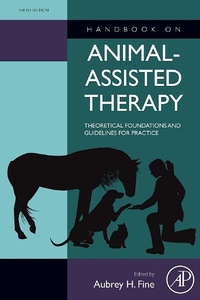
Handbook on Animal-Assisted Therapy
Theoretical Foundations and Guidelines for Practice
3rd Edition
Published on 21. September 2010
588 pages
978-0-12-381454-8 (ISBN)
Description

In the 10 years since the first edition of Handbook on Animal-Assisted Therapy published, the field has changed considerably. The third edition of the Handbook highlights advances in the field, with 10 new chapters and over 50% new material. In reading this book, therapists will discover the benefits of incorporating animal assisted therapy into their practice, how to design and implement animal assisted interventions, and the efficacy of animal assisted therapy with different disorders and patient populations. Coverage includes the use of AAT with children, families, and the elderly, in counseling and psychotherapy settings, and for treating a variety of specific disorders.
- Includes coverage of the use of cats, dogs, birds, and horses
- Discusses the "why" to use animals in therapy as well as the "how"
- Covers the use of animal-assisted therapy with different special populations and to treat different disorders
More details
Other editions
New editions
Aubrey H. Fine
Handbook on Animal-Assisted Therapy
Foundations and Guidelines for Animal-Assisted Interventions
E-Book
05/2015
4th Edition
Academic Press
€50.95
Available for download
Additional editions
Aubrey H. Fine
Handbook on Animal-Assisted Therapy
Theoretical Foundations and Guidelines for Practice
Book
09/2010
3rd Edition
Academic Press
€68.19
Article exhausted; check for reprint
Previous edition
Megan Mueller Ph. D | Zenithson Ng | Taylor Chastain Griffin
Handbook on Animal-Assisted Therapy
Theoretical Foundations and Guidelines for Practice
E-Book
04/2011
2nd Edition
Academic Press
€62.95
Available for download
Content
SECTION I - The Conceptualization of the Animal-Human Bond: The Foundation for Understanding Animal-Assisted TherapyChapter 1: Human Animal Interactions: Why Health Care Professionals should be Interested in the Human Animal BondChapter 2: Animal Companions and Human Well-Being: An Historical Exploration of the Value of Human-Animal RelationshipsChapter 3: Animal-Assisted Interventions: The What, why, and where of Animal Assisted Interventions: The need for more rigorous researchChapter 4: New and Old Perspectives on the Therapeutic Effect, of Animals and NatureChapter 5: Animals as Social Supports: Insights for Understanding AATChapter 6: Psychological Benefits of Animal CompanionshipChapter 7: The Animal-Human Bond: Health and Wellness
SECTION II - Animal-Assisted Therapy: Conceptual Model and Guidelines for Quality AssuranceChapter 8: Methods, Standards and Guidelines in Selecting Animals for Animal Assisted InterventionsChapter 9: Designing and Implementing Animal-Assisted Therapy Programs in Health and Mental Health OrganizationsChapter 10: A Conversation with Patricia McConnell--Understanding the Other Side of the Leash: What therapists need to know about dog and cat behavior
SECTION III - Best Practices in Animal-Assisted Therapy: Guidelines for Use of AAT with Special PopulationsChapter 11: Animals and Therapists: Incorporating Animals in Outpatient Psychotherapy: Guidelines for ApplicationChapter 12: Application of animal assisted interventions in counseling settings: An overview of alternativesChapter 13: Animals in the Lives of ChildrenChapter 14: Understanding the Role of Animal Assisted Interventions and the Human animal Bond with Persons with an Autistic Spectrum DisorderChapter 15: Understanding the Role of Animals in the Family - Insights and Strategies for CliniciansChapter 16: The Role Animals Play in Enhancing Quality of Life for t
