

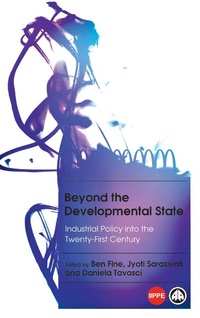
Beyond the Developmental State
Industrial Policy into the Twenty-first Century
1st Edition
Published on 10. May 2013
320 pages
978-1-84964-900-1 (ISBN)
Description

Moving beyond abstract economic models and superficial descriptions of the market, Beyond the Developmental State analyses the economic, political and ideological interests which underpin current socio-economic processes.
Through this approach, the contributors show the close interrelation between states and markets in both national and international contexts. Drawing on a wide range of case studies and themes, the book exposes the theoretical and empirical limitations of the developmental state paradigm, offering alternatives as well as discussing the policy implications and challenges they raise.
For scholars, students and practitioners of development, Beyond the Developmental State presents a decisive break with the old dogmas of both neoliberal orthodoxy and theories of 'market-imperfection', and outlines theoretically and empirically grounded alternatives.
Through this approach, the contributors show the close interrelation between states and markets in both national and international contexts. Drawing on a wide range of case studies and themes, the book exposes the theoretical and empirical limitations of the developmental state paradigm, offering alternatives as well as discussing the policy implications and challenges they raise.
For scholars, students and practitioners of development, Beyond the Developmental State presents a decisive break with the old dogmas of both neoliberal orthodoxy and theories of 'market-imperfection', and outlines theoretically and empirically grounded alternatives.
Reviews / Votes
'A very important book. The contributions are highly original and this work is likely to inform the emergence of a new branch of the literature on economic development' -- Alfredo Saad-Filho, Professor of Political Economy, School of Oriental and African Studies, University of London 'A valuable contribution to the search for inclusive and sustainable development strategies' -- Richard Kozul-Wright, Head, Unit on Economic Cooperation and Integration Among Developing Countries, UNCTADMore details
Series
Edition
1. Auflage
Language
English
Place of publication
London
United Kingdom
Target group
Professional and scholarly
Illustrations
11 b&w figures
File size
5,45 MB
ISBN-13
978-1-84964-900-1 (9781849649001)
Copyright in bibliographic data and cover images is held by Nielsen Book Services Limited or by the publishers or by their respective licensors: all rights reserved.
Schweitzer Classification
Other editions
Additional editions
Ben Fine | Jyoti Saraswati | Daniela Tavasci
Beyond the Developmental State
Industrial Policy into the Twenty-first Century
Book
05/2013
Pluto Press
€126.28
Article exhausted; check different version
Ben Fine | Jyoti Saraswati | Daniela Tavasci
Beyond the Developmental State
Industrial Policy into the Twenty-first Century
Book
05/2013
Pluto Press
€60.85
Article not available at the moment
Persons
Ben Fine is Professor of Economics at SOAS, University of London. He is the author of the critical texts, Macroeconomics and Microeconomics (Pluto, 2016), co-author of Marx's 'Capital' (Pluto, 2016) and co-editor of Beyond the Developmental State (Pluto, 2013). He was awarded both the Deutscher and Myrdal Prizes in 2009.
Ben Fine is Emeritus Professor of Economics at the School of Oriental and African Studies, University of London, and Visiting Professor, Wits School of Governance, University of Witwatersrand, South Africa. He has published over thirty books (one of which won the Deutscher Prize and another the Myrdal Prize) and three hundred articles. He is the founding Chair of IIPPE (the International Initiative for Promoting Political Economy) and has acted as economic advisor to many organisations. He is an acknowledged international authority across fields such as Marxist political economy, history of economic thought, heterodox economics, economics imperialism, social capital, social choice theory, development economics and studies, the British economy and coal industry, consumption studies and South Africa.
Jyoti Saraswati teaches on the Business and Political Economy Program at the Stern School of Business, New York University (NYU). He is the author of Dot.compradors (Pluto, 2012) and co-editor of Beyond the Developmental State (Pluto, 2013).
Daniela Tavasci lectures at the School of Economics and Finance, Queen Mary University of London. In addition to working in the financial sector for seven years, she is the co-editor of Beyond the Developmental State (Pluto, 2013).
Ben Fine is Emeritus Professor of Economics at the School of Oriental and African Studies, University of London, and Visiting Professor, Wits School of Governance, University of Witwatersrand, South Africa. He has published over thirty books (one of which won the Deutscher Prize and another the Myrdal Prize) and three hundred articles. He is the founding Chair of IIPPE (the International Initiative for Promoting Political Economy) and has acted as economic advisor to many organisations. He is an acknowledged international authority across fields such as Marxist political economy, history of economic thought, heterodox economics, economics imperialism, social capital, social choice theory, development economics and studies, the British economy and coal industry, consumption studies and South Africa.
Jyoti Saraswati teaches on the Business and Political Economy Program at the Stern School of Business, New York University (NYU). He is the author of Dot.compradors (Pluto, 2012) and co-editor of Beyond the Developmental State (Pluto, 2013).
Daniela Tavasci lectures at the School of Economics and Finance, Queen Mary University of London. In addition to working in the financial sector for seven years, she is the co-editor of Beyond the Developmental State (Pluto, 2013).
Content
1. Beyond the Developmental State: An Introduction, by
Ben Fine
2. The Rise and Fall of the Developmental State? The case
of the Japanese and South Korean steel industries, by
Hajime Sato
3. An Alternative Perspective on Industrial Policy: The Case
of the South Korean Car Industry, by Kwon-Hyung Lee
4. Labour and the 'Developmental State': A critique of the
developmental state theory of labour, by Dae-oup Chang
5. What of the Developmental State Beyond Catching up?
The Case of the South Korean Microelectronics Industry, by
Humam Al-Jazaeri
6. Globalisation and the Decline of the Developmental
State, by Iain Pirie
7. The Software Industry and Interventionist Policy in
India, by Jyoti Saraswati
8. Lessons for Nigeria from developmental states: the role
of agriculture in structural transformation, by Eka Ikpe
9. Finance and the developmental state: the case of
Argentina, by Daniela Tavasci
10. Systems of Accumulation and the Evolving MEC Sam
Ashman, by Ben Fine and Susan Newman
Index
Ben Fine
2. The Rise and Fall of the Developmental State? The case
of the Japanese and South Korean steel industries, by
Hajime Sato
3. An Alternative Perspective on Industrial Policy: The Case
of the South Korean Car Industry, by Kwon-Hyung Lee
4. Labour and the 'Developmental State': A critique of the
developmental state theory of labour, by Dae-oup Chang
5. What of the Developmental State Beyond Catching up?
The Case of the South Korean Microelectronics Industry, by
Humam Al-Jazaeri
6. Globalisation and the Decline of the Developmental
State, by Iain Pirie
7. The Software Industry and Interventionist Policy in
India, by Jyoti Saraswati
8. Lessons for Nigeria from developmental states: the role
of agriculture in structural transformation, by Eka Ikpe
9. Finance and the developmental state: the case of
Argentina, by Daniela Tavasci
10. Systems of Accumulation and the Evolving MEC Sam
Ashman, by Ben Fine and Susan Newman
Index
