

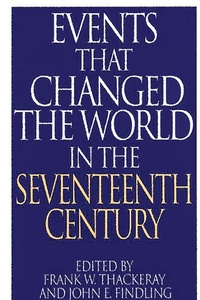
Events That Changed the World in the Seventeenth Century
1st Edition
Published on 30. November 1999
232 pages
978-0-313-00747-7 (ISBN)
Description

It was the age of empire and the dawn of political and scientific revolution. The seventeenth century brought about enormous changes in the global political landscape and in the understanding of the principles of science. From this dynamic century, often fraught with upheaval and bustling with fascinating historical actors, several key events are treated by recognized experts in the field. These important events include, among others:
. The age of the great Russian tsars, Indian moguls, and Japanese shoguns
. The beginning of a four-century dynasty in China
. The reign of Louis XIV
. The expansion of the Ottoman Empire
. England's Glorious Revolution
. The Founding of Jamestown
. The Thirty Years' War
. The Scientific Revolution
To help students understand the major developments of the seventeenth century and their impact on our own time, this unique resource offers detailed description and expert analysis of the century's most important events.
Each of the events is covered in a separate chapter. An introductory essay provides factual materials about the event in a clear, concise, and chronological manner that makes complex history understandable. An interpretive essay, written by a recognized authority in the field, then explores the short-term and far-reaching ramifications of the event. With an annotated bibliography, full-page illustrations, a timeline of important events, a listing of ruling houses and dynasties of the period, and a glossary of names, events, and terms of the seventeenth century, Events That Changed the World in the Seventeenth Century is an ideal addition to the high school, community college, and undergraduate reference shelf, as well as excellent supplementary reading for social studies and world history courses.
. The age of the great Russian tsars, Indian moguls, and Japanese shoguns
. The beginning of a four-century dynasty in China
. The reign of Louis XIV
. The expansion of the Ottoman Empire
. England's Glorious Revolution
. The Founding of Jamestown
. The Thirty Years' War
. The Scientific Revolution
To help students understand the major developments of the seventeenth century and their impact on our own time, this unique resource offers detailed description and expert analysis of the century's most important events.
Each of the events is covered in a separate chapter. An introductory essay provides factual materials about the event in a clear, concise, and chronological manner that makes complex history understandable. An interpretive essay, written by a recognized authority in the field, then explores the short-term and far-reaching ramifications of the event. With an annotated bibliography, full-page illustrations, a timeline of important events, a listing of ruling houses and dynasties of the period, and a glossary of names, events, and terms of the seventeenth century, Events That Changed the World in the Seventeenth Century is an ideal addition to the high school, community college, and undergraduate reference shelf, as well as excellent supplementary reading for social studies and world history courses.
More details
Series
Language
English
Place of publication
New York
United States
Publishing group
Bloomsbury Publishing Plc
Target group
Interest Age: From 7 to 17 years
File size
2,20 MB
ISBN-13
978-0-313-00747-7 (9780313007477)
Copyright in bibliographic data and cover images is held by Nielsen Book Services Limited or by the publishers or by their respective licensors: all rights reserved.
Schweitzer Classification
Other editions
Additional editions
John E. Findling | Frank W. Thackeray
Events That Changed the World in the Seventeenth Century
Book
11/1999
Greenwood Press
€62.50
Shipment within 15-20 days
Persons
FRANK W. THACKERAY is Professor of History at Indiana University Southeast./e He is author of Antecedents of Revolution: Alexander I and the Polish Kingdom (1980) and the co-editor (with John E. Findling) of the Events That Changed the World series and the The Events That Changed America series, both published by Greenwood. Also with John E. Findling, he is co-editor of Statesmen Who Changed the World (1993). He and Findling are also series editors of the Greenwood Histories of the Modern Nations series.
JOHN E. FINDLING is Professor of History at Indiana University Southeast./eHe is the author of Dictionary of American Diplomatic History (1980-89), Close Neighbors, Distant Friends: United States-Central American Relations (1987), and Chicago's Great World's Fairs (1995). With Kimberly D. Pelle, he co-edited Historical Dictionary of World's Fairs and Expositions, 1851-1988 (1990) and Historical Dictionary of the Modern Olympic Movement (1996). With Frank W. Thackeray, he is co-editor of the Events That Changed the World series and the Events That Changed America series and also series editor of the Greenwood Histories of the Modern Nations series.
JOHN E. FINDLING is Professor of History at Indiana University Southeast./eHe is the author of Dictionary of American Diplomatic History (1980-89), Close Neighbors, Distant Friends: United States-Central American Relations (1987), and Chicago's Great World's Fairs (1995). With Kimberly D. Pelle, he co-edited Historical Dictionary of World's Fairs and Expositions, 1851-1988 (1990) and Historical Dictionary of the Modern Olympic Movement (1996). With Frank W. Thackeray, he is co-editor of the Events That Changed the World series and the Events That Changed America series and also series editor of the Greenwood Histories of the Modern Nations series.
Content
Preface
The Time of Troubles, 1598-1618
Interpretive Essay by John T. Alexander
The Establishment of the Tokugawa Shogunate, 1603
Interpretive Essay by Louis G. Perez
The Founding of Jamestown, 1607
Interpretive Essay by Rick Kennedy
The Thirty Years' War, 1618-1648
Interpretive Essay by Garrett L. McAinsh
Louis XIV and the Grand Monarchy, 1643-1715
Interpretive Essay by Andrew P. Trout
The Manchu Conquest, 1644
Interpretive Essay by Yu Shen
The Scientific Revolution, c. 1650
Interpretive Essay by Robert K. DeKosky
The Golden Age of Mogul Power, c. 1650
Interpretive Essay by John McLeod
The Siege of Vienna, 1683
Interpretive Essay by David Stefancic
The Glorious Revolution, 1688-1689
Interpretive Essay by William T. Walker
Appendices
Index
The Time of Troubles, 1598-1618
Interpretive Essay by John T. Alexander
The Establishment of the Tokugawa Shogunate, 1603
Interpretive Essay by Louis G. Perez
The Founding of Jamestown, 1607
Interpretive Essay by Rick Kennedy
The Thirty Years' War, 1618-1648
Interpretive Essay by Garrett L. McAinsh
Louis XIV and the Grand Monarchy, 1643-1715
Interpretive Essay by Andrew P. Trout
The Manchu Conquest, 1644
Interpretive Essay by Yu Shen
The Scientific Revolution, c. 1650
Interpretive Essay by Robert K. DeKosky
The Golden Age of Mogul Power, c. 1650
Interpretive Essay by John McLeod
The Siege of Vienna, 1683
Interpretive Essay by David Stefancic
The Glorious Revolution, 1688-1689
Interpretive Essay by William T. Walker
Appendices
Index
