

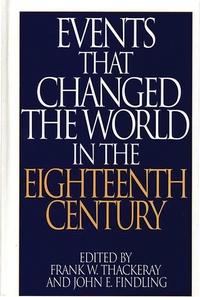
Events That Changed the World in the Eighteenth Century
1st Edition
Published on 26. January 1998
224 pages
978-0-313-00807-8 (ISBN)
Description

Warfare on three continents, empire building, and revolution-political, agricultural, and industrial-dominate 18th-century world history. In Europe royal dynasties formed, fought major wars that carved up the map of Europe and the Americas, and began the great colonial expansion that dominated the next century. But the 18th century also ushered in the Enlightenment, which fired the imagination of Europeans, and the Industrial and Agricultural Revolutions, which changed society and work forever. To help students better understand the major developments of the 18th century and their impact on 19th- and 20th-century history, this unique resource offers detailed description and expert analysis of the 18th century's most important events: Peter the Great's Reform of Russia; the War of the Spanish Succession; the First British Empire; the War of the Austrian Succession and the Seven Years' War; the Enlightenment; the Agricultural Revolution; the American Revolution; the Industrial Revolution; the Slave Trade; and the French Revolution.
Each of the ten events is dealt with in a separate chapter. Designed for students, this unique format features an introductory essay that presents the facts, followed by an interpretive essay that places the event in a broader context and promotes student analysis. The introductory essay provides factual material about the event in a clear, concise, and chronological manner that makes complex history understandable. The interpretive essay, written by a recognized authority in the field in a style designed to appeal to general readership, explores the short-term and far-reaching ramifications of the event. An annotated bibliography identifies the most important recent scholarship about each event. A full-page illustration complements the narrative for each event. Three useful appendices include: a glossary of names, events, and terms; a timeline of important events in 18th-century world history; and a listing of ruling houses and dynasties of 18th-century Europe. This work is an ideal addition to the high school, community college, and undergraduate reference shelf, as well as excellent supplementary reading for social studies and world history courses.
Each of the ten events is dealt with in a separate chapter. Designed for students, this unique format features an introductory essay that presents the facts, followed by an interpretive essay that places the event in a broader context and promotes student analysis. The introductory essay provides factual material about the event in a clear, concise, and chronological manner that makes complex history understandable. The interpretive essay, written by a recognized authority in the field in a style designed to appeal to general readership, explores the short-term and far-reaching ramifications of the event. An annotated bibliography identifies the most important recent scholarship about each event. A full-page illustration complements the narrative for each event. Three useful appendices include: a glossary of names, events, and terms; a timeline of important events in 18th-century world history; and a listing of ruling houses and dynasties of 18th-century Europe. This work is an ideal addition to the high school, community college, and undergraduate reference shelf, as well as excellent supplementary reading for social studies and world history courses.
More details
Series
Language
English
Place of publication
New York
United States
Publishing group
Bloomsbury Publishing Plc
Target group
Interest Age: From 7 to 17 years
File size
2,25 MB
ISBN-13
978-0-313-00807-8 (9780313008078)
Copyright in bibliographic data and cover images is held by Nielsen Book Services Limited or by the publishers or by their respective licensors: all rights reserved.
Schweitzer Classification
Other editions
Additional editions
John E. Findling | Frank W. Thackeray
Events That Changed the World in the Eighteenth Century
Book
01/1998
Greenwood Press
€70.30
Shipment within 15-20 days
Persons
FRANK W. THACKERAY is Professor of History at Indiana University Southeast. He is coeditor of the Greenwood Press Events That Changed the World, Events That Changed America, and Histories of the Modern Nations series. He is also coeditor of Statesmen Who Changed the World: A Biobibliographical Dictionary of Diplomacy (Greenwood, 1993) and author of Antecedents of Revolution: Alexander I and the Polish Congress Kingdom, 1815-1825 (1980). He is a former Fulbright scholar to Poland.
JOHN E. FINDLING is Professor of History at Indiana University Southeast. He is coeditor of the Greenwood Press Events That Changed the World, Events That Changed America, and Histories of the Modern Nations series. He is author of Dictionary of American Diplomatic History (Greenwood, rev. ed. 1989) and Close Neighbors, Distant Friends: U.S.-Central American Relations (1987). He is editor of Historical Dictionary of Worlds Fairs and Expositions (1990) and coeditor of Historical Dictionary of the Modern Olympic Movement (Greenwood, 1996).
JOHN E. FINDLING is Professor of History at Indiana University Southeast. He is coeditor of the Greenwood Press Events That Changed the World, Events That Changed America, and Histories of the Modern Nations series. He is author of Dictionary of American Diplomatic History (Greenwood, rev. ed. 1989) and Close Neighbors, Distant Friends: U.S.-Central American Relations (1987). He is editor of Historical Dictionary of Worlds Fairs and Expositions (1990) and coeditor of Historical Dictionary of the Modern Olympic Movement (Greenwood, 1996).
Content
Preface
Peter the Great Reforms Russia, 1689-1725
Introduction
Interpretive Essay by Taylor Stults
The War of the Spanish Succession, 1701-1714
Introduction
Interpretive Essay by Andrew P. Trout
The First British Empire, 1701-1763
Introduction
Interpretive Essay by Thomas Prasch
The War of the Austrian Succession and the Seven Years' War, 1740-1763
Introduction
Interpretive Essay by Franz A. J. Szabo
The Enlightenment, c. 1750
Introduction
Interpretive Essay by Linda E. Mitchell
The Agricultural Revolution, c. 1750
Introduction
Interpretive Essay by Robert D. Cornwall
The American Revolution, 1763-1783
Introduction
Interpretive Essay by Rick Kennedy
The Industrial Revolution, c. 1775
Introduction
Interpretive Essay by David Mitch
The Atlantic Slave Trade, c. 1780
Introduction
Interpretive Essay by Kenneth Banks
The French Revolution, 1789-1799
Introduction
Interpretive Essay by Donald H. Barry
Appendix A: Glossary
Appendix B: Timeline
Appendix C: Ruling Houses and Dynasties
Index
Peter the Great Reforms Russia, 1689-1725
Introduction
Interpretive Essay by Taylor Stults
The War of the Spanish Succession, 1701-1714
Introduction
Interpretive Essay by Andrew P. Trout
The First British Empire, 1701-1763
Introduction
Interpretive Essay by Thomas Prasch
The War of the Austrian Succession and the Seven Years' War, 1740-1763
Introduction
Interpretive Essay by Franz A. J. Szabo
The Enlightenment, c. 1750
Introduction
Interpretive Essay by Linda E. Mitchell
The Agricultural Revolution, c. 1750
Introduction
Interpretive Essay by Robert D. Cornwall
The American Revolution, 1763-1783
Introduction
Interpretive Essay by Rick Kennedy
The Industrial Revolution, c. 1775
Introduction
Interpretive Essay by David Mitch
The Atlantic Slave Trade, c. 1780
Introduction
Interpretive Essay by Kenneth Banks
The French Revolution, 1789-1799
Introduction
Interpretive Essay by Donald H. Barry
Appendix A: Glossary
Appendix B: Timeline
Appendix C: Ruling Houses and Dynasties
Index
