

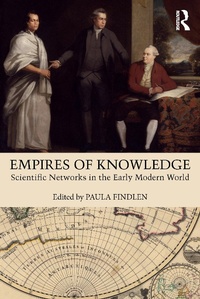
Empires of Knowledge
Scientific Networks in the Early Modern World
1st Edition
Published on 26. October 2018
412 pages
978-0-429-86793-4 (ISBN)
Description

Empires of Knowledge charts the emergence of different kinds of scientific networks - local and long-distance, informal and institutional, religious and secular - as one of the important phenomena of the early modern world. It seeks to answer questions about what role these networks played in making knowledge, how information traveled, how it was transformed by travel, and who the brokers of this world were.
Bringing together an international group of historians of science and medicine, this book looks at the changing relationship between knowledge and community in the early modern period through case studies connecting Europe, Asia, the Ottoman Empire, and the Americas. It explores a landscape of understanding (and misunderstanding) nature through examinations of well-known intelligencers such as overseas missions, trading companies, and empires while incorporating more recent scholarship on the many less prominent go-betweens, such as translators and local experts, which made these networks of knowledge vibrant and truly global institutions.
Empires of Knowledge is the perfect introduction to the global history of early modern science and medicine.
Bringing together an international group of historians of science and medicine, this book looks at the changing relationship between knowledge and community in the early modern period through case studies connecting Europe, Asia, the Ottoman Empire, and the Americas. It explores a landscape of understanding (and misunderstanding) nature through examinations of well-known intelligencers such as overseas missions, trading companies, and empires while incorporating more recent scholarship on the many less prominent go-betweens, such as translators and local experts, which made these networks of knowledge vibrant and truly global institutions.
Empires of Knowledge is the perfect introduction to the global history of early modern science and medicine.
Reviews / Votes
"Empires of Knowledge reflects the idea - sadly too rare today - of an historiographical experiment. Drawing on the methodological and theoretical resources of the new history of information and the Republic of letters, and on network-based approaches reflecting the material turn, the book seeks, at different levels, to problematize the notion of the scientific network in the modern period, showing the patient work of composing and recomposing the naturalist world between the Renaissance and the Enlightenment and mapping in detail the circulatory paths that enabled the establishment of long distance relations and maintained the perception of globalisation. Tracking the progress of a letter, agent, object, or idea becomes a means to repopulate the global history of science with a variety of agencies and to create a materially-based geospatial archive. From Renaissance Italy to the China of Emperor Qianlong, taking in the England of Samuel Hartlib and Henry Oldenburg, and the Jesuit networks of Kircher in the Napoleonic period, Empires of Knowledge rejects any separation between Europe and elsewhere to show the entanglement of different worlds. Where historians used to contrast two geographies, two historiographies, the book manages to articulate the long networks of empires with those shorter of the European Republic of letters. From antiquarian culture to geology, linguistics to natural history, and medicine to astronomy, the book reflects a vast, shimmering, varied landscape of practices and disciplines that are not all intended to be cumulative, but which, through their contact, deconstruct the usual narratives. Underpinned by the digital turn and spatial history, this book offers a different vision of the globalization of science that, rather than focusing on integration, infinite conquest, and completeness, is concerned to provide an image of the naturalist world based on interconnecting networks."Stephane van Damme, European University Institute, Italy
More details
Edition
1. Auflage
Language
English
Place of publication
London
United Kingdom
Publishing group
Taylor & Francis Ltd
Target group
College/higher education
Illustrations
44 Illustrations, black and white
File size
61,67 MB
ISBN-13
978-0-429-86793-4 (9780429867934)
Copyright in bibliographic data and cover images is held by Nielsen Book Services Limited or by the publishers or by their respective licensors: all rights reserved.
Schweitzer Classification
Other editions
Additional editions
Book
11/2018
1st Edition
Routledge
€245.12
Shipment within 10-20 days
Book
11/2018
1st Edition
Routledge
€69.51
Shipment within 10-20 days
Person
Paula Findlen is Ubaldo Pierotti Professor of Italian History at Stanford University, USA. Her research focuses on science and culture in early modern Italy. She is the 2016 recipient of the Premio Galileo. Recent publications include Early Modern Things: Objects and Their Histories, 1500-1800.
Content
Introduction: Early modern scientific networks: knowledge and community in a globalizing world, 1500-1800 (Paula Findlen)
Part I: Brokers of knowledge
Chapter 1: A scholarly intermediary between the Ottoman Empire and Renaissance Europe (Robert Morrison)
Chapter 2: How information travels: Jesuit networks, scientific knowledge, and the early modern Republic of Letters, 1540-1640 (Paula Findlen)
Chapter 3: Deciphering the Ignatian Tree: the Catholic Horoscope of the Society of Jesus (Marcelo Aranda)
Chapter 4: The early modern information factory: how Samuel Hartlib turned correspondence into knowledge (Carol Pal)
Part II: Configuring scientific networks
Chapter 5: Letters and questionnaires: the correspondence of Henry Oldenburg and the early Royal Society of London's Inquiries for Natural History (Iordan Avramov)
Chapter 6: Ingenuous investigators: Antonio Vallisneri's regional network and the making of natural knowledge in eighteenth-century Italy (Ivano Dal Prete)
Chapter 7: Corresponding in war and peace: the challenge of rebooting Anglo-French scientific relations during the Peace of Amiens (Elise Lipkowitz)
Part III: How knowledge travels
Chapter 8: Giant bones and the Taunton Stone: American antiquities, world history, and the Protestant International (Lydia Barnett)
Chapter 9: The tarot of Yu the Great: the search for civilization's origins between France and China in the Age of Enlightenment (Alexander Statman)
Chapter 10: Spaces of circulation and empires of knowledge: ethnolinguistics and cartography in early colonial India (Kapil Raj)
Part IV: The local and the global
Chapter 11: Recentering centers of calculation: reconfiguring knowledge networks within global empires of trade (Matthew Sargent)
Chapter 12: The Atlantic World medical complex (Londa Schiebinger)
Epilogue: Scientific networks reconsidered
Chapter 14: Following ghosts: skinning science in early modern Eurasia (Carla Nappi)
Chapter 15: Conceptualizing knowledge networks: agents and patterns of "flow" (Rachel Midura)
Chapter 16: Afterword (Harold J. Cook)
Part I: Brokers of knowledge
Chapter 1: A scholarly intermediary between the Ottoman Empire and Renaissance Europe (Robert Morrison)
Chapter 2: How information travels: Jesuit networks, scientific knowledge, and the early modern Republic of Letters, 1540-1640 (Paula Findlen)
Chapter 3: Deciphering the Ignatian Tree: the Catholic Horoscope of the Society of Jesus (Marcelo Aranda)
Chapter 4: The early modern information factory: how Samuel Hartlib turned correspondence into knowledge (Carol Pal)
Part II: Configuring scientific networks
Chapter 5: Letters and questionnaires: the correspondence of Henry Oldenburg and the early Royal Society of London's Inquiries for Natural History (Iordan Avramov)
Chapter 6: Ingenuous investigators: Antonio Vallisneri's regional network and the making of natural knowledge in eighteenth-century Italy (Ivano Dal Prete)
Chapter 7: Corresponding in war and peace: the challenge of rebooting Anglo-French scientific relations during the Peace of Amiens (Elise Lipkowitz)
Part III: How knowledge travels
Chapter 8: Giant bones and the Taunton Stone: American antiquities, world history, and the Protestant International (Lydia Barnett)
Chapter 9: The tarot of Yu the Great: the search for civilization's origins between France and China in the Age of Enlightenment (Alexander Statman)
Chapter 10: Spaces of circulation and empires of knowledge: ethnolinguistics and cartography in early colonial India (Kapil Raj)
Part IV: The local and the global
Chapter 11: Recentering centers of calculation: reconfiguring knowledge networks within global empires of trade (Matthew Sargent)
Chapter 12: The Atlantic World medical complex (Londa Schiebinger)
Epilogue: Scientific networks reconsidered
Chapter 14: Following ghosts: skinning science in early modern Eurasia (Carla Nappi)
Chapter 15: Conceptualizing knowledge networks: agents and patterns of "flow" (Rachel Midura)
Chapter 16: Afterword (Harold J. Cook)
