

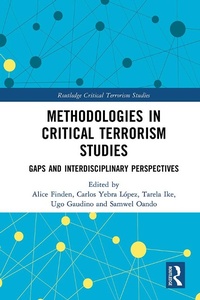
Methodologies in Critical Terrorism Studies
Gaps and Interdisciplinary Perspectives
1st Edition
Published on 4. January 2024
232 pages
978-1-003-83525-7 (ISBN)
Description

This interdisciplinary book presents an intervention into methodological practices in the subfield of Critical Terrorism Studies, and features established and early career scholars.
The volume interrogates the role that research methods play in shaping the sub-discipline of Critical Terrorism Studies (CTS). It responds to two major methodological gaps within CTS: (1) the dearth of Global South cases and voices, and decolonial and feminist approaches; and (2) the lack of engagement with 'traditional' disciplines and quantitative methods. Together, authors demonstrate that interdisciplinary methodological dialogues can open up new possibilities for researchers seeking pathways towards and definitions of emancipation, social justice and freedom from violence. Simultaneously, the book shows that by focusing on the possibilities that methodologies open up to us and by maintaining a commitment to reflexive practice, we expand our understandings of what are 'legitimate' and 'acceptable' forms of research, thus challenging the Critical/Terrorism Studies divide. The chapters draw upon a wide range of empirical cases, including Nigeria, Kenya, France, Brazil and the UK, focusing on three key issues within Critical Terrorism Studies: its own relationship with and perpetuation of epistemic violence; decolonial, postcolonial, Global South, feminist and queer approaches; and more 'traditional' approaches and methods as a means to interrogate the methodological binary between Critical Terrorism Studies and Terrorism Studies.
This book will be of much interest to students of critical terrorism studies, counter-terrorism, security studies and International Relations in general.
The volume interrogates the role that research methods play in shaping the sub-discipline of Critical Terrorism Studies (CTS). It responds to two major methodological gaps within CTS: (1) the dearth of Global South cases and voices, and decolonial and feminist approaches; and (2) the lack of engagement with 'traditional' disciplines and quantitative methods. Together, authors demonstrate that interdisciplinary methodological dialogues can open up new possibilities for researchers seeking pathways towards and definitions of emancipation, social justice and freedom from violence. Simultaneously, the book shows that by focusing on the possibilities that methodologies open up to us and by maintaining a commitment to reflexive practice, we expand our understandings of what are 'legitimate' and 'acceptable' forms of research, thus challenging the Critical/Terrorism Studies divide. The chapters draw upon a wide range of empirical cases, including Nigeria, Kenya, France, Brazil and the UK, focusing on three key issues within Critical Terrorism Studies: its own relationship with and perpetuation of epistemic violence; decolonial, postcolonial, Global South, feminist and queer approaches; and more 'traditional' approaches and methods as a means to interrogate the methodological binary between Critical Terrorism Studies and Terrorism Studies.
This book will be of much interest to students of critical terrorism studies, counter-terrorism, security studies and International Relations in general.
Reviews / Votes
'This necessary and important volume makes the case for self-reflexivity and methodological pluralism in Critical Terrorism Studies to guard against Eurocentric, racist, and colonial modes of thought that, despite the criticality of its methods, continue to shape much of the scholarship in this field. The contributions to this volume showcase the richness and urgency of postcolonial, decolonial, non-Western, Global South, abolitionist, feminist, and queer approaches, whose insights are central for making visible, rather than perpetuating, the systems of oppression in which "terrorism," as well as its (critical) study, participate.'Dr Verena Erlenbusch-Anderson, Syracuse University, US
More details
Series
Edition
1. Auflage
Language
English
Place of publication
London
United Kingdom
Publishing group
Taylor & Francis Ebooks
Target group
College/higher education
Professional and scholarly
Illustrations
3 Tables, black and white; 1 Line drawings, black and white; 1 Illustrations, black and white
ISBN-13
978-1-003-83525-7 (9781003835257)
Copyright in bibliographic data and cover images is held by Nielsen Book Services Limited or by the publishers or by their respective licensors: all rights reserved.
Schweitzer Classification
Other editions
Additional editions
Alice E. Finden | Carlos Yebra Lopez | Tarela Ike
Methodologies in Critical Terrorism Studies
Gaps and Interdisciplinary Perspectives
Book
05/2025
1st Edition
Routledge
€67.10
Shipment within 10-20 days
Alice E. Finden | Carlos Yebra Lopez | Tarela Ike
Methodologies in Critical Terrorism Studies
Gaps and Interdisciplinary Perspectives
Book
01/2024
1st Edition
Routledge
€206.20
Shipment within 10-20 days
Persons
Alice Finden is Assistant Professor in International Politics at Durham University, UK.
Carlos Yebra Lopez is a lecturer at University College London, UK
Tarela Ike is a Senior Visiting Fellow at Coal City University, Nigeria.
Ugo Gaudino works as a Guest Teacher at the London School of Economics and as a lecturer at Kingston University.
Samwel Oando is a Research Associate at the Institute for the Study of African Realities (ISAR) of the Africa International University (AIU), Kenya.
Carlos Yebra Lopez is a lecturer at University College London, UK
Tarela Ike is a Senior Visiting Fellow at Coal City University, Nigeria.
Ugo Gaudino works as a Guest Teacher at the London School of Economics and as a lecturer at Kingston University.
Samwel Oando is a Research Associate at the Institute for the Study of African Realities (ISAR) of the Africa International University (AIU), Kenya.
Content
Introduction: Methodological Plurality and Reflexivity Part One: The Field of Critical Terrorism Studies and Violence 1. Calibrating Violences in Critical Terrorism Studies 2. "Terrorism" as Abjection: Queering/Abolishing Critical Terrorism Studies 3. A Decolonial Mission for Critical Terrorism Studies: Interrogating the Gendered Coloniality and Colonial Function of the Dominant Discourse on Terrorism. Part Two: The Eurocentricity of Critical Terrorism Studies and Global South Approaches 4. Postcolonial Spaces and Critical Terrorism Studies: Towards a Dialogic Research Agenda 5. Cannibalising the Visual in Critical Terrorism Studies: A Counter-Visuality of the 01/08 Anti-democratic Attacks in Brazil 6. Indigenous Voice in Tackling Violent Extremism in Kenya: Coloniality and Exclusion of African Women Part Three: Bridging Disciplinary and Methodological Gaps in Critical Terrorism Studies 7. Going beyond the State-Centrism of Critical Terrorism Studies: Studying Counterterrorism as Contestation across Political Parties 8. Bringing in New Voices: Non-English Linguistic Corpora and Critical Terrorism Studies 9. Rethinking Methodologies in Critical Terrorism Studies: A Mixed-Method Randomised Control Trial Study on Community Reintegration of Former Boko Haram Members in Nigeria
