

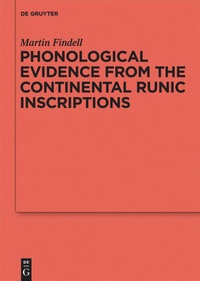
Phonological Evidence from the Continental Runic Inscriptions
Description

The linguistic analysis of runic inscriptions on the Continent tends to focus on individual texts or on groups of texts seen as parallel. We can advance our understanding of the state of Continental Germanic dialects in the 5th-7th centuries by examining the evidence for the major sound changes in a larger dataset.
The study begins with a brief discussion of the Proto-Germanic phonemic system and the major processes by which the systems of Old High German (OHG) and Old Saxon (OS) develop from it. The main body of the work consists of the analysis of a corpus of 90 inscriptions (including, but not confined to, those conventionally labeled "South Germanic") for evidence of these changes. Rather than making the individual inscription the focus for analysis, the investigation groups together all possible witnesses to a particular phonological process.
In many respects, the data are found to be consistent with the anticipated developments of OHG and OS; but we encounter some problems which the existing models of the sound changes cannot account for. There is also some evidence for processes at work in the dialects of the inscriptions which are not attested in OHG or OS.
More details
Other editions
Additional editions
Person
Content
2 - Prefatory note [Seite 6]
3 - Abbreviations [Seite 23]
3.1 - Abbreviations for languages and linguistic terms [Seite 23]
3.2 - Abbreviations for sources [Seite 24]
4 - Part I: Text [Seite 25]
4.1 - 1. The Continental runic inscriptions [Seite 27]
4.1.1 - 1.1 General introduction [Seite 27]
4.1.1.1 - 1.1.1 The dialect(s) of the inscriptions [Seite 28]
4.1.1.2 - 1.1.2 Chronology and dating [Seite 29]
4.1.1.3 - 1.1.3 Reconstructing and representing PGmc [Seite 30]
4.1.1.4 - 1.1.4 Orthography and phonology: the relationship of grapheme to phoneme [Seite 31]
4.1.2 - 1.2 The corpus of runic inscriptions [Seite 32]
4.1.2.1 - 1.2.1 Geographical and chronological context [Seite 32]
4.1.2.2 - 1.2.2 Content and graphology [Seite 33]
4.1.2.3 - 1.2.3 Authenticity [Seite 34]
4.2 - 2. Phonology and runic orthography [Seite 35]
4.2.1 - 2.1 Introduction [Seite 35]
4.2.2 - 2.2 The vocalic system of lPGmc [Seite 35]
4.2.2.1 - 2.2.1 Short vowels [Seite 35]
4.2.2.2 - 2.2.2 Long vowels [Seite 37]
4.2.2.3 - 2.2.3 Diphthongs [Seite 37]
4.2.2.4 - 2.2.4 On the distinction "front" vs. "back" [Seite 38]
4.2.3 - 2.3 The vocalic systems of OHG and OS [Seite 39]
4.2.3.1 - 2.3.1 Diphthongs [Seite 39]
4.2.3.1.1 - 2.3.1.1 PGmc*/eu/ [Seite 39]
4.2.3.1.2 - 2.3.1.2 The NWGmc monophthongisation of unstressed */ai/ and */au/ [Seite 42]
4.2.3.1.3 - 2.3.1.3 PGmc */ai/ in OHG and OS [Seite 43]
4.2.3.1.3.1 - 2.3.1.3.1 Conditions for monophthongisation [Seite 43]
4.2.3.1.3.2 - 2.3.1.3.2 Chronology [Seite 44]
4.2.3.1.3.3 - 2.3.1.3.3 Phonetic development [Seite 45]
4.2.3.1.4 - 2.3.1.4 PGmc */au/ in OHG and OS [Seite 46]
4.2.3.1.4.1 - 2.3.1.4.1 Conditions for monophthongisation [Seite 46]
4.2.3.1.4.2 - 2.3.1.4.2 Chronology [Seite 46]
4.2.3.1.4.3 - 2.3.1.4.3 Phonetic development [Seite 47]
4.2.3.2 - 2.3.2 Back vocalics [Seite 47]
4.2.3.2.1 - 2.3.2.1 PGmc */u/ [Seite 47]
4.2.3.2.2 - 2.3.2.2 PGmc */u¯/ [Seite 48]
4.2.3.2.3 - 2.3.2.3 PGmc */o¯/ [Seite 49]
4.2.3.2.4 - 2.3.2.4 PGmc */w/ [Seite 50]
4.2.3.3 - 2.3.3 Front vocalics [Seite 51]
4.2.3.3.1 - 2.3.3.1 PGmc */i/ [Seite 51]
4.2.3.3.2 - 2.3.3.2 PGmc */e/ [Seite 52]
4.2.3.3.3 - 2.3.3.3 PGmc */i¯/ [Seite 53]
4.2.3.3.4 - 2.3.3.4 PGmc */e¯1/ [Seite 53]
4.2.3.3.5 - 2.3.3.5 PGmc */e¯2/ [Seite 53]
4.2.3.3.6 - 2.3.3.6 PGmc */j/ [Seite 54]
4.2.3.4 - 2.3.4 Low vowels [Seite 55]
4.2.3.4.1 - 2.3.4.1 PGmc */a/ [Seite 55]
4.2.3.4.2 - 2.3.4.2 "Primary" i-umlaut [Seite 56]
4.2.3.4.3 - 2.3.4.3 lPGmc */a¯x/ < PGmc */anx/ [Seite 57]
4.2.3.5 - 2.3.5 Anaptyxis [Seite 57]
4.2.3.6 - 2.3.6 Summary [Seite 58]
4.2.4 - 2.4 The consonantal system of lPGmc [Seite 59]
4.2.4.1 - 2.4.1 Subcategorising the obstruents [Seite 61]
4.2.5 - 2.5 The consonantal systems of OHG and OS [Seite 62]
4.2.5.1 - 2.5.1 The obstruents [Seite 62]
4.2.5.1.1 - 2.5.1.1 Early development of the PGmc obstruents [Seite 62]
4.2.5.1.1.1 - 2.5.1.1.1 Reflexes of PGmc */b/ [Seite 62]
4.2.5.1.1.2 - 2.5.1.1.2 Reflexes of PGmc */g/ [Seite 63]
4.2.5.1.1.3 - 2.5.1.1.3 Loss of PGmc */z/ [Seite 63]
4.2.5.1.2 - 2.5.1.2 The Second Consonant Shift [Seite 64]
4.2.5.1.2.1 - 2.5.1.2.1 Phonetic development: Tenuisverschiebung [Seite 64]
4.2.5.1.2.2 - 2.5.1.2.2 Phonetic development: Medienverschiebung [Seite 66]
4.2.5.1.2.3 - 2.5.1.2.3 Geographical distribution [Seite 67]
4.2.5.1.2.4 - 2.5.1.2.4 Chronology [Seite 67]
4.2.5.1.3 - 2.5.1.3 Spirantenschwachung and the despirantisation of /./ [Seite 69]
4.2.5.1.4 - 2.5.1.4 Other processes affecting the obstruents [Seite 70]
4.2.5.1.4.1 - 2.5.1.4.1 Notkers Anlautgesetz and final devoicing [Seite 70]
4.2.5.1.4.2 - 2.5.1.4.2 Deletion of /h/ [Seite 71]
4.2.5.1.4.3 - 2.5.1.4.3 Irregular(?) changes in consonant clusters [Seite 72]
4.2.5.2 - 2.5.2 The sonorants [Seite 73]
4.2.5.2.1 - 2.5.2.1 The "liquids" (PGmc */l r/) [Seite 73]
4.2.5.2.1.1 - 2.5.2.1.1 The phonetic quality of OHG OS /r/ [Seite 74]
4.2.5.2.2 - 2.5.2.2 The nasals (PGmc */m n/) [Seite 75]
4.2.5.3 - 2.5.3 Epenthetic (and prothetic) consonants [Seite 76]
4.2.5.4 - 2.5.4 Summary [Seite 77]
4.2.6 - 2.6 Runic orthography [Seite 78]
4.2.6.1 - 2.6.1 Graphemic representation of the high vowels and the corresponding semivowels [Seite 78]
4.2.6.2 - 2.6.2 Orthographic rules proposed in the runological literature [Seite 78]
4.3 - 3. The diphthongs [Seite 81]
4.3.1 - 3.1 PGmc */eu/ [Seite 81]
4.3.1.1 - 3.1.1 Data [Seite 82]
4.3.1.2 - 3.1.2 Summary and discussion [Seite 91]
4.3.1.2.1 - 3.1.2.1 Umlaut [Seite 92]
4.3.1.2.2 - 3.1.2.2 UG consonant-conditioned variation [Seite 94]
4.3.1.3 - 3.1.3 Conclusion: reflexes of */eu/ in the corpus [Seite 97]
4.3.2 - 3.2 PGmc */ai/ [Seite 98]
4.3.2.1 - 3.2.1 Data: digraphs [Seite 98]
4.3.2.1.1 - 3.2.1.1 Summary: digraphs representing PGmc */ai/ [Seite 104]
4.3.2.2 - 3.2.2 Data: monographs [Seite 105]
4.3.2.2.1 - 3.2.2.1 Summary: monographs representing PGmc */ai/ [Seite 113]
4.3.2.2.1.1 - 3.2.2.1.1 Unstressed syllables: the NWGmc monophthongisation [Seite 113]
4.3.2.2.1.2 - 3.2.2.1.2 Stressed syllables: the OHG/OS monophthongisation [Seite 115]
4.3.2.3 - 3.2.3 Conclusion: reflexes of */ai/ in the corpus [Seite 116]
4.3.2.3.1 - 3.2.3.1 Unstressed syllables: the NWGmc monophthongisation [Seite 116]
4.3.2.3.2 - 3.2.3.2 Stressed syllables: the OHG and OS monophthongisations [Seite 117]
4.3.3 - 3.3 PGmc */au/ [Seite 119]
4.3.3.1 - 3.3.1 Data: digraphs [Seite 119]
4.3.3.1.1 - 3.3.1.1 Summary: digraphs representing PGmc */au/ [Seite 123]
4.3.3.2 - 3.3.2 Data: monographs [Seite 125]
4.3.3.2.1 - 3.3.2.1 Summary: monographs representing PGmc */au/ [Seite 127]
4.3.3.3 - 3.3.3 Conclusion: reflexes of */au/ in the corpus [Seite 127]
4.4 - 4. The back vocalics [Seite 129]
4.4.1 - 4.1 Data [Seite 130]
4.4.2 - 4.2 Summary [Seite 172]
4.4.2.1 - 4.2.1 Reflexes of */u/ [Seite 172]
4.4.2.1.1 - 4.2.1.1 Stressed/stem syllables [Seite 172]
4.4.2.1.2 - 4.2.1.2 Unstressed syllables [Seite 173]
4.4.2.2 - 4.2.2 Anaptyctic vowels [Seite 174]
4.4.2.3 - 4.2.3 Reflexes of */o¯/ [Seite 175]
4.4.2.3.1 - 4.2.3.1 Stressed syllables [Seite 175]
4.4.2.3.2 - 4.2.3.2 Unstressed syllables [Seite 176]
4.4.2.4 - 4.2.4 Reflexes of */u¯/ [Seite 177]
4.4.2.4.1 - 4.2.4.1 Stressed syllables [Seite 177]
4.4.2.4.2 - 4.2.4.2 Unstressed syllables [Seite 177]
4.4.2.5 - 4.2.5 Reflexes of */w/ [Seite 177]
4.4.3 - 4.3 Conclusions [Seite 180]
4.4.4 - 4.4 The nom. o¯-stems: a problem in morphophonology [Seite 181]
4.4.4.1 - 4.4.1 Sequences in -u [Seite 182]
4.4.4.2 - 4.4.2 Sequences in -Ø [Seite 183]
4.4.4.3 - 4.4.3 Sequences in -a [Seite 184]
4.4.4.3.1 - 4.4.3.1 Co-textual evidence for the assignment of oblique case [Seite 184]
4.4.4.3.2 - 4.4.3.2 Summary of co-textual evidence [Seite 186]
4.4.4.3.3 - 4.4.3.3 Putative nom.sg. o¯-stems in -a [Seite 186]
4.4.4.4 - 4.4.4 Sequences in -o [Seite 187]
4.4.4.5 - 4.4.5 Conclusions on the nom.sg. o¯-stem suffix(es) [Seite 188]
4.5 - 5. The front vocalics [Seite 191]
4.5.1 - 5.1 Data [Seite 191]
4.5.2 - 5.2 Summary [Seite 234]
4.5.2.1 - 5.2.1 Reflexes of the short front vowels [Seite 234]
4.5.2.1.1 - 5.2.1.1 Stressed syllables [Seite 234]
4.5.2.1.2 - 5.2.1.2 Unstressed syllables [Seite 236]
4.5.2.2 - 5.2.2 Reflexes of the long front vowels [Seite 238]
4.5.2.2.1 - 5.2.2.1 */i¯/ in stressed syllables [Seite 238]
4.5.2.2.2 - 5.2.2.2 */e¯1/ in stressed syllables [Seite 238]
4.5.2.2.3 - 5.2.2.3 */e¯2/ in stressed syllables [Seite 239]
4.5.2.2.4 - 5.2.2.4 Long front vowels in unstressed syllables [Seite 239]
4.5.2.3 - 5.2.3 Reflexes of */j/ [Seite 240]
4.5.2.4 - 5.2.4 The "yew-rune" N [Seite 241]
4.5.3 - 5.3 Conclusions [Seite 243]
4.6 - 6. The low vowels [Seite 245]
4.6.1 - 6.1 Data [Seite 245]
4.6.2 - 6.2 Summary [Seite 264]
4.6.3 - 6.3 Conclusions [Seite 266]
4.7 - 7. The consonants [Seite 267]
4.7.1 - 7.1 The obstruents [Seite 267]
4.7.1.1 - 7.1.1 The "labials" (PGmc */p b f/) [Seite 268]
4.7.1.1.1 - 7.1.1.1 Data [Seite 268]
4.7.1.1.2 - 7.1.1.2 Summary [Seite 280]
4.7.1.1.2.1 - 7.1.1.2.1 PGmc */p/ [Seite 280]
4.7.1.1.2.2 - 7.1.1.2.2 PGmc */b/ [Seite 280]
4.7.1.1.2.3 - 7.1.1.2.3 PGmc */f/ [Seite 281]
4.7.1.2 - 7.1.2 The "dentals" (PGmc */t d ? s z/) [Seite 282]
4.7.1.2.1 - 7.1.2.1 Data [Seite 282]
4.7.1.2.2 - 7.1.2.2 Summary [Seite 305]
4.7.1.2.2.1 - 7.1.2.2.1 PGmc */t/ [Seite 305]
4.7.1.2.2.2 - 7.1.2.2.2 PGmc */d/ [Seite 306]
4.7.1.2.2.3 - 7.1.2.2.3 PGmc */./ [Seite 307]
4.7.1.2.2.4 - 7.1.2.2.4 PGmc */s/ [Seite 311]
4.7.1.2.2.5 - 7.1.2.2.5 PGmc */z/ [Seite 312]
4.7.1.3 - 7.1.3 The "gutturals" (PGmc */k g x/) [Seite 313]
4.7.1.3.1 - 7.1.3.1 Data [Seite 313]
4.7.1.3.2 - 7.1.3.2 Summary [Seite 331]
4.7.1.3.2.1 - 7.1.3.2.1 PGmc */k/ [Seite 331]
4.7.1.3.2.2 - 7.1.3.2.2 PGmc */g/ [Seite 332]
4.7.1.3.2.3 - 7.1.3.2.3 PGmc */x/ [Seite 333]
4.7.1.4 - 7.1.4 Conclusions on the obstruents [Seite 334]
4.7.1.4.1 - 7.1.4.1 The Second Consonant Shift [Seite 334]
4.7.1.4.2 - 7.1.4.2 Spirantenschwächung [Seite 336]
4.7.1.4.3 - 7.1.4.3 Initial and final devoicing [Seite 337]
4.7.2 - 7.2 The sonorants [Seite 337]
4.7.2.1 - 7.2.1 The "liquids" (PGmc */l r/) [Seite 337]
4.7.2.1.1 - 7.2.1.1 Data [Seite 337]
4.7.2.1.2 - 7.2.1.2 Summary and conclusions [Seite 354]
4.7.2.2 - 7.2.2 The nasals (PGmc */m n/) [Seite 355]
4.7.2.2.1 - 7.2.2.1 Data [Seite 355]
4.7.2.2.2 - 7.2.2.2 Summary and conclusions [Seite 368]
4.8 - 8. The phonological system(s) of "Continental Runic" [Seite 371]
4.8.1 - 8.1 Vocalics [Seite 371]
4.8.1.1 - 8.1.1 Short vowels [Seite 371]
4.8.1.1.1 - 8.1.1.1 Stressed syllables [Seite 371]
4.8.1.1.2 - 8.1.1.2 Unstressed syllables [Seite 372]
4.8.1.1.3 - 8.1.1.3 Anaptyxis [Seite 372]
4.8.1.2 - 8.1.2 Long vowels [Seite 373]
4.8.1.2.1 - 8.1.2.1 Stressed syllables [Seite 373]
4.8.1.2.2 - 8.1.2.2 Unstressed syllables [Seite 373]
4.8.1.3 - 8.1.3 Diphthongs [Seite 374]
4.8.1.3.1 - 8.1.3.1 Stressed syllables [Seite 374]
4.8.1.3.2 - 8.1.3.2 Unstressed syllables [Seite 375]
4.8.1.4 - 8.1.4 Semivowels [Seite 376]
4.8.2 - 8.2 Consonants [Seite 376]
4.8.2.1 - 8.2.1 Obstruents [Seite 376]
4.8.2.2 - 8.2.2 Sonorants [Seite 378]
4.8.3 - 8.3 Theoretical and methodological considerations [Seite 378]
4.8.3.1 - 8.3.1 Grapheme and phoneme [Seite 378]
4.8.3.2 - 8.3.2 Phonological theory [Seite 381]
5 - Part II: Catalogue [Seite 383]
5.1 - Notes on catalogue entries [Seite 385]
5.1.1 - Designation of items [Seite 385]
5.1.2 - Concordance [Seite 385]
5.1.3 - Find-site [Seite 385]
5.1.4 - Context [Seite 385]
5.1.5 - Provenance [Seite 386]
5.1.6 - Datings [Seite 386]
5.1.7 - Readings [Seite 386]
5.1.8 - Images [Seite 387]
5.2 - 1. Aalen [Seite 389]
5.3 - 2. Aquincum [Seite 390]
5.4 - 3. Arlon [Seite 391]
5.5 - 4. Aschheim II [Seite 393]
5.6 - 5. Aschheim III [Seite 394]
5.7 - 6. Bad Ems [Seite 395]
5.8 - 7. Bad Krozingen A [Seite 396]
5.9 - 8. Balingen [Seite 398]
5.10 - 9. Beuchte [Seite 399]
5.11 - 10. Bezenye I [Seite 401]
5.12 - 11. Bezenye II [Seite 402]
5.13 - 12. Bopfingen [Seite 403]
5.14 - 13. Borgharen [Seite 404]
5.15 - 14. Bülach [Seite 405]
5.16 - 15. Charnay [Seite 407]
5.17 - 16. Chéhéry [Seite 409]
5.18 - 17. Dischingen I [Seite 411]
5.19 - 18. Donzdorf [Seite 412]
5.20 - 19. Eichstetten [Seite 414]
5.21 - 20. Engers [Seite 416]
5.22 - 21. Erpfting [Seite 417]
5.23 - 22. Ferwerd [Seite 418]
5.24 - 23. Freilaubersheim [Seite 419]
5.25 - 24. Fréthun I [Seite 420]
5.26 - 25. Friedberg [Seite 421]
5.27 - 26. Gammertingen [Seite 423]
5.28 - 27. Geltorf II [Seite 424]
5.29 - 28. Gomadingen [Seite 425]
5.30 - 29. Griesheim [Seite 426]
5.31 - 30. Hailfingen I [Seite 428]
5.32 - 31. Hailfingen II [Seite 429]
5.33 - 32. ┼Hainspach [Seite 431]
5.34 - 33. Heide [Seite 432]
5.35 - 34. Heilbronn-Böckingen I [Seite 433]
5.36 - 35. Hitsum [Seite 434]
5.37 - 36. Hohenstadt [Seite 436]
5.38 - 37. Hoogebeintum [Seite 437]
5.39 - 38. Hüfingen I [Seite 438]
5.40 - 39. Hüfingen II [Seite 440]
5.41 - 40. Hüfingen III [Seite 441]
5.42 - 41. Igling-Unterigling [Seite 442]
5.43 - 42. ┼Kärlich [Seite 443]
5.44 - 43. "Kent" [Seite 444]
5.45 - 44. Kirchheim/Teck I [Seite 446]
5.46 - 45. Kirchheim/Teck II [Seite 448]
5.47 - 46. ┼Kleines Schulerloch [Seite 449]
5.48 - 47. Lauchheim I [Seite 450]
5.49 - 48. Lauchheim II [Seite 451]
5.50 - 49. Liebenau [Seite 452]
5.51 - 50. Mertingen [Seite 453]
5.52 - 51. München-Aubing I [Seite 455]
5.53 - 52. München-Aubing II [Seite 456]
5.54 - 53. Neudingen-Baar I [Seite 457]
5.55 - 54. Neudingen-Baar II [Seite 458]
5.56 - 55. Niederstotzingen [Seite 460]
5.57 - 56. Nordendorf I [Seite 461]
5.58 - 57. Nordendorf II [Seite 464]
5.59 - 58. Oberflacht [Seite 465]
5.60 - 59. Oettingen [Seite 467]
5.61 - 60. Osthofen [Seite 468]
5.62 - 61. Pforzen I [Seite 469]
5.63 - 62. Pforzen II [Seite 472]
5.64 - 63. Pleidelsheim [Seite 474]
5.65 - 64. ┼Rubring [Seite 475]
5.66 - 65. ┼Rügen [Seite 476]
5.67 - 66. Saint-Dizier [Seite 478]
5.68 - 67. Schretzheim I [Seite 479]
5.69 - 68. Schretzheim II [Seite 481]
5.70 - 69. Schretzheim III [Seite 482]
5.71 - 70. Schwangau [Seite 484]
5.72 - 71. Sievern [Seite 485]
5.73 - 72. Skodborg [Seite 486]
5.74 - 73. Skonager III [Seite 487]
5.75 - 74. Soest [Seite 489]
5.76 - 75. Steindorf [Seite 490]
5.77 - 76. Stetten [Seite 492]
5.78 - 77. Szabadbattyán [Seite 494]
5.79 - 78. ┼Trier [Seite 496]
5.80 - 79. Weimar I [Seite 497]
5.81 - 80. Weimar II [Seite 498]
5.82 - 81. Weimar III [Seite 499]
5.83 - 82. Weimar IV [Seite 501]
5.84 - 83. Weingarten I [Seite 502]
5.85 - 84. Weingarten II [Seite 504]
5.86 - 85. ┼Weser I [Seite 505]
5.87 - 86. ┼Weser II [Seite 507]
5.88 - 87. ┼Weser III [Seite 508]
5.89 - 88. ┼Wijnaldum B [Seite 509]
5.90 - 89. Wremen [Seite 510]
5.91 - 90. Wurmlingen [Seite 511]
6 - Appendix 1: Handlist of Continental runic inscriptions excluded from the corpus [Seite 514]
6.1 - Inscriptions with find-sites in the study area, but dated before c.400 AD [Seite 514]
6.2 - Inscriptions with find-sites in the study area, but positively identifiable as non-WGmc [Seite 514]
6.3 - Inscriptions outside the study area, possibly classified as WGmc, but excluded due to early date [Seite 514]
6.4 - Frisian inscriptions excluded due to use of additional runes [Seite 514]
6.5 - Inscriptions (or rune-like carvings) with find-sites in the study area, but of doubtful runic character [Seite 514]
6.6 - Inscriptions with find-sites in the area which are positively identified as runic, but have no linguistic interpretation [Seite 515]
6.7 - Inscriptions found in the area but consisting only of (partial) fuþarks [Seite 516]
6.8 - Items known to be modern forgeries [Seite 516]
6.9 - Additional exclusion (see § 1.2.2) [Seite 516]
7 - Appendix 2: Suspect inscriptions. Possible forgeries and the assessment of authenticity [Seite 517]
8 - Appendix 3: The "Berlin" scabbard mouthpiece [Seite 522]
9 - Maps [Seite 527]
10 - Bibliography [Seite 533]
10.1 - Abbreviations for journals and corporate authors [Seite 533]
10.2 - References [Seite 533]
10.3 - Fonts [Seite 554]
11 - Index of inscriptions [Seite 555]
