

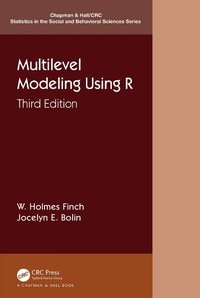
Multilevel Modeling Using R
3rd Edition
Published on 5. April 2024
338 pages
978-1-040-00452-4 (ISBN)
Description

Like its bestselling predecessor, Multilevel Modeling Using R, Third Edition provides the reader with a helpful guide to conducting multilevel data modeling using the R software environment.
After reviewing standard linear models, the authors present the basics of multilevel models and explain how to fit these models using R. They then show how to employ multilevel modeling with longitudinal data and demonstrate the valuable graphical options in R. The book also describes models for categorical dependent variables in both single-level and multilevel data.
The third edition of the book includes several new topics that were not present in the second edition. Specifically, a new chapter has been included, focussing on fitting multilevel latent variable modeling in the R environment. With R, it is possible to fit a variety of latent variable models in the multilevel context, including factor analysis, structural models, item response theory, and latent class models. The third edition also includes new sections in Chapter 11 describing two useful alternatives to standard multilevel models, fixed effects models and generalized estimating equations. These approaches are particularly useful with small samples and when the researcher is interested in modeling the correlation structure within higher-level units (e.g., schools). The third edition also includes a new section on mediation modeling in the multilevel context, in Chapter 11.
This thoroughly updated revision gives the reader state-of-the-art tools to launch their own investigations in multilevel modeling and gain insight into their research.
After reviewing standard linear models, the authors present the basics of multilevel models and explain how to fit these models using R. They then show how to employ multilevel modeling with longitudinal data and demonstrate the valuable graphical options in R. The book also describes models for categorical dependent variables in both single-level and multilevel data.
The third edition of the book includes several new topics that were not present in the second edition. Specifically, a new chapter has been included, focussing on fitting multilevel latent variable modeling in the R environment. With R, it is possible to fit a variety of latent variable models in the multilevel context, including factor analysis, structural models, item response theory, and latent class models. The third edition also includes new sections in Chapter 11 describing two useful alternatives to standard multilevel models, fixed effects models and generalized estimating equations. These approaches are particularly useful with small samples and when the researcher is interested in modeling the correlation structure within higher-level units (e.g., schools). The third edition also includes a new section on mediation modeling in the multilevel context, in Chapter 11.
This thoroughly updated revision gives the reader state-of-the-art tools to launch their own investigations in multilevel modeling and gain insight into their research.
More details
Series
Edition
3rd edition
Language
English
Place of publication
London
United Kingdom
Publishing group
Taylor & Francis Ltd
Target group
Professional and scholarly
Illustrations
4 Tables, black and white; 19 Line drawings, color; 25 Line drawings, black and white; 19 Illustrations, color; 25 Illustrations, black and white
ISBN-13
978-1-040-00452-4 (9781040004524)
Copyright in bibliographic data and cover images is held by Nielsen Book Services Limited or by the publishers or by their respective licensors: all rights reserved.
Schweitzer Classification
Other editions
Additional editions
W. Holmes Finch | Jocelyn E. Bolin
Multilevel Modeling Using R
Book
04/2024
3rd Edition
Chapman & Hall/CRC
€186.80
Shipment within 10-20 days
W. Holmes Finch | Jocelyn E. Bolin
Multilevel Modeling Using R
Book
04/2024
3rd Edition
Chapman & Hall/CRC
€84.20
Shipment within 10-20 days
Persons
Holmes Finch is a Professor in the Department of Educational Psychology at Ball State University where he has been since 2003. He received his PhD from the University of South Carolina in 2002. Dr. Finch teaches courses in factor analysis, structural equation modeling, categorical data analysis, regression, multivariate statistics and measurement to graduate students in psychology and education. His research interests are in the areas of multilevel models, latent variable modeling, methods of prediction and classification, and nonparametric multivariate statistics. Holmes is also an Accredited Professional Statistician (PStat (R)).
Jocelyn Bolin received her PhD in Educational Psychology from Indiana University Bloomington in 2009. Her dissertation consisted a comparison of statistical classification analyses under situations of training data misclassification. She is now an Assistant Professor in the Department of Educational Psychology at Ball State University where she has been since 2010. Dr. Bolin teaches courses on introductory and intermediate statistics, multiple regression analysis and multilevel modeling for graduate students in social science disciplines. Her research interests include statistical methods for classification and clustering and use of multilevel modeling in the social sciences. She is a member of the American Psychological Association, the American Educational Research Association and the American Statistical Association. Jocelyn is also an Accredited Professional Statistician (PStat (R)).
Ken Kelley is the Edward F. Sorin Society Professor of IT, Analytics, and Operations (ITAO) and the Senior Associate Dean for Faculty and Research in the Mendoza College of Business at the University of Notre Dame. Professor Kelley is in the analytics group within the ITAO Department and works to advance analytic methods in his research in a variety of ways from a variety of perspectives to improve the methods used in human-centered research, from the foundational area of psychology to applied areas in business. His work crosses several traditional disciplinary boundaries, which he believes is important when considering various aspects of the human condition. More specifically, he evaluates, improves, and develops methods to better study human-centered research from a methodological perspective. The entire effort is in the data science space, particularly from the psychometric and statistical traditions of framing inferential questions. His most significant methodological contributions are in research design involving the interplay between effect size, confidence intervals, statistical significance, and sample size planning. His work depends heavily on statistical computing, with most of the methods he has developed implemented in R packages (e.g., MBESS, BUCCS, SMRD). In addition to methodological work, he collaborates in a variety of human-centered areas in which he develops needed or apply advanced or nonstandard methods to best address questions. Kelley is co-director of the Human-centered Analytics Lab (HAL) in the Mendoza College of Business. HAL is an interdisciplinary mash-up of technology, psychology, methodology, and business. Dr. Kelley is the developer of the MBESS package for the R statistical language and environment, an Accredited Professional Statistician (PStat (R)), and associate editor of Psychological Methods.
Jocelyn Bolin received her PhD in Educational Psychology from Indiana University Bloomington in 2009. Her dissertation consisted a comparison of statistical classification analyses under situations of training data misclassification. She is now an Assistant Professor in the Department of Educational Psychology at Ball State University where she has been since 2010. Dr. Bolin teaches courses on introductory and intermediate statistics, multiple regression analysis and multilevel modeling for graduate students in social science disciplines. Her research interests include statistical methods for classification and clustering and use of multilevel modeling in the social sciences. She is a member of the American Psychological Association, the American Educational Research Association and the American Statistical Association. Jocelyn is also an Accredited Professional Statistician (PStat (R)).
Ken Kelley is the Edward F. Sorin Society Professor of IT, Analytics, and Operations (ITAO) and the Senior Associate Dean for Faculty and Research in the Mendoza College of Business at the University of Notre Dame. Professor Kelley is in the analytics group within the ITAO Department and works to advance analytic methods in his research in a variety of ways from a variety of perspectives to improve the methods used in human-centered research, from the foundational area of psychology to applied areas in business. His work crosses several traditional disciplinary boundaries, which he believes is important when considering various aspects of the human condition. More specifically, he evaluates, improves, and develops methods to better study human-centered research from a methodological perspective. The entire effort is in the data science space, particularly from the psychometric and statistical traditions of framing inferential questions. His most significant methodological contributions are in research design involving the interplay between effect size, confidence intervals, statistical significance, and sample size planning. His work depends heavily on statistical computing, with most of the methods he has developed implemented in R packages (e.g., MBESS, BUCCS, SMRD). In addition to methodological work, he collaborates in a variety of human-centered areas in which he develops needed or apply advanced or nonstandard methods to best address questions. Kelley is co-director of the Human-centered Analytics Lab (HAL) in the Mendoza College of Business. HAL is an interdisciplinary mash-up of technology, psychology, methodology, and business. Dr. Kelley is the developer of the MBESS package for the R statistical language and environment, an Accredited Professional Statistician (PStat (R)), and associate editor of Psychological Methods.
Content
1. Linear models 2. An introduction to multilevel data structure 3. Fitting level-2 models in R 4. Level-3 and higher models 5. Longitudinal data analysis using multilevel models 6. Graphing data in multilevel contexts 7. Brief introduction to generalized linear models 8. Multilevel generalized linear models (MGLMs) 9. Bayesian multilevel modeling 10. Multilevel latent variable models 11. Additional modeling frameworks for multilevel data 12. Advanced issues in multilevel modeling
