

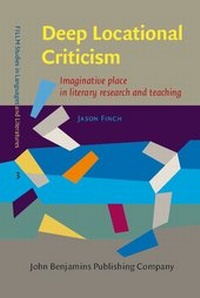
Deep Locational Criticism
Imaginative place in literary research and teaching
1st Edition
Published on 15. March 2016
XIII, 240 pages
978-90-272-6726-9 (ISBN)
Description

A lively series of spatial turns in literary studies since the 1990s give rise to this engaged and practical book, devoted to the question of how to teach and study the relationship between all sorts of literature and all sorts of location. Among the many concrete examples explored are texts created between the early seventeenth and the early twenty-first centuries, in genres ranging from stage drama and lyric poetry to television, by way of several studies of fiction definable in a broad way as realist. Writers and thinkers discussed include Michel de Certeau, Edward Casey, Gwendolyn Brooks, Christina Rossetti, Dickens, J. Hillis Miller, Lynne Reid Banks, Heidegger, Shakespeare, Thomas Middleton, Thomas Dekker, Stephen C. Levinson, Bernard Malamud, E.M. Forster, Thomas Burke and Samuel Beckett. The approach draws on the philosophical topology of Jeff Malpas as a way of getting to grips with the experiential qualities of located lives as they are recorded and constructed discursively. The book is aimed at students and teachers of literary place at all university levels.
More details
Other editions
Additional editions
Book
03/2016
John Benjamins Publishing Co
€100.70
Shipment within 10-15 days
Person
Content
- Intro
- Deep Locational Criticism
- Editorial page
- Title page
- LCC data
- Table of contents
- Series editor's preface
- Acknowledgements
- List of images and maps
- 1. Introduction
- A distinctive activity
- Organization of the work
- Preliminaries
- Place versus space? Casey and Certeau
- Contextualism and meta-contextualism
- Fascism and the problem of place
- Working principles
- Inside and outside texts
- Interactivity, interdependence and the lived body
- Scale, limits, technologies
- Topographic not synoptic
- Place first
- Not two but three
- Terminology
- The landscape alternative
- The case for location
- Imaginative place
- Experience
- Methodology
- A triad
- Zooming
- Scholarly, creative and cartographic resources
- Summing up
- 2. Applications in research and pedagogy
- Locating two poets
- Gwendolyn Brooks in "Bronzeville" and Chicago
- Christina Rossetti in London
- The intratextual landscape of a single work of literature: Bleak House
- Hillis Miller and Dickens: A study in topographic criticism
- Mapping novels in the head
- A line running down through England
- Two pedagogic forays into the decayed inner city
- A Fulham novel: Photographs and cultural difference
- 39.289372°N, 76.646848°W: The Imaginative Place Project
- Conclusion
- 3. The Heideggerian fourfold and a Shakespeare play
- Reclaiming Heidegger for literary studies
- Mysticism, fascism and deconstruction
- Literature, art and interaction
- The fourfold of Henry IV, Part Two
- Conclusion: Multiple temporalities, multiple fourfolds
- 4. The precise spot occupied by a Renaissance playhouse
- Theatre and thing
- Afterlives and repeated returns
- The Roaring Girl on London's peripheries
- A guide for the provincial gallant?
- Liberties, fields, suburbs and beyond
- The intermediate fortune
- Time travel
- Conclusion: Context and space revisited
- 5. Spatial deixis and a single story
- Levinson's neo-Whorfian linguistics
- Context and the thing
- Frames of reference in "The Letter"
- Extra-textual reference: Long Island
- Paths of reading
- 6. Technology and toponym in a canonized novel
- Electronic maps and cosmopolitanism
- Placing Forster's Abinger Hammer: Online maps and legwork
- Mapping Chapter 19 of Howards End with toponyms
- The potential of literary GIS
- 7. An imaginative place: The East End of London
- Repeated returns to the East End
- Plotting the shifting East End
- Stages on one road: Gissing, Shaw, Morrison
- Going too far? Thomas Burke and the ethics of slum fiction
- The East End after Burke
- Second stab
- 8. Anti-place and multiple place in Beckett
- Placed and unplaced writing?
- London toponyms in Murphy: A board-game world
- The madhouse of Murphy: Anti-place re-placed
- Regions of "nameless things"
- Turning the telescope on the without: The "manywheres" of Endgame
- Conclusion: Toponyms, regions and categories of writer
- Afterword
- A-Z glossary of terms
- List of references
- Index
- Deep Locational Criticism
