

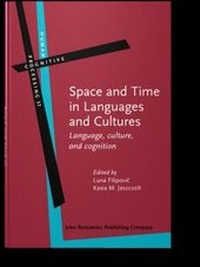
Space and Time in Languages and Cultures
Language, culture, and cognition
1st Edition
Published on 24. July 2012
XIII, 363 pages
978-90-272-7360-4 (ISBN)
Description

This is an interdisciplinary volume that focuses on the central topic of the representation of events, namely cross-cultural differences in representing time and space, as well as various aspects of the conceptualisation of space and time. It brings together research on space and time from a variety of angles, both theoretical and methodological. Crossing boundaries between and among disciplines such as linguistics, psychology, philosophy, or anthropology forms a creative platform in a bold attempt to reveal the complex interaction of language, culture, and cognition in the context of human communication and interaction.
The authors address the nature of spatial and temporal constructs from a number of perspectives, such as cultural specificity in determining time intervals in an Amazonian culture, distinct temporalities in a specific Mongolian hunter community, Russian-specific conceptualisation of temporal relations, Seri and Yucatec frames of spatial reference, memory of events in space and time, and metaphorical meaning stemming from perception and spatial artefacts, to name but a few themes.
The topic of space and time in language and culture is also represented, from a different albeit related point of view, in the sister volume Space and Time in Languages and Cultures: Linguistic diversity (HCP 36) which focuses on the language-specific vis-à-vis universal aspects of linguistic representation of spatial and temporal reference.
The authors address the nature of spatial and temporal constructs from a number of perspectives, such as cultural specificity in determining time intervals in an Amazonian culture, distinct temporalities in a specific Mongolian hunter community, Russian-specific conceptualisation of temporal relations, Seri and Yucatec frames of spatial reference, memory of events in space and time, and metaphorical meaning stemming from perception and spatial artefacts, to name but a few themes.
The topic of space and time in language and culture is also represented, from a different albeit related point of view, in the sister volume Space and Time in Languages and Cultures: Linguistic diversity (HCP 36) which focuses on the language-specific vis-à-vis universal aspects of linguistic representation of spatial and temporal reference.
More details
Other editions
Additional editions
Luna Filipovic | Katarzyna M. Jaszczolt
Space and Time in Languages and Cultures
Language, culture, and cognition
Book
07/2012
John Benjamins Publishing Co
€100.70
Shipment within 10-15 days
Persons
Content
Editors and contributors
Foreword: Space and time in languages, cultures, and cognition
Kasia M. Jaszczolt and Luna Filipovic
Introduction: Linguistic, cultural, and cognitive approaches to space and time
Luna Filipovic and Kasia M. Jaszczolt
Part I. Linguistic and conceptual representation of events
1. Event-based time intervals in an Amazonian culture
Vera da Silva Sinha, Chris Sinha, Wany Sampaio and Jörg Zinken
2. Vagueness in event times: An epistemic solution
Minyao Huang
3. Aspectual coercions in content composition
Nicholas Asher and Julie Hunter
4. Back to the future: Just where are forthcoming events located?
Alan M. Wallington
Part II. Cultural perspectives on space and time
5. The "Russian" attitude to time
Valentina Apresjan
6. Two temporalities of the Mongolian wolf hunter
Bernard Charlier
7. Koromu temporal expressions: Semantic and cultural perspectives
Carol Priestley
8. Universals and specifics of 'time' in Russian
Anna Gladkova
Part III. Conceptualizing spatio-temporal relations
9. Linguistic manifestations of the space-time (dis)analogy
Ronald W. Langacker
10. Vectors and frames of reference: Evidence from Seri and Yucatec
Jürgen Bohnemeyer and Carolyn O'Meara
11. Verbal and gestural expression of motion in French and Czech
Katerina Fibigerová, Michèle Guidetti and Lenka Sulová
12. Language-specific effects on lexicalisation and memory of motion events
Luna Filipovic and Sharon Geva
13. Space and time in episodic memory: Philosophical and developmental perspectives
James Russell and Jonathan Davies
14. Conceptualizing the present through construal aspects: The case of the English temporal constructions
Grzegorz Drozdz
15. From perception of spatial artefacts to metaphorical meaning
Marlene Johansson Falck
Contents of the companion volume: Linguistic diversity
Name index
Foreword: Space and time in languages, cultures, and cognition
Kasia M. Jaszczolt and Luna Filipovic
Introduction: Linguistic, cultural, and cognitive approaches to space and time
Luna Filipovic and Kasia M. Jaszczolt
Part I. Linguistic and conceptual representation of events
1. Event-based time intervals in an Amazonian culture
Vera da Silva Sinha, Chris Sinha, Wany Sampaio and Jörg Zinken
2. Vagueness in event times: An epistemic solution
Minyao Huang
3. Aspectual coercions in content composition
Nicholas Asher and Julie Hunter
4. Back to the future: Just where are forthcoming events located?
Alan M. Wallington
Part II. Cultural perspectives on space and time
5. The "Russian" attitude to time
Valentina Apresjan
6. Two temporalities of the Mongolian wolf hunter
Bernard Charlier
7. Koromu temporal expressions: Semantic and cultural perspectives
Carol Priestley
8. Universals and specifics of 'time' in Russian
Anna Gladkova
Part III. Conceptualizing spatio-temporal relations
9. Linguistic manifestations of the space-time (dis)analogy
Ronald W. Langacker
10. Vectors and frames of reference: Evidence from Seri and Yucatec
Jürgen Bohnemeyer and Carolyn O'Meara
11. Verbal and gestural expression of motion in French and Czech
Katerina Fibigerová, Michèle Guidetti and Lenka Sulová
12. Language-specific effects on lexicalisation and memory of motion events
Luna Filipovic and Sharon Geva
13. Space and time in episodic memory: Philosophical and developmental perspectives
James Russell and Jonathan Davies
14. Conceptualizing the present through construal aspects: The case of the English temporal constructions
Grzegorz Drozdz
15. From perception of spatial artefacts to metaphorical meaning
Marlene Johansson Falck
Contents of the companion volume: Linguistic diversity
Name index
