

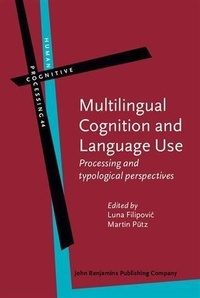
Multilingual Cognition and Language Use
Processing and typological perspectives
1st Edition
Published on 10. June 2014
X, 337 pages
978-90-272-7028-3 (ISBN)
Description

This volume provides a multifaceted view of certain key themes in multilingualism research today and offers future directions for this research area in the context of the multilingual development of individuals and societies. The selection of studied languages is eclectic (e.g. Amondawa, Cantonese, Bulgarian, Dene, Dutch, Eipo, Frisian, German, Mandarin Chinese, Maori, Russian, Spanish, and Yukatek, among others), they are typologically diverse, and they are contrasted from a variety of perspectives, such as cognitive development, aging, acquisition, grammatical and lexical processing, and memory. This collection also illustrates novel insights into the linguistic relativity debate that multilingual studies can offer, such as new and revealing perspectives on some well-known topics (e.g. colour categorisation or language transfer). The critical and comprehensive discussions of theoretical and methodological considerations presented in this volume are fundamental for numerous current, future, empirical and interdisciplinary studies of linguistic diversity, linguistic typology, and multilingual processing.
More details
Other editions
Additional editions
Luna Filipovic | Martin Puetz
Multilingual Cognition and Language Use
Processing and typological perspectives
Book
06/2014
John Benjamins Publishing Co
€100.70
Shipment within 10-15 days
Persons
Content
- Multilingual Cognition and Language Use
- Editorial page
- Title page
- LCC data
- Table of contents
- Editors and contributors
- Foreword: Multilingual cognition and language use
- Introduction: Understanding multilingualism
- 1. Preliminary remarks
- 2. Defining multilingualism and its core themes
- 3. Multilingualism in the mind
- 4. Multilingualism research and its place in the universality/relativity debate
- 5. The present volume
- 6. Future explorations
- References
- Part I. Multilingual contrasts: Interfaces and integrations
- Methodological approaches in the study of linguistic relativity
- 1. Introduction
- 2. Identifying and characterizing a relevant language contrast
- 3. Articulating and assessing related patterns in cognitive activity
- 3.1 Articulating a cognitive prediction based on language patterns
- 3.2 Assessing for the presence of predicted cognitive patterns
- 3.3 Addressing concerns about language interference
- 4. Establishing the shaping role of language
- 4.1 Internal assessment design
- 4.2 Comparative studies with additional languages
- 4.3 Developmental studies with children
- 4.4 Studies with second language learners
- 5. Conclusion
- References
- Frequency of use and basic vocabulary
- 1. Introduction
- 2. Data and methods
- 3. Comparison: Swadesh-200, Swadesh-100 and the Leipzig-Jakarta list
- 4. Deviations from the general correlations
- 5. Discussion
- 5.1 Why might we expect deviation in the data?
- 5.2 General remarks regarding the overall correlation and its implications
- 6. Conclusion
- References
- Appendix 1
- Appendix 2
- Appendix 3
- A contrastive study of colour terms in French and German causal constructions
- 1. Introduction
- 2. Previous research on colour terms
- 3. Theoretical and methodological framework
- 3.1 Causal constructions
- 3.2 Conceptual metonymy and metaphor
- 3.3 Typological differences
- 4. Contrastive study of causal constructions in French and German
- 4.1 Differences in frequency
- 4.2 Differences in connotation
- 5. Conclusions
- References
- Corpora
- Compound verbs in English and Bulgarian and the relativity debate
- 1. Introduction
- 2. Revisiting the culture-cognition-language interface
- 2.1 The inheritance
- 2.2 How words and word-formation relate to language and cognition
- 2.3 The place and role of compound verbs
- 3. The nature and status of compound verbs in English and Bulgarian
- 4. The ergative cryptotype
- 5. Conclusions
- References
- HERE, NEAR, FAR Spatial conceptualisation and cognition in a cross-linguistic perspective
- 1. Introduction
- 2. Theoretical background: The Natural Semantic Metalanguage
- 3. 'Here', 'near', and 'far' concepts in Russian and English
- 3.1 'Here'-concepts in Russian and English
- 3.2 'Near'-concepts in Russian and English
- 3.3 'Far' in Russian and English
- 4. Conclusions
- References
- Cognitive maps of landmark orientation
- 1. Introduction
- 2. Theoretical issues
- 2.1 Cognitive maps
- 2.2 Cognitive maps of landmarks for orientation and navigation
- 3. Anthropological background: Dene Chipewyan
- 3.1 Physical environment of the Dene Chipewyan people
- 3.2 Anthropological background: Eipomek
- 4. Natural limitations by landmarks in Eipo and Dene
- 4.1 Cognitive maps of landmark orientation in Eipomek
- 4.2 Cognitive maps of landmark orientation in Dene Chipewyan
- 5. Conclusion
- References
- Is space-time metaphorical mapping universal? Time for a cultural turn
- 1. Time and space in world, mind, and language
- 2. Concepts of time in history and culture
- 2.1 The Clock and the Calendar
- 2.2 Time interval systems, "passage", and space-time metaphor
- 2.3 Time in the Amondawa language
- 3. Concluding reflections
- References
- Part II. Bilingual processing: Language representation and language use
- Efficiency of the bilingual mind
- 1. Introduction
- 2. Efficiency as the driving force
- 3. Words and beyond: Storage and activation
- 4. Bilingual syntax(es?)
- 5. See, say, and store: Language-memory synergy in bilinguals
- 6. Harnessing efficiency in second language acquisition
- 7. Conclusion
- References
- About phonological, grammatical, and semantic accents in bilinguals' language use and their cause
- 1. Introduction
- 2. Parallel activation in bilingual memory
- 2.1 Parallel activation in bilingual word recognition
- 2.2 Parallel activation in bilingual word production
- 3. Accents in bilinguals' language use
- 3.1 Phonological accents
- 3.2 Grammatical accents
- 3.3 Semantic accents
- 4. Conclusion
- References
- Aging and bilingual processing: Age-related and individual differences in groups of early bilingual
- 1. Introduction
- 2. Verbal production and verbal fluency
- 3. Bilingualism and executive control
- 4. Language background and language use
- 5. Methodology
- 5.1 Participants
- 5.2 Procedure, general
- 6. Results
- 7. Discussion and conclusion
- References
- L1-based prototypicality effects in L2 vocabulary learning
- 1. Introduction
- 2. Working hypothesis and experiment design
- 2.1 Experiment 1: Normative study - identification of cultural variations in prototypicality
- 2.2 Experiment 2: A no-cued English-word-learning and immediate cued-recall task
- 3. Discussion
- 4. Conclusion
- References
- Finding a wooden jandal in the jandal wood
- 1. Introduction: The bilingual language mode
- 2. Previous research on bilingual transfer in compounding
- 3. Methodology of data elicitation and analysis
- 3.1 Nominal compounds in Maori and English
- 3.2 Task design and participants
- 3.3 Data analysis
- 4. Results
- 5. Discussion
- 6. Conclusion
- References
- Appendix
- Name index
- Subject index
- Language index
