

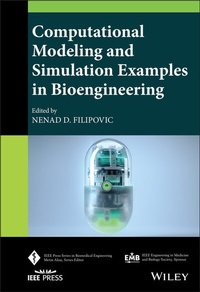
Computational Modeling and Simulation Examples in Bioengineering
Description

Computational Modeling and Simulation Examples in Bioengineering provides a comprehensive introduction to the emerging field of bioengineering. It provides the theoretical background necessary to simulating pathological conditions in the bones, muscles, cardiovascular tissue, and cancers, as well as lung and vertigo disease. The methodological approaches used for simulations include the finite element, dissipative particle dynamics, and lattice Boltzman. The text includes access to a state-of-the-art software package for simulating the theoretical problems. In this way, the book enhances the reader's learning capabilities in the field of biomedical engineering.
The aim of this book is to provide concrete examples of applied modeling in biomedical engineering. Examples in a wide range of areas equip the reader with a foundation of knowledge regarding which problems can be modeled with which numerical methods. With more practical examples and more online software support than any competing text, this book organizes the field of computational bioengineering into an accessible and thorough introduction. Computational Modeling and Simulation Examples in Bioengineering:
* Includes a state-of-the-art software package enabling readers to engage in hands-on modeling of the examples in the book
* Provides a background on continuum and discrete modeling, along with equations and derivations for three key numerical methods
* Considers examples in the modeling of bones, skeletal muscles, cartilage, tissue engineering, blood flow, plaque, and more
* Explores stent deployment modeling as well as stent design and optimization techniques
* Generates different examples of fracture fixation with respect to the advantages in medical practice applications
Computational Modeling and Simulation Examples in Bioengineering is an excellent textbook for students of bioengineering, as well as a support for basic and clinical research. Medical doctors and other clinical professionals will also benefit from this resource and guide to the latest modeling techniques.
More details
Other editions
Additional editions

Person
NENAD D. FILIPOVIC, PhD, is a Professor in the Faculty of Engineering and Head of the Center for Bioengineering at the University of Kragujevac, Serbia. He also leads national and international projects in bioengineering and software development, including joint research projects with Harvard University and the University of Texas. He is a Managing Editor for the Journal of the Serbian Society for Computational Mechanics and a member of IEEE, European Society of Biomechanics (ESB).
Content
Editor Biography xi
Author Biographies xii
Preface xv
1 Computational Modeling of Abdominal Aortic Aneurysms 1
Nenad D. Filipovic
1.1 Background 1
1.2 Clinical Trials for AAA 2
1.3 Computational Methods Applied for AAA 3
1.4 Experimental Testing to Determine Material Properties 6
1.5 Material Properties of the Aorta Wall 8
1.6 ILT Modeling 9
1.7 Finite Element Procedure and Fluid-Structure Interaction 12
1.7.1 Displacement Force Calculations 12
1.7.2 Shear Stress Calculation 13
1.7.3 Modeling the Deformation of Blood Vessels 13
1.7.4 FSI Interaction 15
1.8 Data Mining and Future Clinical Decision Support System 16
1.9 Conclusions 19
References 23
2 Modeling the Motion of Rigid and Deformable Objects in Fluid Flow 33
Tijana Djukic and Nenad D. Filipovic
2.1 Introduction 33
2.2 Numerical Model 35
2.2.1 Modeling Blood Flow 36
2.2.2 Modeling Solid-Fluid Interaction 40
2.2.2.1 Modeling the Motion of Rigid Particle 42
2.2.2.2 Modeling the Motion of Deformable Particle 45
2.2.3 Modeling Deformation of the Particle 46
2.2.3.1 Force Caused by the Surface Strain of Membrane 47
2.2.3.2 Force Caused by the Bending of the Membrane 51
2.2.3.3 Force Caused by the Change of Surface area of the Membrane 51
2.2.3.4 Force Caused by the Change of Volume 52
2.2.4 Modeling the Flow of Two Fluids with Different Viscosity that are Separated by the Membrane of the Solid 52
2.3 Results 54
2.3.1 Modeling the Behavior of Particles in Poiseuille Flow 55
2.3.2 Modeling the Behavior of Particles in Shear Flow 57
2.3.3 Modeling Behavior of Particles in Stenotic Artery 74
2.3.4 Modeling Behavior of Particles in Artery with Bifurcation 77
2.4 Conclusion 81
References 82
3 Application of Computational Methods in Dentistry 87
Ksenija Zelic Mihajlovic, Arso M. Vukicevic, and Nenad D. Filipovic
3.1 Introduction 87
3.2 Finite Element Method in Dental Research 88
3.2.1 Development of FEM in Dental Research 89
3.2.1.1 Morphology and Dimensions of the Structures - Application of Digital Imaging Systems 90
3.2.1.2 FE Model - Required/Composing Structures 91
3.2.1.3 Simulating Occlusal Load 92
3.2.1.4 Boundary Conditions 94
3.2.1.5 Importance of Periodontal Ligament, Spongious, and Cortical Bone 95
3.2.2 Overview of FEM in Dental Research - Most Important Topics in the Period 2010-2020 96
3.2.2.1 FEM in the Research Related to Implants, Restorative Dentistry, and Prosthodontics 97
3.2.2.2 FEM in Analysis of Biomechanical Behavior of Structures in Masticatory Complex 101
3.2.2.3 FEM in Orthodontic Research 102
3.2.2.4 FEM in Studies of Trauma in the Dentoalveolar Region 103
3.3 Examples of FEA in Clinical Research in Dentistry 103
3.3.1 Example 1- Assessment of Critical Breaking Force and Failure Index 104
3.3.1.1 Background 104
3.3.1.2 Materials and Methods 104
3.3.1.3 Results and Discussion 111
3.3.2 Example 2 - Assessment of the Dentine Fatigue Failure 118
3.3.2.1 Background 118
3.3.2.2 Materials and Methods 119
3.3.2.3 Results and Discussion 124
References 131
4 Determining Young's Modulus of Elasticity of Cortical Bone from CT Scans 141
Aleksandra Vulovic and Nenad D. Filipovic
4.1 Introduction 141
4.2 Bone Structure 143
4.3 Young's Modulus of Elasticity of Bone Tissue 145
4.3.1 Factors Influencing Elasticity Modulus 145
4.3.2 Experimental Calculation of Elasticity Modulus 146
4.4 Tool for Calculating the Young's Modulus of Elasticity of Cortical Bone from CT Scans 151
4.4.1 Theoretical Background 151
4.4.2 Practical Application 152
4.5 Numerical Analysis of Femoral Bone Using Calculated Elasticity Modulus 157
4.5.1 Femoral Bone Model 157
4.5.2 Material Properties 159
4.5.3 Boundary Conditions 159
4.5.4 Obtained Results 161
4.5.4.1 Case 1 165
4.5.4.2 Case 2 165
4.5.4.3 Case 3 166
4.5.4.4 Comparison of the Obtained Results 166
4.6 Conclusion 169
Acknowledgements 169
References 170
5 Parametric Modeling of Blood Flow and Wall Interaction in Aortic Dissection 175
Igor B. Saveljic and Nenad D. Filipovic
5.1 Introduction 175
5.2 Medical Background 177
5.2.1 Circulatory System 177
5.2.2 Aorta 178
5.2.3 Structure and Function of the Arterial Wall 179
5.2.4 Aortic Dissection 181
5.2.5 History of Aortic Dissection 182
5.2.6 Classification of Aortic Dissection 182
5.2.7 Diagnostic Techniques 185
5.2.7.1 Aortography 185
5.2.7.2 Computed Tomography 185
5.2.7.3 Echocardiography 186
5.2.7.4 Magnetic Resonance 186
5.2.7.5 Intravascular Ultrasound 187
5.2.8 Treatment of Acute Aortic Dissection 187
5.2.8.1 Drug Therapy 187
5.2.8.2 Surgical Treatment 188
5.3 Theoretical Background 189
5.3.1 Continuum Mechanics 189
5.3.1.1 Lagrange and Euler's Formulation of the Material Derivative 189
5.3.1.2 Law of Conservation of Mass 191
5.3.1.3 Navier-Stokes Equations 192
5.3.1.4 Equations of Solid Motion 193
5.3.2 Solid-Fluid Interaction 196
5.4 Blood Flow in the Arteries 196
5.4.1 Stationary Flow 197
5.4.2 Oscillatory (Pulsating) Flow 198
5.4.3 Flow in Curved Pipes 199
5.4.4 Blood Flow in Bifurcations 200
5.5 Numerical Simulations 201
5.6 Conclusions 213
References 213
6 Application of AR Technology in Bioengineering 219
Dalibor D. Nikolic and Nenad D. Filipovic
6.1 Introduction 219
6.2 Review of AR Technology 220
6.2.1 Augmented Reality Devices 220
6.2.2 AR Screen Based on the Monitor 221
6.2.3 AR Screen Based on Mobile Devices 221
6.2.4 Head Mounting Screen 221
6.2.5 AR in Biomedical Engineering 224
6.3 Marker-based AR Simple Application, Based on the OpenCV Framework 227
6.3.1 Generating ArUco Markers in OpenCV 229
6.4 Marker-less AR Simple Application, Based on the OpenCV Framework 235
6.4.1 Use Feature Descriptors to Find the Target Image in a Video 236
6.4.2 Calculating the Camera-intrinsic Matrix 247
6.4.3 Rendering AR with a Simple OpenGL Object (Cube) 250
6.5 Conclusion 255
References 255
7 Augmented Reality Balance Physiotherapy in HOLOBALANCE Project 259
Nenad D. Filipovic and Zarko Milosevic
7.1 Introduction 259
7.2 Motivation 261
7.3 Holograms-Based Balance Physiotherapy 265
7.4 Mock-ups 265
7.4.1 Meta 2 266
7.4.2 HoloLens 268
7.4.3 Holobox 270
7.4.4 Modeling of BP in Unity 3D 272
7.5 Final Version 273
7.5.1 Balance Physiotherapy Hologram (BPH) 278
7.5.2 BPH-MCWS Communication 279
7.5.3 Speech Recognition 286
7.5.4 Localization 288
7.5.5 Motion Capturing 288
7.5.6 Marker-less Motion Capture 289
7.5.7 Marker-based Motion Capture 290
7.5.8 Optical Systems 291
7.5.9 World Tracking 291
7.6 Biomechanical Model of Avatar Based on the Muscle Modeling 295
7.6.1 Muscle Modeling 298
References 301
8 Modeling of the Human Heart - Ventricular Activation Sequence and ECG Measurement 305
Nenad D. Filipovic
8.1 Introduction 305
8.2 Materials and Methods 307
8.2.1 Material Model Based on Holzapfel Experiments 309
8.2.2 Biaxial Loading: Experimental Curves 309
8.3 Determination of Stretches in the Material Local Coordinate System 310
8.4 Determination of Normal Stresses from Current Stretches 313
8.4.1 Determination of Shear Stresses from Current Shear Strains 314
8.5 Results and Discussion 316
8.6 Conclusion 317
Acknowledgements 320
References 320
9 Implementation of Medical Image Processing Algorithms on FPGA Using Xilinx System Generator 323
Tijana I. suSterSic¿ and Nenad D. Filipovic
9.1 Brief Introduction to FPGA 323
9.1.1 Xilinx System Generator 325
Algorithm Exploration 326
Implementing Part of a Larger Design 327
Implementing a Complete Design 327
9.1.2 Image Processing on FPGAs Using XSG 327
9.2 Building a Simple Model Using XSG 329 Prerequisites 330
9.3 Medical Image Processing Using XSG 334
9.3.1 Image Pre- and Post-Processing 334
9.3.2 Algorithms for Image Preprocessing 335
9.3.2.1 Algorithm for Negative Image 335
9.3.2.2 Algorithm for Image Contrast Stretching 337
9.3.2.3 Image Edge Detection 337
9.3.3 Hardware Co-Simulation 351
9.4 Results and Discussion 352
9.5 Conclusions 359
Acknowledgments 359
References 360
Index 363
1
Computational Modeling of Abdominal Aortic Aneurysms
Nenad D. Filipovic1,2
1Faculty of Engineering, University of Kragujevac, Kragujevac, Serbia
2Bioengineering Research and Development Center, BioIRC, Kragujevac, Serbia
1.1 Background
Abdominal aortic aneurysm (AAA) is a dilation of the aorta beyond 50% of the normal vessel diameter [1] that is frequently observed in the aging population [2] and it affects 6-9% of the people in the industrialized world. It is a major health problem that typically affects men after the age of 50 [3] and it is the thirteenth leading cause of death in Western societies [4]. AAAs cause about 15 000 deaths per year in the United States only [5], and 1.3% of all deaths among men aged 65-85 years in developed countries [6-8]. In the United States alone, 1.5 million have undiagnosed AAAs [3]. They can remain asymptomatic for most of their development and, if left untreated, they can enlarge and eventually rupture with catastrophic mortality rate of 80% [9] to 90% [2]. On the other hand, the mortality following elective AAA repair has significantly improved to 3-6% [10] which clearly demonstrates the need of diagnosing and monitoring AAAs on time in order to make progress in both medical and economic domain.
A myriad of different factors are established in the literature to account for AAA formation, expansion, and, eventually, rupture. Namely, a substantial amount of research on AAA expansion and rupture focuses on different biological and biomechanical factors and, lately, special attention is put to genes and chemical influences. Among biological factors and risk factors, authors usually discuss the influence of diameter, sex, blood pressure, chronic obstructive pulmonary disease, and smoking [11]. From a biomechanical point of view, major factors contributing to AAA expansion and rupture are the wall stress [12, 13] and strength [14], wall stiffness [15], vessel asymmetry [16-19], intraluminal thrombus (ILT) [20, 21], entire geometry [22, 23], etc. Namely, according to the biomechanical perspective, AAA rupture is usually defined as a material failure of the degenerated AAA wall to withstand the stress exerted on it [24]. However, the relationship between rupture and biomechanics of aorta proved to be more complex [10] and the evaluation based only on one of these parameters is not sufficient.
For many years, diameter was taken to be the primary parameter associated with rupture risk estimation. Namely, the threshold of =5.5 cm3 was applied as indicative for AAA repair [10]. However, continuous studies in the past showed that while 10-24% of small aneurysms (<5.5 cm) may rupture [1], aneurisms which diameter exceeds the threshold remain stable. These findings cast doubt over the suitability of surgical repair based solely on the maximum diameter criterion [16-18]. In order to refute "diameter criterion" rule, many other criteria and parameters ensued. In contrast, the survey conducted in 2006 [25] confirmed that 92% of surgeons still use maximum diameter criterion and growth rate in making decisions about the surgical intervention while 19% of them stated that they were not even aware that biomechanics may influence the rupture risk. The results of the survey suggest that cooperation of surgeons and engineers is necessary in order not just to make technical advances but to implement them in practice.
Mutual collaboration of clinicians and engineers resulted in different efforts and methodologies proposed in the last few decades, all striving to make progress in the domain of AAA expansion and rupture prediction. This paper reviews some of the most significant studies in the area of AAA modeling in the past decades which further understanding of utmost importance for making additional progress toward validation and application in the clinical setting. We firstly described computational methods applied for AAA in chronological order. Then, different experimental testing as well as our own testing is described in order to determine the mechanical properties of AAA. Mechanical-chemical including ILT modeling is separately analyzed. Finite element procedure including fluid-structure interaction (FSI) from our group is described. In the end, some of data mining (DM) approach and vision for future clinical decision support system (DSS) is given.
1.2 Clinical Trials for AAA
The known risk factors for AAA include male sex, smoking, hypertension, and a family history of AAA in a first-degree relative [26]. Many clinical studies confirmed that smoking is the most important modifiable risk factor for AAA [27-33]. Some authors discovered that the duration of smoking and daily cigarette number are also associated with a higher risk of AAA [28, 34]. One large systematic review of studies evaluating smoking and aortic aneurysm placed the relative risk of aortic aneurysm-related events in current smokers between 3 and 6 [34]. Smoking contributes significantly to the prevalence of AAA and may account for 75% of all AAA, 4 cm in diameter or larger [33].
A history of hypertension and myocardial infarction or coronary artery bypass surgery was negatively associated, whereas a body mass index =25 kg/m2 was protective [35].
1.3 Computational Methods Applied for AAA
The study of Darling et al. [36] was one of the first studies to conclude that AAA rupture predominately occurs on posterior walls. Namely, in the autopsy study conducted almost 40 years ago on AAA patients, among whom 473 died with surgically intact arteriosclerotic AAAs, it was reported that 82% of ruptures occurred along the posterior and posteriolateral wall of AAA. Consequently, it was important to examine the wall stress acting on these regions in AAA, so that many studies were influenced to direct their research toward examining posterior wall stress for clinical relevance. One of the first studies to apply the finite element analysis (FEA) to determine the AAA wall stress was the study of [37] who concluded that FEA has a potential of becoming a crucial tool in the study of vascular mechanics. Their study was followed by extensive research in the area of numerically predicted AAA wall stress that continues even at present. However, limitations of this study include the use of idealized models with regular structures and evenly distributed wall stress.
In 1998, Vorp et al. [38] published a study on the influence of maximum diameter and aortic aneurysm asymmetry on mechanical wall stress. They investigated the effects of asymmetry on 3D stress distribution in the wall of AAA and refuted the critical diameter criterion suggesting that all AAAs with the same diameter have the same risk of rupture. They generated 10 virtual computer models with commercial software (Pro-Engineer v. 16.0; Parametric Technology Waltham, Mass) according to two protocols. In the first protocol, five models were generated with constant maximum diameter parameter (6 cm) while asymmetry ß varied from 0.3 to 1.0. In the second protocol, asymmetry was kept constant ß = 0.4 while maximum diameter parameter varied from 4 to 8 cm. The results confirmed that both parameters had the influence on the increase and decrease in the wall stress in the different sections of the aneurisms and that aneurysm rupture was caused by a gross mechanical failure of the aortic wall which occurs when wall stress exceeds the strength of the tissue. It was also concluded that maximum stress occurs on the posterior wall for small AAAs (=5), while for larger AAAs peak stress is on the anterior surface. Although it pioneered in proving the effects of asymmetry, the study was performed on virtual models, so potential limitations assuming that AAA wall is homogenous, isotropic, and linearly elastic with small strains and uniform thickness have to be taken into account when analyzing real AAA models.
Venkatasubramaniam et al. [10] refuted traditional views that relate aneurysm size to the risk of rupture. They conducted a comparative study of aortic wall stress in ruptured and non-ruptured aneurysms with an aim to prove the importance of wall stress when predicting the risk of rupture in individual patients. Namely, the study included computed tomography (CT) scans of 27 patients (12 ruptured and 15 non-ruptured AAA), predominantly males. Using the finite element method, they calculated wall stress using the geometry of AAA, the material properties of the aortic wall, and the forces and constraints acting on the wall. The material properties were used from a previously validated mathematical model by [39-41]. ANSYS 6.1 program (ASN Systems Ltd, Cannonsburg, USA) was utilized for the analysis and post-processing while the von Mises stress was used to evaluate the state of the aneurysms. There were no important differences in the mean diameter between two groups (6.8 cm for non-ruptured and 7.6 cm for ruptured, P > 0.1) and there were two aneurysms that ruptured at small diameters of 5.0 and 5.7 cm. The authors concluded that AAA that ruptured or went on to rupture had significantly higher peak stress (mean 1.02 MPa) compared with non-ruptured (mean...
