

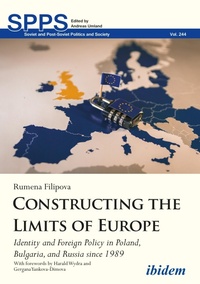
Constructing the Limits of Europe
Identity and Foreign Policy in Poland, Bulgaria, and Russia since 1989
Published on 30. April 2022
496 pages
978-3-8382-7649-6 (ISBN)
Description

This comparative study harks back to the revolutionary year of 1989 and asks two critical questions about the resulting reconfiguration of Europe in the aftermath of the collapse of communism: Why did Central and East European states display such divergent outcomes of their socio-political transitions? Why did three of those states-Poland, Bulgaria, and Russia-differ so starkly in terms of the pace and extent of their integration into Europe?
Rumena Filipova argues that Poland's, Bulgaria's, and Russia's dominating conceptions of national identity have principally shaped these countries' foreign policy behavior after 1989. Such an explanation of these three nations' diverging degrees of Europeanization stands in contrast to institutionalist-rationalist, interest-based accounts of democratic transition and international integration in post-communist Europe.
She thereby makes a case for the need to include ideational factors into the study of International Relations and demonstrates that identities are not easily malleable and may not be as fluid as often assumed. She proposes a theoretical "middle-ground" argument that calls for "qualified post-positivism" as an integrated perspective that combines positivist and post-positivist orientations in the study of IR.
Reviews / Votes
"A forensic account of varying Eastern and Central European perspectives on the process of Euro-Atlantic integration in post-communist Europe since 1989 with a particular focus on Poland, Bulgaria, and Russia. The book is an innovative and, in many respects, cautionary tale, reminding that the tortuous process of integration depended on long-term culturally and historically embedded attitudes and affinities-and therefore could not start from scratch."-Neil MacFarlane, Lester B Pearson Professor of International Relations, University of OxfordMore details
Series
Edition
New edition
Language
English
Place of publication
Hannover
Germany
Target group
Professional and scholarly
Edition type
New edition
Illustrations
Illustrations
File size
5,56 MB
ISBN-13
978-3-8382-7649-6 (9783838276496)
Copyright in bibliographic data and cover images is held by Nielsen Book Services Limited or by the publishers or by their respective licensors: all rights reserved.
Schweitzer Classification
Other editions
Additional editions
Rumena Filipova
Constructing the Limits of Europe
Identity and Foreign Policy in Poland, Bulgaria, and Russia since 1989
Book
04/2022
ibidem
€49.90
Shipment within 10-15 days
Persons
Dr. Rumena Filipova studied Political Science and International Relations at Cambridge and Oxford. She is Chairperson and Co-Founder of the Institute for Global Analytics in Sofia. Previously, Filipova was a researcher at the Center for the Study of Democracy in Sofia; she also held visiting fellowships at the Carnegie Moscow Center, the Polish Institute of International Affairs in Warsaw, and the Center for Liberal Strategies in Sofia. Her books include Tackling Kremlin's Media Capture in Southeast Europe (Center for the Study of Democracy 2021), Countering Kremlin's Media Influence in Europe (Center for the Study of Democracy 2021), The Shrinking Space for Media Freedom in Southeast Europe in the Midst of COVID-19 Pandemic and State of Emergency (Konrad-Adenauer-Stiftung 2020).
Content
- Intro
- Acknowledgments
- Foreword
- Foreword
- 1 Central and Eastern Europe after the1989 Revolution. Diverging Identities in a Reunifying Era
- 2 Are the Social Sciences Indeed 'Sciences'? Towards a Middle-Ground Methodological Perspective
- 3 Shades of Affinity. An Interactive Constructivist Theory of Self and Other in Bordering Belongingness
- 4 The Interactive Constructivist Theory ofSelf & Other and IR Debates. Refinement, Dialogue and Challenge
- 5 A European Trailblazer. The Thick Europeanisation of Polish Foreign Policy
- 6 Neither In, Nor Out. The Ambivalent Europeanisation of Bulgarian Foreign Policy
- 7 Europe's Outlier. The Thin Europeanisation of Russian Foreign Policy
- 8 Three Limits of Europe. Poland, Bulgaria and Russia in Comparative Perspective
- Epilogue. Europe Beyond the 30-year Limit
- List of Abbreviations
- Bibliography
