

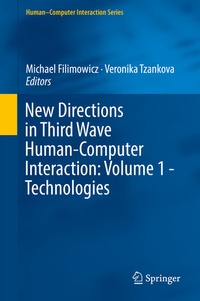
New Directions in Third Wave Human-Computer Interaction: Volume 1 - Technologies
Description

As the first extensive exploration of contemporary third wave HCI, this handbook covers key developments at the leading edge of human-computer interactions. Now in its second decade as a major current of HCI research, the third wave integrates insights from the humanities and social sciences to emphasize human dimensions beyond workplace efficiency or cognitive capacities. The earliest HCI work was strongly based on the concept of human-machine coupling, which expanded to workplace collaboration as computers came into mainstream professional use. Today HCI can connect to almost any human experience because there are new applications for every aspect of daily life.
Volume 1 - Technologies covers technical application areas related to artificial intelligence, metacreation, machine learning, perceptual computing, 3D printing, critical making, physical computing, the internet of things, accessibility, sonification, natural language processing, multimodal display, andvirtual reality.
More details
Other editions
Additional editions
Persons
Veronika Tzankova is a PhD candidate in SIAT, having previously gained her MA in the same program. Her Masters research was in the areas of interactive technologies within contexts of social appropriation and democratic inclusiveness. Her current doctoral work is in the area of embodied cognition approaches to interaction design, with a focus on contact sports.
