

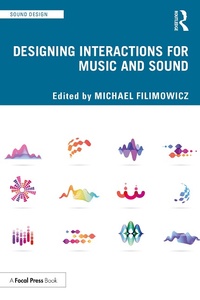
Designing Interactions for Music and Sound
1st Edition
Published on 19. April 2022
226 pages
978-1-000-57593-4 (ISBN)
Description

Designing Interactions for Music and Sound presents multidisciplinary research and case studies in electronic music production, dance-composer collaboration, AI tools for live performance, multimedia works, installations in public spaces, locative media, AR/VR/MR/XR and health.
As the follow-on volume to Foundations in Sound Design for Interactive Media, the authors cover key practices, technologies and concepts such as: classifications, design guidelines and taxonomies of programs, interfaces, sensors, spatialization and other means for enhancing musical expressivity; controllerism, i.e. the techniques of non-musician performers of electronic music who utilize MIDI, OSC and wireless technologies to manipulate sound in real time; artificial intelligence tools used in live club music; soundscape poetics and research creation based on audio walks, environmental attunement and embodied listening; new sound design techniques for VR/AR/MR/XR that express virtual human motion; and the use of interactive sound in health contexts, such as designing sonic interfaces for users with dementia.
Collectively, the chapters illustrate the robustness and variety of contemporary interactive sound design research, creativity and its many applied contexts for students, teachers, researchers and practitioners.
As the follow-on volume to Foundations in Sound Design for Interactive Media, the authors cover key practices, technologies and concepts such as: classifications, design guidelines and taxonomies of programs, interfaces, sensors, spatialization and other means for enhancing musical expressivity; controllerism, i.e. the techniques of non-musician performers of electronic music who utilize MIDI, OSC and wireless technologies to manipulate sound in real time; artificial intelligence tools used in live club music; soundscape poetics and research creation based on audio walks, environmental attunement and embodied listening; new sound design techniques for VR/AR/MR/XR that express virtual human motion; and the use of interactive sound in health contexts, such as designing sonic interfaces for users with dementia.
Collectively, the chapters illustrate the robustness and variety of contemporary interactive sound design research, creativity and its many applied contexts for students, teachers, researchers and practitioners.
More details
Series
Edition
1. Auflage
Language
English
Place of publication
London
United Kingdom
Publishing group
Taylor & Francis Ebooks
Target group
College/higher education
Professional and scholarly
Illustrations
27 Tables, black and white; 50 Line drawings, black and white; 6 Halftones, black and white; 56 Illustrations, black and white
ISBN-13
978-1-000-57593-4 (9781000575934)
Copyright in bibliographic data and cover images is held by Nielsen Book Services Limited or by the publishers or by their respective licensors: all rights reserved.
Schweitzer Classification
Other editions
Additional editions

Michael Filimowicz
Designing Interactions for Music and Sound
Book
04/2022
1st Edition
CRC Press
€206.30
Shipment within 15-20 days
Michael Filimowicz
Designing Interactions for Music and Sound
Book
04/2022
1st Edition
CRC Press
€74.30
Shipment within 15-20 days
Person
Michael Filimowicz is Senior Lecturer in the School of Interactive Arts and Technology (SIAT) at Simon Fraser University. He has a background in computer mediated communications, audiovisual production, new media art and creative writing. His research develops new multimodal display technologies and forms, exploring novel form factors across different application contexts including gaming, immersive exhibitions and simulations.
Content
List of Figures
List of Tables
Contributor Bios
Volume Introduction
Chapter 1: Designing Interactive Musical Interfaces by Dan Overholt
Chapter 2: Collective Controllerism: a Non-musician's Perspective of Interactive Dance as Controllerist Practice by Manoli Moriaty
Chapter 3: Compute and Resonate: Creating Electronic Music of the Acid Genre for Presentation within a Club Environment Utilizing Accessible Artificial Intelligence and Computer-based Generative Tools by Dylan Davis
Chapter 4: Sonic Poetics of the Tidal Flats by Prophecy Sun, Freya Zinovieff, Kristin Carlson and Reese Muntean
Chapter 5: Designing Sound Installations in Public Spaces: A Collaborative Research Creation Approach by Catherine Guastavino, Valerian Fraisse, Simone D'Ambrosio, Etienne Legast and Maryse Lavoie
Chapter 6: Embodied Listening within Geolocative Sonic Art by Jimmy Eadie
Chapter 7: Sound Mixed Reality Prompts for People with Dementia: a Familiar and Meaningful Experience by Shital Desai, Joel Ong, Deborah Fels and Arlene Astell
Chapter 8: Leveraging Motion and Conceptual Frameworks of Sound as a Novel Means of Sound Design in Extended Reality by Tom A. Garner.
Index
List of Tables
Contributor Bios
Volume Introduction
Chapter 1: Designing Interactive Musical Interfaces by Dan Overholt
Chapter 2: Collective Controllerism: a Non-musician's Perspective of Interactive Dance as Controllerist Practice by Manoli Moriaty
Chapter 3: Compute and Resonate: Creating Electronic Music of the Acid Genre for Presentation within a Club Environment Utilizing Accessible Artificial Intelligence and Computer-based Generative Tools by Dylan Davis
Chapter 4: Sonic Poetics of the Tidal Flats by Prophecy Sun, Freya Zinovieff, Kristin Carlson and Reese Muntean
Chapter 5: Designing Sound Installations in Public Spaces: A Collaborative Research Creation Approach by Catherine Guastavino, Valerian Fraisse, Simone D'Ambrosio, Etienne Legast and Maryse Lavoie
Chapter 6: Embodied Listening within Geolocative Sonic Art by Jimmy Eadie
Chapter 7: Sound Mixed Reality Prompts for People with Dementia: a Familiar and Meaningful Experience by Shital Desai, Joel Ong, Deborah Fels and Arlene Astell
Chapter 8: Leveraging Motion and Conceptual Frameworks of Sound as a Novel Means of Sound Design in Extended Reality by Tom A. Garner.
Index
