

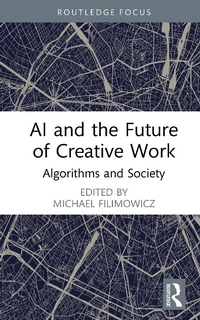
AI and the Future of Creative Work
Algorithms and Society
1st Edition
Published on 26. May 2023
112 pages
978-1-000-92478-7 (ISBN)
Description

This book focuses on the intelligent technologies that are transforming creative practices and industries.
The future of creative work will be more complicated than "the robots will take our jobs." The workplace is becoming increasingly hybridized, with human and computational labor complementing each other. Some economic roles for the former will no doubt fade over time, while new roles are created to produce artificial intelligence (AI)-related technologies and implementations for productivity. New tools for the generation and personalization of content across platforms will be as ubiquitous as the automation of repetitive tasks in content creation workflows. Cultural conceptions of what it means to be a creative worker will necessarily change as a result of these transformations in human-machine labor. The volume covers the possibilities of humans and robots developing collegial relationships, creative cybernetics as machines and artists become co-creators of art, the reconcentration of corporate power as AI transforms the music industry, the rhetoric of algorithm-driven cultural production in streaming media and how artisans provide a model of counter-hegemony to automation processes.
Scholars and students from many backgrounds, as well as policy makers, journalists and the general reading public, will find a multidisciplinary approach to questions posed by creative labor and industry research from communication, philosophy, robotics, media, music and the creative arts, informatics, information science, and computer science and engineering.
The future of creative work will be more complicated than "the robots will take our jobs." The workplace is becoming increasingly hybridized, with human and computational labor complementing each other. Some economic roles for the former will no doubt fade over time, while new roles are created to produce artificial intelligence (AI)-related technologies and implementations for productivity. New tools for the generation and personalization of content across platforms will be as ubiquitous as the automation of repetitive tasks in content creation workflows. Cultural conceptions of what it means to be a creative worker will necessarily change as a result of these transformations in human-machine labor. The volume covers the possibilities of humans and robots developing collegial relationships, creative cybernetics as machines and artists become co-creators of art, the reconcentration of corporate power as AI transforms the music industry, the rhetoric of algorithm-driven cultural production in streaming media and how artisans provide a model of counter-hegemony to automation processes.
Scholars and students from many backgrounds, as well as policy makers, journalists and the general reading public, will find a multidisciplinary approach to questions posed by creative labor and industry research from communication, philosophy, robotics, media, music and the creative arts, informatics, information science, and computer science and engineering.
More details
Series
Edition
1. Auflage
Language
English
Place of publication
London
United Kingdom
Publishing group
Taylor & Francis Ltd
Target group
Professional and scholarly
College/higher education
Illustrations
3 Line drawings, black and white; 3 Illustrations, black and white
ISBN-13
978-1-000-92478-7 (9781000924787)
Copyright in bibliographic data and cover images is held by Nielsen Book Services Limited or by the publishers or by their respective licensors: all rights reserved.
Schweitzer Classification
Other editions
Additional editions
Book
10/2024
1st Edition
Routledge
€32.70
Shipment within 10-20 days
Book
05/2023
1st Edition
Routledge
€77.40
Shipment within 10-20 days
Person
Michael Filimowicz is Senior Lecturer in the School of Interactive Arts and Technology (SIAT) at Simon Fraser University. He has a background in computer-mediated communications, audiovisual production, new media art and creative writing. His research develops new multimodal display technologies and forms, exploring novel form factors across different application contexts including gaming, immersive exhibitions and simulations.
Content
1 Can a Robot Be a (Good) Colleague?; 2 Creative Machine-Human Collaboration: Toward a Cybernetic Approach to Artificial Intelligence and Machine Learning Techniques in the Creative Arts; 3 Slave to the 'Rithm: The AI turn in the Music Industries; 4 A "New Economy" of Blockbusters? Netflix, Algorithms and the Narratives of Transformation in Audiovisual Capitalism; 5 Counter-hegemonic AI: The Role of Artisanal Identity in the Design of Automation for a Liberated Economy
