

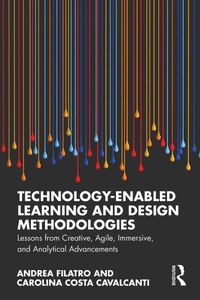
Technology-Enabled Learning and Design Methodologies
Lessons from Creative, Agile, Immersive, and Analytical Advancements
1st Edition
Published on 30. December 2024
242 pages
978-1-040-30307-8 (ISBN)
Description

Technology-Enabled Learning and Design Methodologies offers a comprehensive and example-rich guide to the latest technological and methodological advancements in education. This book systematically organizes a rich variety of educational innovations into four distinct groups of teaching-learning methodologies, each with its own focus and disruptive potential:
? Creative methodologies, centered on student protagonism and creativity, which shift the traditional roles in the teaching-learning process, empowering students to take an active, leading role in their education and encouraging creative thinking and expression.
? Agile methodologies, focused on time management and adaptability, which optimize students' time and attention through microlearning and other bite-sized content, activities, and assessments.
? Immersive methodologies, driven by simulated real-world scenarios, which blur the boundaries between learning environments and real-life contexts in order to immerse learners in challenging, story-driven environments linked to clear learning objectives.
? Analytical methodologies, based on computation power, which support personalized, adaptive, and evidence-based teaching and learning by collecting and processing student data.
Through a practical, dialogical approach, filled with visual resources and real-world examples, the authors provide solid theoretical foundations for their methodologies of focus, positioning them within a broader spectrum that goes beyond mere consumption of isolated techniques or technologies. This will be a relevant resource for current and aspiring instructional designers, educational technologists, subject matter experts, teaching faculty, researchers, and other stakeholders involved in face-to-face, distance, or hybrid education.
? Creative methodologies, centered on student protagonism and creativity, which shift the traditional roles in the teaching-learning process, empowering students to take an active, leading role in their education and encouraging creative thinking and expression.
? Agile methodologies, focused on time management and adaptability, which optimize students' time and attention through microlearning and other bite-sized content, activities, and assessments.
? Immersive methodologies, driven by simulated real-world scenarios, which blur the boundaries between learning environments and real-life contexts in order to immerse learners in challenging, story-driven environments linked to clear learning objectives.
? Analytical methodologies, based on computation power, which support personalized, adaptive, and evidence-based teaching and learning by collecting and processing student data.
Through a practical, dialogical approach, filled with visual resources and real-world examples, the authors provide solid theoretical foundations for their methodologies of focus, positioning them within a broader spectrum that goes beyond mere consumption of isolated techniques or technologies. This will be a relevant resource for current and aspiring instructional designers, educational technologists, subject matter experts, teaching faculty, researchers, and other stakeholders involved in face-to-face, distance, or hybrid education.
More details
Edition
1. Auflage
Language
English
Place of publication
London
United Kingdom
Publishing group
Taylor & Francis Ltd
Target group
College/higher education
Professional and scholarly
Illustrations
9 Tables, black and white; 11 Line drawings, black and white; 15 Halftones, black and white; 26 Illustrations, black and white
ISBN-13
978-1-040-30307-8 (9781040303078)
Copyright in bibliographic data and cover images is held by Nielsen Book Services Limited or by the publishers or by their respective licensors: all rights reserved.
Schweitzer Classification
Other editions
Additional editions
Andrea Filatro | Carolina Costa Cavalcanti
Technology-Enabled Learning and Design Methodologies
Lessons from Creative, Agile, Immersive, and Analytical Advancements
Book
12/2024
1st Edition
Routledge
€197.50
Shipment within 10-20 days
Andrea Filatro | Carolina Costa Cavalcanti
Technology-Enabled Learning and Design Methodologies
Lessons from Creative, Agile, Immersive, and Analytical Advancements
Book
12/2024
1st Edition
Routledge
€61.60
Shipment within 10-20 days

Andrea Filatro
Technology-Enabled Learning and Design Methodologies
Lessons from Creative, Agile, Immersive, and Analytical Advancements
Book
12/2024
Routledgetaylor & Francis Group
Unfortunately, price unknown
Available (delivery time upon request)
Persons
Andrea Filatro is Professor at Administration Institute Foundation, Brazil, as well as an independent consultant in distance and hybrid education for IDB (Inter-American Development Bank).
Carolina Costa Cavalcanti is Core Faculty at Fundacao Dom Cabral, Brazil, and Director of the Genoa Learn Lab Consultancy.
Carolina Costa Cavalcanti is Core Faculty at Fundacao Dom Cabral, Brazil, and Director of the Genoa Learn Lab Consultancy.
Content
Introduction 1. Creative Methodologies 2. Agile Methodologies 3. Immersive Methodologies 4. Analytical Methodologies 5. Final Words: The future is now ... and soon, too
