

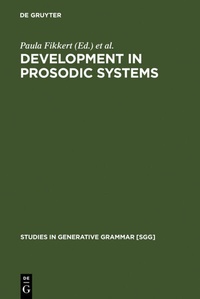
Development in Prosodic Systems
1st Edition
Published on 27. September 2011
VIII, 463 pages
978-3-11-089453-0 (ISBN)
Description

This book brings together papers on various aspects of prosodic development from a generative linguistic perspective. It addresses issues such as the relationship between tone, stress and quantity, the evidence for prosodic change from metrics and discusses the role of analogy, language contact, and language acquisition in change. The unique combination of different methodologies and perspectives investigating development in prosodic systems provides a new and broader scope on historical linguistics.
More details
Other editions
Additional editions
Paula Fikkert | Haike Jacobs
Development in Prosodic Systems
Book
01/2003
1st Edition
De Gruyter Mouton
€229.00
Article exhausted; check different version
Paula Fikkert | Haike Jacobs
Development in Prosodic Systems
Book
12/2002
1st Edition
De Gruyter Mouton
€159.95
Shipment within 7-9 days
Persons
Paula Fikkert teaches at the Dutch Department of the University of Nijmegen.
Haike Jacobs is Associate Professor at the University of Nijmegen and the Free University of Amsterdam.
Content
- Intro
- Introduction
- The relationship between tone and vowel length in two neighboring Dutch Limburgian dialects
- Prosodic change in progress: from quantity language to accent language
- Prosodic change from tone to vowel length in Korean
- Diachrony of the Scandinavian accent typology
- Kaluza's Law and the progress of Old English metrics
- Middle English stress doubles: New evidence from Chaucer's meter
- Constraining S and satisfying fit
- From phrase-final to post-initial accent in western Basque
- Swiss German vowel length through time
- The prosodic structure of prefixed words in the history of West Germanic
- Left-hand word-stress in the history of English
- Why preantepenultimate stress in Latin requires an OT-account
- From prosody to place: The development of prosodic contrasts into place of articulation contrast in the history of Miogliola
- Language index
- Subject index
