

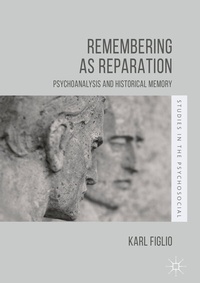
Remembering as Reparation
Psychoanalysis and Historical Memory
1st Edition
Published on 26. October 2017
XIII, 284 pages
978-1-137-59591-1 (ISBN)
Description

This book brings together psychoanalysis, clinical and theoretical, with history in a study of remembering as reparation: not compensation, but recognition of the actuality of perpetration and the remorseful urge to rejuvenate whatever represents this damage. Karl Figlio argues that this process, intensively studied by Melanie Klein, is shadowed by manic reparation, which simulates, but is antithetical, to it. Both aim for peace of mind: the former in a guilt-induced attitude of making better a damaged 'good object', internal and external; the latter, supported by defences thoroughly studied in psychoanalysis, in claiming liberation from an accusatory object.
This psychoanalytic line of thinking converges with historical scholarship on post-war German memory and memorialization. Remembering is posited as ambivalent - it is reparative, in 'remembering true', with respect and self-respect. It is also manic reparative, in 'remembering false', shedding bondsto the actuality of history through acts of triumph and liberation.
This thoughtful book highlights new features of history and memory work, especially the importance of emotion, and will be of great value to students, academics and practitioners across the fields of psychoanalysis, memory studies, German studies and modern history.
This psychoanalytic line of thinking converges with historical scholarship on post-war German memory and memorialization. Remembering is posited as ambivalent - it is reparative, in 'remembering true', with respect and self-respect. It is also manic reparative, in 'remembering false', shedding bondsto the actuality of history through acts of triumph and liberation.
This thoughtful book highlights new features of history and memory work, especially the importance of emotion, and will be of great value to students, academics and practitioners across the fields of psychoanalysis, memory studies, German studies and modern history.
Reviews / Votes
"A vital contribution to understanding German memory and memorialization of the Holocaust. By bridging psychoanalysis and history, Karl Figlio sheds new light on the psychological dynamics that have shaped Germany's attempts at reparation. This book is full of important insights about the ongoing struggle with memory, responsibility and historical trauma." (Roger Frie, author of Not in My Family: German Memory and Responsibility After the Holocaust)"Facing up to painfully complicated and actively troublesome histories and working them through -- the arduous process of really effective remembering -- requires collaborating across different kinds of knowledge and different traditions of thought. Nazism and the Holocaust present this dilemma at its most extreme. With carefully reasoned patience yet patent political urgency, Karl Figlio asks the practitioners of psychoanalysis and history to sit down together." (Geoff Eley, Karl Pohrt Distinguished University Professor of ContemporaryHistory, University of Michigan)
More details
Series
Language
English
Place of publication
London
United Kingdom
Publishing group
Palgrave Macmillan UK
Target group
Professional and scholarly
Product notice
Reflowable
Illustrations
XIII, 284 p. 10 illus., 5 illus. in color.
File size
10,11 MB
ISBN-13
978-1-137-59591-1 (9781137595911)
DOI
10.1057/978-1-137-59591-1
Schweitzer Classification
Other editions
Additional editions
Book
11/2017
Palgrave Macmillan
€85.59
Article exhausted; check different version
Person
Karl Figlio is Professor Emeritus in the Department for Psychosocial and Psychoanalytic Studies, University of Essex, UK. He is a Senior Member of the Psychoanalytic Psychotherapy Association of the British Psychoanalytic Council and an Associate of the British Psychoanalytical Society. He has published widely in the history of science, psychoanalysis and psychoanalysis and culture.
Content
Chapter 1: Introduction.- Chapter 2: The Internal World.- Chapter 3: Psychoanalysis and the 'Social Subject'.- Chapter 4: Delusional Enemies.- Chapter 5: Solidarity, Catastrophe and Ambivalence.- Chapter 6: Conflicts of Remembering: The Historikerstreit.- Chapter 7: Remembering and Not Remembering.- Chapter 8: The Unconscious Division of Germany.- Chapter 9: Reparation.- Chapter 10: Remembering, Memorialization and Reparation.- Chapter 11: Conclusion.
