

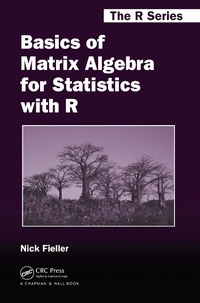
Basics of Matrix Algebra for Statistics with R
Published on 3. September 2018
248 pages
978-1-315-36231-1 (ISBN)
Description

A Thorough Guide to Elementary Matrix Algebra and Implementation in R
Basics of Matrix Algebra for Statistics with R provides a guide to elementary matrix algebra sufficient for undertaking specialized courses, such as multivariate data analysis and linear models. It also covers advanced topics, such as generalized inverses of singular and rectangular matrices and manipulation of partitioned matrices, for those who want to delve deeper into the subject.
The book introduces the definition of a matrix and the basic rules of addition, subtraction, multiplication, and inversion. Later topics include determinants, calculation of eigenvectors and eigenvalues, and differentiation of linear and quadratic forms with respect to vectors. The text explores how these concepts arise in statistical techniques, including principal component analysis, canonical correlation analysis, and linear modeling.
In addition to the algebraic manipulation of matrices, the book presents numerical examples that illustrate how to perform calculations by hand and using R. Many theoretical and numerical exercises of varying levels of difficulty aid readers in assessing their knowledge of the material. Outline solutions at the back of the book enable readers to verify the techniques required and obtain numerical answers.
Avoiding vector spaces and other advanced mathematics, this book shows how to manipulate matrices and perform numerical calculations in R. It prepares readers for higher-level and specialized studies in statistics.
Basics of Matrix Algebra for Statistics with R provides a guide to elementary matrix algebra sufficient for undertaking specialized courses, such as multivariate data analysis and linear models. It also covers advanced topics, such as generalized inverses of singular and rectangular matrices and manipulation of partitioned matrices, for those who want to delve deeper into the subject.
The book introduces the definition of a matrix and the basic rules of addition, subtraction, multiplication, and inversion. Later topics include determinants, calculation of eigenvectors and eigenvalues, and differentiation of linear and quadratic forms with respect to vectors. The text explores how these concepts arise in statistical techniques, including principal component analysis, canonical correlation analysis, and linear modeling.
In addition to the algebraic manipulation of matrices, the book presents numerical examples that illustrate how to perform calculations by hand and using R. Many theoretical and numerical exercises of varying levels of difficulty aid readers in assessing their knowledge of the material. Outline solutions at the back of the book enable readers to verify the techniques required and obtain numerical answers.
Avoiding vector spaces and other advanced mathematics, this book shows how to manipulate matrices and perform numerical calculations in R. It prepares readers for higher-level and specialized studies in statistics.
Reviews / Votes
"...belongs to the category of mathematics books that integrate a programming language with substantive content. On the substantive side, the author has meticulously selected matrix algebra topics that are fundamental to learning, using, and understanding statistics. In this manner, the reader is saved time by focusing on matrix mathematics which is of most relevance to statistics. In addition, an instructor also benefits from the concise introduction to matrix algebra related to statistics. Therefore, this book can easily be adopted as a matrix algebra supplemental book in a syllabus on statistics. The exercises are short but rigorous, with detailed solutions provided at the end of the book...as a traditional text to teach practical matrix algebra to students taking multivariate and more advanced statistics courses, this book can be of good use."-Abdolvahab Khademi, University of Massachusetts, Journal of Statistical Software, July 2016
"Key features of the book include highlighting useful tricks when manipulating matrices, derivation of key results with step-by-step cross-referenced explanations and demonstrations of implementing the techniques in R using numerical examples...it is a good beginner's guide to understanding and manipulating matrices in R. It is suitable for early year undergraduate students and anyone who wishes to be introduced to matrix algebra in R in preparation for high-level or specialised studies in statistics. The book's collection of summaries and key results also make it a good handbook for any statistician to refer to."
-Shuangzhe Liu, Stastistical Papers, July 2016
"... a concise and straightforward presentation of matrix algebra techniques that are commonly used in statistics. Furthermore, the book discusses how to implement numerical instances of these techniques using R. ... If you have a need or desire to carry out matrix computations in R, then it is likely that here you will find the needed commands. There are several nice features ... it is very easy to find the R command for carrying out a specific matrix calculation. ... useful as a reference. In addition, the author provides helpful tips and tricks for working with R. Another positive feature of this book is the applications to statistics. ... the inclusion of exercises facilitates the use of this book as a course text."
-MAA Reviews, January 2016
More details
Series
Language
English
Place of publication
London
United Kingdom
Publishing group
Taylor & Francis Ltd
Target group
College/higher education
File size
7,20 MB
ISBN-13
978-1-315-36231-1 (9781315362311)
Copyright in bibliographic data and cover images is held by Nielsen Book Services Limited or by the publishers or by their respective licensors: all rights reserved.
Schweitzer Classification
Other editions
Additional editions
Nick Fieller
Basics of Matrix Algebra for Statistics with R
Book
03/2021
1st Edition
Chapman & Hall/CRC
€74.50
Shipment within 15-20 days
Nick Fieller
Basics of Matrix Algebra for Statistics with R
Book
07/2015
1st Edition
Chapman & Hall/CRC
€95.00
Shipment within 15-20 days
Person
Dr. Nick Fieller is a retired senior lecturer in the School of Mathematics and Statistics and an honorary research fellow in archaeology at the University of Sheffield. His research interests include multivariate data analysis and statistical modeling in the pharmaceutical industry, archaeology, and forensic sciences.
Content
Introduction. Vectors and Matrices. Rank of Matrices. Determinants. Inverses. Eigenanalysis of Real Symmetric Matrices. Vector and Matrix Calculus. Further Topics. Key Applications to Statistics. Outline Solutions to Exercises. Bibliography. Index.
