

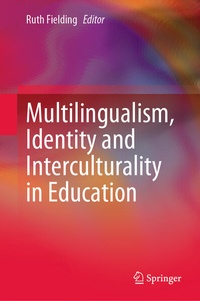
Multilingualism, Identity and Interculturality in Education
Description

Reviews / Votes
"The collection provides an excellent set of discussions that explore and showcase the complexities of language, identity and interculturality. It also offers practical guidance for researchers and teachers in the development of multilingual awareness and identities." (Qing Gao, Journal of Multilingual and Multicultural Development, December 18, 2023)More details
Other editions
Additional editions
Person
Dr Ruth Fielding is a SENIOR LECTURER at Monash University, Australia, and her research focuses on multilingualism, language education and identity. Ruth began her career as a secondary school teacher of French and German, before undertaking a PhD which focused on multilingualism and identity negotiation. Ruth was awarded the Michael Clyne Prize for her thesis in 2010, jointly awarded by the Applied Linguistics Association of Australia (ALAA) and the Australian Linguistics Society (ALS). Ruth's research and professional work centers around a program of research which explores bilingual/multilingual identity, language teacher education, pedagogy and assessment in language learning and teaching, and intercultural approaches in languages education. Ruth's research program seeks to transform teaching and learning through shifting approaches to languages. She works with teachers to understand how identity and intercultural understanding are interwoven in language education. Herresearch also seeks to understand how education in super-diverse cities takes place to further develop education for diversity and inclusion. Her research has appeared in several journals and in a number of edited volumes. She is also an advisor and consultant to educational organisations in Australia, advising on languages and multilingual issues.
Content
Chapter 1. Introduction - Multilingualism, Identity and Interculturality as Constructs in Education.- Chapter 2. Conceptualising the Multilingual Intercultural Identity Approach in Languages Education.- Chapter 3. "My languaging is ok, your languaging is ok!": Multilingual identity as the wellspring of intercultural development.- Chapter 4. The intersection of multilingualism and intercultural competence in the Norwegian foreignl language curriculum: teachers' perspectives.- Chapter 5. Trying harder than everyone else; examining how young former refugees reconstruct new identities that assist them to 'get ahead' in Australian education.- Chapter 6. Identity, investment and interculturality in adult multilingualism: between monolingual mindsets and diversity activism.- Chapter 7. Multiplying the identity factor. Harnessing the language resources of the language ecology for expressing Aboriginal and Torres Strait Islander identity.- Chapter 8. From Bilingual to Plurilingual Identity:How to Advance Language Learners' Plurilinguality and Pluriculturality.- Chapter 9. Diversity Matters: Harnessing the linguistic and cultural resources of multilingual children and families.- Chapter 10. Future Directions for Multilingualism, Identity and Intercultural Understanding in Education.
