

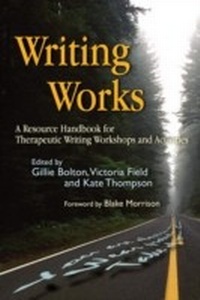
Writing Works
A Resource Handbook for Therapeutic Writing Workshops and Activities
Published on 15. August 2006
256 pages
978-1-84642-549-3 (ISBN)
Description

The use of creative writing as a route to personal development is a powerful therapeutic tool - a fact that is recognized in the growing numbers of workshops and writing groups within professional contexts, including clinical, health and criminal justice settings.
Writing Works is a guide for writers or therapists working with groups or individuals and is full of practical advice on everything from the equipment needed to run a session to ideas for themes, all backed up by the theory that underpins the methods explained. Experienced practitioners in the field contribute detailed illuminating accounts of organizing writing workshops for a wide range of different clients, together with examples of their outcomes.
This book will be an invaluable start-up reference for arts therapists and professionals working across the health, social care and caring professions, and one that will be referred to again and again.
Writing Works is a guide for writers or therapists working with groups or individuals and is full of practical advice on everything from the equipment needed to run a session to ideas for themes, all backed up by the theory that underpins the methods explained. Experienced practitioners in the field contribute detailed illuminating accounts of organizing writing workshops for a wide range of different clients, together with examples of their outcomes.
This book will be an invaluable start-up reference for arts therapists and professionals working across the health, social care and caring professions, and one that will be referred to again and again.
Reviews / Votes
This is an important resource for anyone who runs writing workshops and a delightful, unputdownable adventure - yes, really! - for anyone who thinks it matters that writing works... I loved the chapters on place and objects, although, as before, I am not looking for overtly 'therapeutic' outcomes. I delight in the recognition of the importance of doing worthwhile, satisfying work. The authors clearly believe that a rigorous attitude to quality is in no way in conflict with catharsis and discovery. I loved the succinctness of the accounts "This is what I wanted to do. This is what happened". I read this book as I read many creative writing handbooks: as a total immersion experience in a familiar but stimulating pool; a pool that refreshes, relaxes, buoys me up, gives me opportunities for vigorous exercise. -- Lapidus Quarterly The subheading explains what Writing Works is all about: A resource handbook for therapeutic writing workshops and activities.The use of creative writing as a route to personal development is a powerful and therapeutic tool, and therapeutic writing groups are run not only by writers but also by health professionals, occupational therapists and nurses as well as social workers of various kinds. And these groups will often take place in community centres, hospitals, schools, homes for the elderly and rehabilitation centres. This is a highly specialised field in which group leaders will encourage participants to use writing (as the book puts it) 'to explore themselves and their situations, and to express what they think or feel'. The practical aspects of running such a group are explained in the early chapters, and there are also plenty of suggestions for writing exercises that can be set and explored in group sessions. Typical exercises would involve allowing an inanimate object to 'speak' and to write down what it says, using published poems as a springboard for therapeutic writing, and using writing to explore the ways in which group members believe they are perceived by others. -- Writers Magazine Three editors; but - including these three - forty nine contributors. Is it this number and variety of voices which makes Writing Works not merely interesting, but satisfying. It is a collection of simple, sound and enthusiastic advice about using writing as therapy, and it is all the better for spelling out what might be taken for granted.- the importance of the organization, context, location amenities needed before even beginning to work with those who are writing to learn about themselves....Writing works contains many exercises and activity which any creative writing teacher could use with success. In fact, although this is a handbook for therapists, is has a great deal to teach us about how we think through what we are doing, and why, in any writing course/class/workshop. It is also extremely readable, and edited in such a skilful way that it feels as if there is one editor, rather than three. The tone is reassuring, consistent, warm - and a real testament to the work of Lapidus as an organization, as well as the sensitivity of the teachers who contributed... Every NAWE member should buy this book. -- NAWE NEWS- Supplement to Writing in Education The book is full of vignettes from practitioners' experiences of using creative writing in many different ways to bring about therapeutic expression or catharsis. It is presented as a resource handbook for therapeutic writing workshops and activities, and as such contains many interesting approaches and ideas for running successful therapeutic groups...It would be an excellent resource for ideas and developing skills for experienced occupational therapists in mental health and educational settings. -- British Journal of Occupational TherapyAll prices
More details
Series
Edition
Digital original
Language
English
Place of publication
London
United Kingdom
Target group
College/higher education
Professional and scholarly
Edition type
Digital original
File size
0,89 MB
ISBN-13
978-1-84642-549-3 (9781846425493)
Copyright in bibliographic data and cover images is held by Nielsen Book Services Limited or by the publishers or by their respective licensors: all rights reserved.
Schweitzer Classification
Other editions
Additional editions
Victoria Field | Gillie Bolton | Kate Thompson
Writing Works
A Resource Handbook for Therapeutic Writing Workshops and Activities
Book
08/2006
Jessica Kingsley Publishers
€31.60
Shipment within 15-20 days
Persons
Gillie Bolton has worked in reflective and therapeutic writing for personal and professional development for twenty-five years, and has written and edited five books, one of which is now in its third edition. A grandmother of three, she lives in Bloomsbury, London, and Hope Valley, Derbyshire. Kate Thompson is a BACP senior accredited counsellor and supervisor and a journal therapist. After gaining a degree in English Literature from Cambridge University and therapeutic training, she developed a method of combining the two. She is a faculty member of the Center for Journal Therapy and Institute for Therapeutic Writing and lives in Colorado, USA.
Content
Foreword by Blake Morrison. Someone Says by David Hart. Acknowledgements. 1. Introduction. What this book offers and why. Gillie Bolton. Running groups. Victoria Field. Writing in therapy. Kate Thompson. Part One: Writing from without. 2. Warming Up and Working Together. Edited by Kate Thompson. 3. Writing About Place. Edited by Victoria Field. 4. Writing from Objects. Edited by Gillie Bolton. 5. Writing from Published Poems. Edited by Victoria Field. 6. Writing in Form. Edited by Victoria Field. Part Two: Writing from Within. 7. What People Need to Write. Edited by Kate Thompson. 8. Different Masks. Edited by Victoria Field. 9. Who Am I? Edited by Gillie Bolton. 10. Life's Journey. Edited by Gillie Bolton. 11. Loss and Change. Edited by Kate Thompson. 12. Conclusion. Index.

