

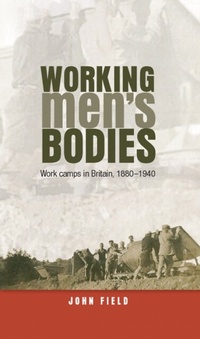
Working Men's Bodies
Work Camps in Britain, 1880-1940
1st Edition
Published on 16. May 2016
272 pages
978-1-5261-1252-1 (ISBN)
Description

Britain's work camp systems have never before been studied in depth. Highly readable, and based on thorough archival research and the reminiscences of those involved, this fascinating book addresses the relations between work, masculinity, training and citizen service.
The book is a comprehensive study, from the labour colonies of late Victorian and Edwardian Britain to the government instructional centres of the 1930s. It covers therapeutic communities for alcoholics, epileptics, prostitutes and 'mental defectives', as well as alternative communities founded by socialists, anarchists and nationalists in the hope of building a new world. It explores residential training schemes for women, many of which sought to develop 'soft bodies' fit for domestic service, while more mainstream camps were preoccupied with 'hardening' male bodies through heavy labour.
Working men's bodies will interest anyone specialising in modern British history, and those concerned with social policy, training policy, unemployment, and male identities. -- .
The book is a comprehensive study, from the labour colonies of late Victorian and Edwardian Britain to the government instructional centres of the 1930s. It covers therapeutic communities for alcoholics, epileptics, prostitutes and 'mental defectives', as well as alternative communities founded by socialists, anarchists and nationalists in the hope of building a new world. It explores residential training schemes for women, many of which sought to develop 'soft bodies' fit for domestic service, while more mainstream camps were preoccupied with 'hardening' male bodies through heavy labour.
Working men's bodies will interest anyone specialising in modern British history, and those concerned with social policy, training policy, unemployment, and male identities. -- .
Reviews / Votes
This is a fascinating, well-written and thoughtful study.'Working Men's Bodies: Work Camps in Britain, 1880-1940 is an exhaustive exploration of the role of work camps and camp movements in modern British history...The sheer scope of John Field's analysis is impressive...It is an important contribution to shared understandings of how bodies are shaped and managed through public discourse and policy interventions. Working Men's Bodies will therefore also appeal to readers interested in sociology, labor policy, and the gendered nature of work.'
Abbas, Carleton University, H-Disability July 2016 -- .
All prices
More details
Language
English
Place of publication
United Kingdom
Target group
College/higher education
Professional and scholarly
ISBN-13
978-1-5261-1252-1 (9781526112521)
Copyright in bibliographic data and cover images is held by Nielsen Book Services Limited or by the publishers or by their respective licensors: all rights reserved.
Schweitzer Classification
Other editions
Additional editions
Book
11/2013
Manchester University Press
€131.50
Article not available at the moment
Person
John Field is a Professor in the School of Education, University of Stirling, Scotland -- .
Content
1. Colonising the land
2. 'We work amongst the lowest stratum of life': the early labour colonies
3. Labour colonies and public health
4. Alternative living in the English countryside: utopian colonies
5. 'The landless man to the manless land': labour colonies and the Empire
6. 'Save our young people from a kind of dry rot': compulsion and the Labour government, 1929-1931
7. Incremental growth: Instructional Centres under the National Government
8. 'Light green uniforms, white apron and caps': training unemployed women
9. Camps as social service and social movement
10. 'Down with the Concentration Camps!' Opposition and protest
Conclusion - Understanding work camps: memory and context
Index -- .
2. 'We work amongst the lowest stratum of life': the early labour colonies
3. Labour colonies and public health
4. Alternative living in the English countryside: utopian colonies
5. 'The landless man to the manless land': labour colonies and the Empire
6. 'Save our young people from a kind of dry rot': compulsion and the Labour government, 1929-1931
7. Incremental growth: Instructional Centres under the National Government
8. 'Light green uniforms, white apron and caps': training unemployed women
9. Camps as social service and social movement
10. 'Down with the Concentration Camps!' Opposition and protest
Conclusion - Understanding work camps: memory and context
Index -- .

