

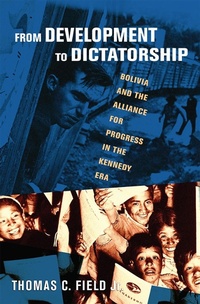
From Development to Dictatorship
Bolivia and the Alliance for Progress in the Kennedy Era
Published on 8. May 2014
296 pages
978-0-8014-7044-8 (ISBN)
Description

During the most idealistic years of John F. Kennedy's Alliance for Progress development program, Bolivia was the highest per capita recipient of U.S. foreign aid in Latin America. Nonetheless, Washington's modernization programs in early 1960s' Bolivia ended up on a collision course with important sectors of the country's civil society, including radical workers, rebellious students, and a plethora of rightwing and leftwing political parties. In From Development to Dictatorship, Thomas C. Field Jr. reconstructs the untold story of USAID's first years in Bolivia, including the country's 1964 military coup d'etat.Field draws heavily on local sources to demonstrate that Bolivia's turn toward anticommunist, development-oriented dictatorship was the logical and practical culmination of the military-led modernization paradigm that provided the liberal underpinnings of Kennedy's Alliance for Progress. In the process, he explores several underappreciated aspects of Cold War liberal internationalism: the tendency of "development" to encourage authoritarian solutions to political unrest, the connection between modernization theories and the rise of Third World armed forces, and the intimacy between USAID and CIA covert operations. Challenging the conventional dichotomy between ideology and strategy in international politics, From Development to Dictatorship engages with a growing literature on development as a key rubric for understanding the interconnected processes of decolonization and the Cold War.
Reviews / Votes
A compelling local portrait of the violence that anticommunist development brought on the Bolivian left, the fracturing of the country's nationalist and revolutionary parties under the pressures of U.S. intervention, and the forms of political mobilization that the Bolivian state fought and cultivated in the Andean mines and villages.- Amy C. Offner (H-Diplo Roundtable Reviews) A splendid piece of scholarship. Extensively and inventively researched, engagingly narrated, and consistently thought-provoking, this is an example of international history at its best... gripping in a manner that is rarely found in academic studies... a highly impressive achievement.
- Thomas Tunstall Allcock (H-Diplo Roundtable Reviews) A tremendous contribution to the historiography.
- Philip E. Muehlenbeck (H-Diplo Roundtable Reviews) Field emphasizes that it was Washington's relentless promotion of modernization schemes by any means necessary that drove Bolivia to the brink of civil war. This superb study serves as a model for future explorations of the Alliance for Progress in Latin America.
- Stephen M. Streeter (Journal of American History) Field shows how U.S. Agency for International Development (USAID) funding was employed to arm peasant militias against militant miners, all in the name of development. Field's book is well-researched and his work benefits from a deep engagement with Bolivia.
- Andrew J. Kirkendall (H-Diplo Essay) Field's extensive multi-archival research allows him to provide a highly detailed account of Bolivia's military rebellion and the government's overthrow in 1964 and incorporate the perspectives of various actors into his analysis. He persuasively argues that, in Bolivia, US implementation of the Alliance for Progress was contingent on an 'approach that was authoritarian from the beginning' and can best be characterized as 'arrogant interventionism, backed up cynically by the language of development and modernization.' Field's comprehensive use of archival material has enabled him to produce a compelling case study of the Alliance for Progress that provides new insights into the causal link between development and authoritarianism. His nuanced analysis has resulted in insightful conclusions that reveal the important intersection of ideology and strategy within Cold War international relations.
- Mark Seddon (International History Review) This is international history at its best with insight that has implications well beyond the immediate country. Highly recommended.
- J. P. Dunn (Choice Magazine) This is very well written with primary sources, not classic leftist cliche, but with declassified documents, USAID reports, and US government reports. Thomas Field paints the portrait of a Bolivian government genuflecting before foreign imposition. I want to congratulate him for this study. It's like reading a novel, which is why I was able to read it so quickly. It takes you in quickly.
- Bolivian Vice President Alvaro Garcia Linera (Discurso Presidencial) Field has written an excellent book on two key areas of US foreign relations: the history of development and USA-Latin American relations. Even as the majority of works on development focus on the non-Latin American parts of the Third World, Field shows the reader the importance of understanding how economic development worked or did not work during the 'high tide' of the implementation of Modernization Theory in Latin America.
- James F. Siekmeier, West Virginia University (Journal of Contemporary History)
More details
Series
Language
English
Place of publication
Ithaca
United States
Product notice
Reflowable
Illustrations
6 halftones, 2 line figures - 6 Halftones, black and white
ISBN-13
978-0-8014-7044-8 (9780801470448)
Copyright in bibliographic data and cover images is held by Nielsen Book Services Limited or by the publishers or by their respective licensors: all rights reserved.
Schweitzer Classification
Other editions
Additional editions
Jonas Pontusson
From Development to Dictatorship
Bolivia and the Alliance for Progress in the Kennedy Era
Book
01/2018
Cornell University Press
€41.03
Shipment within 15-20 days
Thomas C. Field
From Development to Dictatorship
Bolivia and the Alliance for Progress in the Kennedy Era
Book
05/2014
Cornell University Press
€148.56
Shipment within 10-20 days
Person
Thomas C. Field Jr. is Assistant Professor of Global Security and Intelligence Studies at Embry-Riddle Aeronautical University.
Content
Introduction: Ideology as Strategy
1. Modernization's Heavy Hand: The Triangular Plan for Bolivia
2. Development as Anticommunism: The Targeting of Bolivian Labor
3. "Bitter Medicine": Military Civic Action and the Battle of Irupata
4. Development's Detractors: Miners, Housewives, and the Hostage Crisis at Siglo XX
5. Seeds of Revolt: The Making of an Antiauthoritarian Front
6. Revolutionary Bolivia Puts On a Uniform: The 1964 Bolivian Coup d'Etat
Conclusion: Development and Its Discontents
1. Modernization's Heavy Hand: The Triangular Plan for Bolivia
2. Development as Anticommunism: The Targeting of Bolivian Labor
3. "Bitter Medicine": Military Civic Action and the Battle of Irupata
4. Development's Detractors: Miners, Housewives, and the Hostage Crisis at Siglo XX
5. Seeds of Revolt: The Making of an Antiauthoritarian Front
6. Revolutionary Bolivia Puts On a Uniform: The 1964 Bolivian Coup d'Etat
Conclusion: Development and Its Discontents
