

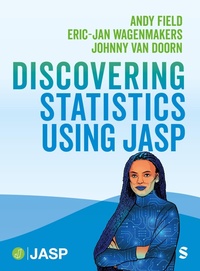
Discovering Statistics Using JASP
1st Edition
Published on 28. March 2025
792 pages
978-1-0362-0207-1 (ISBN)
Description

Unlock the world of statistics with Discovering Statistics using JASP, a comprehensive guide that brings the power of JASP software into the classroom. Building on the legacy of the acclaimed DSUSS series, this book distils complex statistical concepts into engaging, step-by-step content designed for undergraduate courses. Students will gain practical skills in data analysis without needing to learn coding, thanks to JASP's intuitive point-and-click interface.
This first edition also offers:
Global relevance: Features international examples and case studies, making it ideal for diverse classroom settings.
A student-focused approach: An abridged version tailored to undergraduate needs, with accessible summaries and practical solutions.
Cutting-edge tools: Leverages free JASP software, supported by world-renowned experts and the University of Amsterdam.
Alignment with open science: Encourages reproducibility and transparency in research practices.
Perfect for undergraduates and lecturers alike, this book is the ultimate resource for mastering statistics with JASP. The wealth of online resources can be easily integrated into your institution's virtual learning environment or learning management system. This allows you to customise and curate content for use in module preparation, delivery and assessment.
This first edition also offers:
Global relevance: Features international examples and case studies, making it ideal for diverse classroom settings.
A student-focused approach: An abridged version tailored to undergraduate needs, with accessible summaries and practical solutions.
Cutting-edge tools: Leverages free JASP software, supported by world-renowned experts and the University of Amsterdam.
Alignment with open science: Encourages reproducibility and transparency in research practices.
Perfect for undergraduates and lecturers alike, this book is the ultimate resource for mastering statistics with JASP. The wealth of online resources can be easily integrated into your institution's virtual learning environment or learning management system. This allows you to customise and curate content for use in module preparation, delivery and assessment.
More details
Edition
1. Auflage
Language
English
Place of publication
United Kingdom
Publishing group
SAGE Publishing (Digital)
Target group
College/higher education
Product notice
Reflowable
ISBN-13
978-1-0362-0207-1 (9781036202071)
Copyright in bibliographic data and cover images is held by Nielsen Book Services Limited or by the publishers or by their respective licensors: all rights reserved.
Schweitzer Classification
Other editions
Additional editions
Andy Field | Johnny van Doorn | Eric-Jan Wagenmakers
Discovering Statistics Using JASP
Book
04/2025
1st Edition
SAGE Publications Ltd
€62.50
Available immediately
Andy Field | Johnny van Doorn | Eric-Jan Wagenmakers
Discovering Statistics Using JASP
Book
03/2025
1st Edition
SAGE Publications Ltd
€254.10
Shipment within 3-4 weeks
Persons
Andy Field is Professor of Quantitative Methods at the University of Sussex. He has published widely (100+ research papers, 29 book chapters, and 17 books in various editions) in the areas of child anxiety and psychological methods and statistics. His current research interests focus on barriers to learning mathematics and statistics.
He is internationally known as a statistics educator. He has written several widely used statistics textbooks including Discovering Statistics Using IBM SPSS Statistics (winner of the 2007 British Psychological Society book award), Discovering Statistics Using R, and An Adventure in Statistics (shortlisted for the British Psychological Society book award, 2017; British Book Design and Production Awards, primary, secondary and tertiary education category, 2016; and the Association of Learned & Professional Society Publishers Award for innovation in publishing, 2016), which teaches statistics through a fictional narrative and uses graphic novel elements. He has also written the adventr and discovr packages for the statistics software R that teach statistics and R through interactive tutorials.
His uncontrollable enthusiasm for teaching statistics to psychologists has led to teaching awards from the University of Sussex (2001, 2015, 2016, 2018, 2019), the British Psychological Society (2006) and a prestigious UK National Teaching fellowship (2010).
He's done the usual academic things: had grants, been on editorial boards, done lots of admin/service but he finds it tedious trying to remember this stuff. None of them matter anyway because in the unlikely event that you've ever heard of him it'll be as the 'Stats book guy'. In his spare time, he plays the drums very noisily in a heavy metal band, and walks his cocker spaniel, both of which he finds therapeutic.
Prof. dr. Eric-Jan Wagenmakers is a mathematical psychologist and a dedicated Bayesian at the University of Amsterdam, Netherlands. His lab heads the development of the JASP open-source software program for statistical analyses.
He is internationally known as a statistics educator. He has written several widely used statistics textbooks including Discovering Statistics Using IBM SPSS Statistics (winner of the 2007 British Psychological Society book award), Discovering Statistics Using R, and An Adventure in Statistics (shortlisted for the British Psychological Society book award, 2017; British Book Design and Production Awards, primary, secondary and tertiary education category, 2016; and the Association of Learned & Professional Society Publishers Award for innovation in publishing, 2016), which teaches statistics through a fictional narrative and uses graphic novel elements. He has also written the adventr and discovr packages for the statistics software R that teach statistics and R through interactive tutorials.
His uncontrollable enthusiasm for teaching statistics to psychologists has led to teaching awards from the University of Sussex (2001, 2015, 2016, 2018, 2019), the British Psychological Society (2006) and a prestigious UK National Teaching fellowship (2010).
He's done the usual academic things: had grants, been on editorial boards, done lots of admin/service but he finds it tedious trying to remember this stuff. None of them matter anyway because in the unlikely event that you've ever heard of him it'll be as the 'Stats book guy'. In his spare time, he plays the drums very noisily in a heavy metal band, and walks his cocker spaniel, both of which he finds therapeutic.
Prof. dr. Eric-Jan Wagenmakers is a mathematical psychologist and a dedicated Bayesian at the University of Amsterdam, Netherlands. His lab heads the development of the JASP open-source software program for statistical analyses.
Content
1. Why is my evil lecturer forcing me to learn statistics?
2. The SPINE of statistics
3. The phoenix of statistics
4. The JASP environment
5. Visualizing data
6. The beast of bias
7. Correlation
8. The linear model (regression)
9. Categorical predictors: Comparing two means
10. Moderation and mediation
11. GLM 1: Comparing several independent means
12. GLM 2: Comparing means adjusted for other predictors (analysis of covariance)
13. GLM 3: Factorial designs
14. GLM 4: Repeated-measures designs
15. Non-parametric models
16. Categorical outcomes: chi-square
17. Categorical outcomes: logistic regression
2. The SPINE of statistics
3. The phoenix of statistics
4. The JASP environment
5. Visualizing data
6. The beast of bias
7. Correlation
8. The linear model (regression)
9. Categorical predictors: Comparing two means
10. Moderation and mediation
11. GLM 1: Comparing several independent means
12. GLM 2: Comparing means adjusted for other predictors (analysis of covariance)
13. GLM 3: Factorial designs
14. GLM 4: Repeated-measures designs
15. Non-parametric models
16. Categorical outcomes: chi-square
17. Categorical outcomes: logistic regression
