

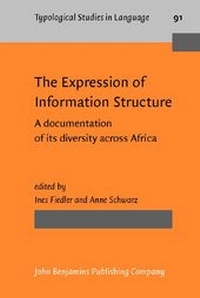
The Expression of Information Structure
A documentation of its diversity across Africa
1st Edition
Published on 24. March 2010
XII, 383 pages
978-90-272-8842-4 (ISBN)
Description

This book analyzes the different patterns found across subsaharan Africa to express information structure. Based on languages from all four African language phyla, it documents the great diversity of linguistic means used to encode information-structural phenomena and is therefore highly relevant for some of the most pertinent questions in modern linguistic theory. The special contribution of this volume is the perspective on a variety of information-structurally related phenomena which go far beyond classical notions such as focus and topic. Detailed investigations are dedicated to so far less discussed focal subcategories, like focus on verbal operators or the thetic-categorical distinction. Finally, the information-structural configuration of unmarked, canonical sentence structures is recognized. The papers provide evidence that the formal means to encode information-structural categories range from means such as morphological markers or syntactic operations, famous in linguistics, to less well-known strategies, such as defocalization rather than focalization.
More details
Other editions
Additional editions
Ines Fiedler | Anne Schwarz
The Expression of Information Structure
A documentation of its diversity across Africa
Book
03/2010
John Benjamins Publishing Co
€111.30
Shipment within 10-15 days
Persons
Content
- The Expression of Information Structure
- Editorial page
- Title page
- LCC data
- Table of contents
- Introduction
- References
- Information structure marking in Sandawe texts
- 1. Introduction
- 2. Grammatical preliminaries
- 3. Previous research on information structure marking in Sandawe
- 4. Information structure marking in Sandawe texts
- 5. Conclusion
- Abbreviations
- References
- Appendices
- Topic and focus fields in Naki
- 1. Introduction
- 2. Brief overview of Naki sentential syntax
- 3. The encoding of information structure in Naki
- 4. Postverbal focalization
- 5. Analyzing postverbal focalization
- 6. Conclusion
- Abbreviations
- References
- The relation between focus and theticity in the Tuu family
- 1. Introduction
- 2. Cleft constructions and contrastive term focus
- 3. Polyfunctional cleft constructions
- 4. Cleft constructions and entity-central theticity
- Abbreviations
- References
- Focus marking in Aghem
- 1. Introduction
- 2. Syntactic marking of focus (Watters 1979)
- 3. Morphological marking of focus on the verbal auxiliary (Anderson 1979)
- 4. Marking of focus in the noun phrase
- 5. Conclusion
- Abbreviations
- References
- On the obligatoriness of focus marking
- 1. Introduction
- 2. Focus-marking strategies in Tar B'arma
- 3. Obligatoriness of focus marking in Tar B'arma
- 4. Conclusion
- Abbreviations
- References
- Focalisation and defocalisation in Isu
- 0. Introduction: Marking properties of informational status in Isu
- 1. Word order: Structural encoding of information value
- 2. Morphological encoding of information value
- 3. Conclusion
- Abbreviations
- References
- Discourse function of inverted passives in Makua-Marevone narratives
- 1. Introduction
- 2. Approach
- 3. Three construction types compared
- 4. Inverted passive constructions in three selected narratives
- 5. Conclusion
- Abbreviations
- References
- Topic-focus articulation in Taqbaylit and Tashelhit Berber
- 1. Introduction
- 2. Views on topic-focus articulation and word order variation in Berber
- 3. Taqbaylit
- 4. Tashelhit
- 5. Word order flexibility and discourse-configurationality over time
- Abbreviations
- References
- Focus in Atlantic languages
- 1. Introduction
- 2. Formal marking of focus in the Atlantic languages
- 3. Focus: Uses and definition
- 4. Related features
- 5. Conclusion
- Abbreviations
- References
- Topic and focus construction asymmetry
- 1. Introduction
- 2. Initial comparison
- 3. Main clause properties
- 4. Resumptive function
- 5. Modifiers in emphatic constituents
- 6. Discussion
- Abbreviations
- References
- Verb-and-predication focus markers in Gur
- 0. Introduction
- 1. Previous analyses
- 2. Theoretical framework and elicitation method
- 3. Focus system
- 4. The role of ME-particles in verb-and-predication focus
- 5. Conclusion
- Abbreviations
- References
- Why contrast matters: Information structure in Gawwada (East Cushitic)
- 1. Generalities
- 2. Basic syntactic structure
- 3. Theoretical background
- 4. Topics
- 5. Topic-comment structures and the formal unmarkedness of focus in Gawwada
- 6. Thetic sentences and the focalization of new subjects
- 7. Marking contrast: =kka
- 8. Argument focus, again: Word-order change
- 9. Incorporation
- 10. Conclusions
- Abbreviations
- References
- Focus and the Ejagham verb system
- 1. A typology of focus
- 2. The perfective and imperfective verbal forms in Western Ejagham
- 3. Scope and communicative point of focus relative to the ConstF forms
- 4. Generalizing on the use of the constituent and operator focus verb forms
- 5. Tense, aspect and mood, and the pragmatic notion of focus
- 6. Concluding comments
- Abbreviations
- References
- Language index
- Subject index
- The series Typological Studies in Language
