

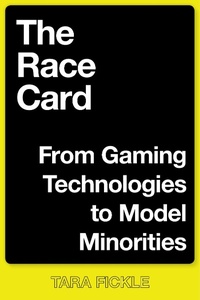
The Race Card
From Gaming Technologies to Model Minorities
Published on 19. November 2019
277 pages
978-1-4798-8436-0 (ISBN)
Description

Winner, 2020 American Book Award, given by the Before Columbus Foundation
How games have been used to establish and combat Asian American racial stereotypes
As Pokemon Go reshaped our neighborhood geographies and the human flows of our cities, mapping the virtual onto lived realities, so too has gaming and game theory played a role in our contemporary understanding of race and racial formation in the United States. From the Chinese Exclusion Act and Japanese American internment to the model minority myth and the globalization of Asian labor, Tara Fickle shows how games and game theory shaped fictions of race upon which the nation relies. Drawing from a wide range of literary and critical texts, analog and digital games, journalistic accounts, marketing campaigns, and archival material, Fickle illuminates the ways Asian Americans have had to fit the roles, play the game, and follow the rules to be seen as valuable in the US.
Exploring key moments in the formation of modern US race relations, The Race Card charts a new course in gaming scholarship by reorienting our focus away from games as vehicles for empowerment that allow people to inhabit new identities, and toward the ways that games are used as instruments of soft power to advance top-down political agendas. Bridging the intellectual divide between the embedded mechanics of video games and more theoretical approaches to gaming rhetoric, Tara Fickle reveals how this intersection allows us to overlook the predominance of game tropes in national culture. The Race Card reveals this relationship as one of deep ideological and historical intimacy: how the games we play have seeped into every aspect of our lives in both monotonous and malevolent ways.
How games have been used to establish and combat Asian American racial stereotypes
As Pokemon Go reshaped our neighborhood geographies and the human flows of our cities, mapping the virtual onto lived realities, so too has gaming and game theory played a role in our contemporary understanding of race and racial formation in the United States. From the Chinese Exclusion Act and Japanese American internment to the model minority myth and the globalization of Asian labor, Tara Fickle shows how games and game theory shaped fictions of race upon which the nation relies. Drawing from a wide range of literary and critical texts, analog and digital games, journalistic accounts, marketing campaigns, and archival material, Fickle illuminates the ways Asian Americans have had to fit the roles, play the game, and follow the rules to be seen as valuable in the US.
Exploring key moments in the formation of modern US race relations, The Race Card charts a new course in gaming scholarship by reorienting our focus away from games as vehicles for empowerment that allow people to inhabit new identities, and toward the ways that games are used as instruments of soft power to advance top-down political agendas. Bridging the intellectual divide between the embedded mechanics of video games and more theoretical approaches to gaming rhetoric, Tara Fickle reveals how this intersection allows us to overlook the predominance of game tropes in national culture. The Race Card reveals this relationship as one of deep ideological and historical intimacy: how the games we play have seeped into every aspect of our lives in both monotonous and malevolent ways.
Reviews / Votes
Revealing the orientalist origins of game studies and locating the very tenants of game theory in Japanese internment, Tara Fickle engages racialization as game-play itself. In doing so, Fickle explodes our understanding of economic survival and success by revealing the centrality of gambling rhetoric-and a willingness for risk-taking-in the appraisal of Japanese Americans as the ultimate model minority. An original and timely intervention that at last accounts for the dominant representation of Asian Americans as both the hard-worker and the obsessed gamer. - Wendy Hui Kyong Chun, author of Updating to Remain the Same: Habitual New Media Revealing the mutual constitution of gaming and racialization, The Race Card's concept of 'ludo-Orientalism' offers a significant new way of understanding the historical discourse of Asian exclusionism, as well as more subtle forms of post-1960s anti-Asian racism. Focusing on representations of Asian Americans as pathological players, Fickle shows how racial discourse is linked to the speculative logic of American exceptionalism. - Colleen Lye, author of America's Asia: Racial Reform and American Literature, 1893-1945 Games of chance, video games, and game theory converge in this examination of the relationship between gamification and racialization in exploring the Asian American experience. ... argues that games are used as a form of soft power geared toward advancing an exclusionary view of national identity. (CHOICE) Fickle brilliantly illuminates the many facets of games as a rich site of potentiality for thinking about Asian and Asian American identity, and how they co-constitute parts of the same problem. The Race Card is both a scathing excoriation of the Orientalist roots of the study of play and games, and an intellectual framing of games as a critical access point for understanding power relations concerning constructions of Asian identity. Witty, controlled, righteously outraged, inspired and incredibly persuasive, The Race Cardsets a new bar for understanding the role of games and play, broadly defined, in the struggle of race relations. - Soraya Murray (American Literary History)More details
Series
Language
English
Place of publication
New York
United States
Target group
Professional and scholarly
Illustrations
23 black and white illustrations
ISBN-13
978-1-4798-8436-0 (9781479884360)
Copyright in bibliographic data and cover images is held by Nielsen Book Services Limited or by the publishers or by their respective licensors: all rights reserved.
Schweitzer Classification
Other editions
Additional editions
Book
11/2019
New York University Press
€36.50
Shipment within 10-20 days
Person
Tara Fickle is Assistant Professor of English at the University of Oregon and an affiliated faculty in Ethnic Studies, the Center for Asian and Pacific Studies, and the New Media & Culture certificate.
