

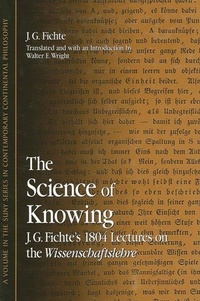
The Science of Knowing
J. G. Fichte's 1804 Lectures on the Wissenschaftslehre
Published on 1. February 2012
270 pages
978-0-7914-8322-0 (ISBN)
Description

The first English translation of Fichte's second set of 1804 lectures on the Wissenschaftslehre.
Considered by some to be his most important text, this series of lectures given by Johann Gottlieb Fichte (1762-1814) at his home in Berlin in 1804 is widely regarded as the most perspicuous presentation of his fundamental philosophy. Now available in English, this translation provides in striking and original language Fichte's exploration of the transcendental foundations of experience and knowing in ways that go beyond Kant and Reinhold and charts a promising, novel pathway for German Idealism. Through a close examination of this work one can see that Fichte's thought is much more than a way station between Kant and Hegel, thus making the case for Fichte's independent philosophical importance.
The text is divided into two parts: a doctrine of truth or reason, and a doctrine of appearance. A central feature of the text is its performative dimension. Philosophy, for Fichte, is something we enact rather than any discursively expressible object of awareness; a philosophical truth is not expressible as a set of propositions but is a spontaneous inwardly occurring realization. Therefore, he always regards the expression of philosophy in words as strategic, aiming to ignite philosophy's essentially inward process and to arouse the event of philosophical insight.
>
Walter E. Wright is Professor of Philosophy at Clark University.
Considered by some to be his most important text, this series of lectures given by Johann Gottlieb Fichte (1762-1814) at his home in Berlin in 1804 is widely regarded as the most perspicuous presentation of his fundamental philosophy. Now available in English, this translation provides in striking and original language Fichte's exploration of the transcendental foundations of experience and knowing in ways that go beyond Kant and Reinhold and charts a promising, novel pathway for German Idealism. Through a close examination of this work one can see that Fichte's thought is much more than a way station between Kant and Hegel, thus making the case for Fichte's independent philosophical importance.
The text is divided into two parts: a doctrine of truth or reason, and a doctrine of appearance. A central feature of the text is its performative dimension. Philosophy, for Fichte, is something we enact rather than any discursively expressible object of awareness; a philosophical truth is not expressible as a set of propositions but is a spontaneous inwardly occurring realization. Therefore, he always regards the expression of philosophy in words as strategic, aiming to ignite philosophy's essentially inward process and to arouse the event of philosophical insight.
>
Walter E. Wright is Professor of Philosophy at Clark University.
More details
Other editions
Additional editions
Book
07/2005
State University of New York Press
€108.00
Shipment within 10-20 days
Book
07/2005
State University of New York Press
€34.00
Shipment within 10-20 days
Persons
Content
Acknowledgments
Introduction
The Lectures
Appendix
Notes
Glossary
Index
