

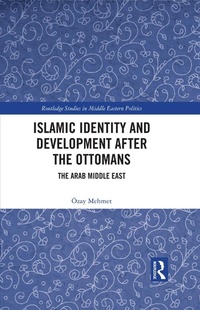
Islamic Identity and Development after the Ottomans
The Arab Middle East
1st Edition
Published on 31. March 2023
288 pages
978-1-000-75008-9 (ISBN)
Description

Exploring themes of identity and development in the post-Ottoman Arab world, this book updates the author's earlier Islamic Identity and Development (Routledge, 1990) to analyse the root causes of chaos, civil war, and conflict in the Islamic Core today.
Adopting a neo-Ottomanist framework, and using the latest scholarship on the Middle East, the author traces the historical development of the current crisis to the First World War, when the West instigated invasions, coup d'etats, civil and proxy wars. It is argued that Western powers have facilitated the dispossession of the Arab people in their overarching aim to gain control of the oil fields. A range of historical case-studies are provided as evidence, from the Balfour Declaration and the Sykes-Picot Agreement to the creation of Israel and the displacement of Islamic refugees. Individual nations are also analysed, including Iran, Saudi Arabia, Iraq, Syria, Libya, and Egypt. Ultimately, the author suggests that artificial countries and unsustainable frontiers are the root causes of the Islamic crisis. However, a realistic (and long-term) solution may lie in the evolution of a new Silk Route Economy.
This book will appeal to graduate-level students in political economy, area studies, international affairs, and Middle East studies generally.
Adopting a neo-Ottomanist framework, and using the latest scholarship on the Middle East, the author traces the historical development of the current crisis to the First World War, when the West instigated invasions, coup d'etats, civil and proxy wars. It is argued that Western powers have facilitated the dispossession of the Arab people in their overarching aim to gain control of the oil fields. A range of historical case-studies are provided as evidence, from the Balfour Declaration and the Sykes-Picot Agreement to the creation of Israel and the displacement of Islamic refugees. Individual nations are also analysed, including Iran, Saudi Arabia, Iraq, Syria, Libya, and Egypt. Ultimately, the author suggests that artificial countries and unsustainable frontiers are the root causes of the Islamic crisis. However, a realistic (and long-term) solution may lie in the evolution of a new Silk Route Economy.
This book will appeal to graduate-level students in political economy, area studies, international affairs, and Middle East studies generally.
Reviews / Votes
"The subject of this book is very timely and relevant, and has gained more prominence recently, especially with the rise of the Islamic-oriented government in today's Turkey. The writing style, the presentation of the material, organization, and the conclusion were clear, reasonable, and well documented. This book will fill the void in the literature and I recommend it very highly to students and scholars that are interested in the region, its culture, and Islam."Tareq Y. Ismael, University of Calgary, Canada
"The Arab Middle East has a long and complex history, an understanding of which is necessary for a full appreciation of the current situation. This book makes an important contribution to that process and gives important new insights."
Fraser Taylor, Carleton University, Canada
"By analyzing the legacy of the Ottoman Empire, Ozay Mehmet-a distinguished emeritus research professor of international affairs at Carleton University in Canada-presents an original perspective on the origins of the modern Middle East. Thus, this study offers a valuable complement to works that instead emphasize the heritage of Western imperialism. Stylistically well written and smoothly flowing, Professor Mehmet's wealth of insights range from earlier centuries up to the new Silk Road Economy, extending from Beijing to Istanbul, Turkish-EU relations, the war in Ukraine, and failures of democracy, among others. Highly recommended."
Michael M. Gunter, Professor of Political Science, Tennessee Technological University, United States
More details
Series
Edition
1. Auflage
Language
English
Place of publication
London
United Kingdom
Publishing group
Taylor & Francis Ltd
Target group
College/higher education
Product notice
Reflowable
Illustrations
12 Tables, black and white
ISBN-13
978-1-000-75008-9 (9781000750089)
Copyright in bibliographic data and cover images is held by Nielsen Book Services Limited or by the publishers or by their respective licensors: all rights reserved.
Schweitzer Classification
Other editions
Additional editions
Book
03/2023
1st Edition
Routledge
€58.30
Shipment within 10-20 days
Book
03/2023
1st Edition
Routledge
€186.20
Shipment within 10-20 days
Person
OEzay Mehmet is Distinguished Research Professor of International Affairs at Carleton University in Ottawa, Canada. He was educated in Cyprus, the London School of Economics (1959-62) and he received his MA and Ph.D in Economics at the University of Toronto. He has taught at various Canadian universities (Windsor, York, Toronto, Ottawa, and Carleton), and is the author of more than 20 academic books and over 100 articles in academic journals.
Content
1. Winners and Losers in Nation-Building in the Post-Ottoman Middle East 2. Chaos in Dar'ul Islam After the Ottomans: The Modern Middle East 3. Recent Scholarship on the End of Ottomans and the Making of the Modern Middle East 4. The Roots of Islamic Underdevelopment: From Mercantilism to Imperialism 5. The Elusive Quest for the Islamic Social Contract: The Contest Between Nationalism and Imperialism 6. The Making of the Modern Middle East: Western Invasion, the Sykes-Picot Legacy, Failed States and Terrorism 7. The New Silk Route: Long-Term Revival of the Muslim World? 8. Europe, Turkey, and Islam: From Crusades to Inter-Faith Cooperation 9. The Muslim Refugee Crisis and Moral Failure 10. Why the Arab World Never Produced a Democratic Leader? 11. Democracy, Arabs, and Islamic Revival? 12. A Summing Up 13. Postscript on Ukraine War
