

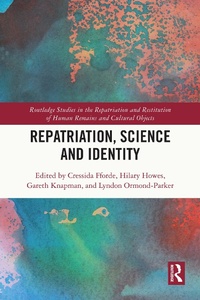
Repatriation, Science and Identity
1st Edition
Published on 30. November 2023
292 pages
978-1-000-98517-7 (ISBN)
Description

Repatriation, Science, and Identity explores the entanglement of race, history, identity and ethics inherent in the application of scientific techniques to determine the provenance of Indigenous Ancestral Remains in repatriation claims and processes.
The book considers how these issues relate to collections of Indigenous Ancestral (bodily) Remains but also their resonance with emerging concerns about the relatively unknown history of scientific interest in Indigenous hair and blood samples. It also explores the more recent practice of sampling for the purposes of DNA analysis and issues concerning the data that has been produced from all of the above types of research. Placing recent interest in applying scientific techniques to repatriation in their historical context, it enables discourses of identity and scientific authority, an assessment of their efficacy and an exploration of ethical and practical challenges and opportunities. In doing so, this book reveals new histories about scientific interest in Indigenous biology and the collections that resulted, as well as providing reflection for all repatriation practitioners considering scientific investigation when faced with the challenges inherent in the repatriation of unprovenanced or poorly provenanced Ancestral Remains.
Providing the reader with a means to approach the value, or otherwise, of the scientific information they may encounter, Repatriation, Science, and Identity is an invaluable resource for researchers and professionals working with Indigenous Ancestral Remains.
The book considers how these issues relate to collections of Indigenous Ancestral (bodily) Remains but also their resonance with emerging concerns about the relatively unknown history of scientific interest in Indigenous hair and blood samples. It also explores the more recent practice of sampling for the purposes of DNA analysis and issues concerning the data that has been produced from all of the above types of research. Placing recent interest in applying scientific techniques to repatriation in their historical context, it enables discourses of identity and scientific authority, an assessment of their efficacy and an exploration of ethical and practical challenges and opportunities. In doing so, this book reveals new histories about scientific interest in Indigenous biology and the collections that resulted, as well as providing reflection for all repatriation practitioners considering scientific investigation when faced with the challenges inherent in the repatriation of unprovenanced or poorly provenanced Ancestral Remains.
Providing the reader with a means to approach the value, or otherwise, of the scientific information they may encounter, Repatriation, Science, and Identity is an invaluable resource for researchers and professionals working with Indigenous Ancestral Remains.
More details
Series
Edition
1. Auflage
Language
English
Place of publication
London
United Kingdom
Publishing group
Taylor & Francis Ltd
Target group
College/higher education
Professional and scholarly
Illustrations
5 Halftones, black and white; 5 Illustrations, black and white
ISBN-13
978-1-000-98517-7 (9781000985177)
Copyright in bibliographic data and cover images is held by Nielsen Book Services Limited or by the publishers or by their respective licensors: all rights reserved.
Schweitzer Classification
Other editions
Additional editions
Cressida Fforde | Hilary Howes | Gareth Knapman
Repatriation, Science and Identity
Book
05/2025
1st Edition
Routledge
€67.70
Shipment within 15-20 days
Cressida Fforde | Hilary Howes | Gareth Knapman
Repatriation, Science and Identity
Book
11/2023
1st Edition
Routledge
€206.70
Shipment within 15-20 days
Persons
Professor Cressida Fforde is a Senior Research Fellow at the Centre for Heritage and Museum Studies at The Australian National University (ANU). She has undertaken scholarly and applied research in repatriation since the early 1990s and has been a founding member of the Return Reconcile Renew initiative since 2013 (www.returnreconcilerenew.info).
Dr Hilary Howes is an Australian Research Council DECRA Fellow based in the Centre for Heritage and Museum Studies at ANU. Her research to date addresses the German-speaking tradition within anthropology and archaeology, focusing on Austrian, German, Russian and Swiss collectors and collecting in Australia and the Pacific region.
Dr Gareth Knapman is a Research Fellow with the Centre for Heritage and Museum Studies at ANU. Dr Knapman previously worked as a curator and repatriation officer at Museum Victoria's Indigenous Cultures Department. He has written extensively on museum collections and collecting and has made significant contributions to Australian Aboriginal history.
Associate Professor Lyndon Ormond-Parker (Alyawarr) is an Australian Research Council Research Fellow (IN220100008) in the Centre for Heritage and Museum Studies at ANU. He is also a Principal Research Fellow in the ARC Centre of Excellence for Automated Decision-Making and Society at RMIT University (CE200100005).
Dr Hilary Howes is an Australian Research Council DECRA Fellow based in the Centre for Heritage and Museum Studies at ANU. Her research to date addresses the German-speaking tradition within anthropology and archaeology, focusing on Austrian, German, Russian and Swiss collectors and collecting in Australia and the Pacific region.
Dr Gareth Knapman is a Research Fellow with the Centre for Heritage and Museum Studies at ANU. Dr Knapman previously worked as a curator and repatriation officer at Museum Victoria's Indigenous Cultures Department. He has written extensively on museum collections and collecting and has made significant contributions to Australian Aboriginal history.
Associate Professor Lyndon Ormond-Parker (Alyawarr) is an Australian Research Council Research Fellow (IN220100008) in the Centre for Heritage and Museum Studies at ANU. He is also a Principal Research Fellow in the ARC Centre of Excellence for Automated Decision-Making and Society at RMIT University (CE200100005).
Content
1. Science, race, identity and repatriation - key issues; 2. Indigenous Bodies Are Not Your Property: Restoring the Authority of Indigenous Consent Restores Justice; 3. Surveying Craniometry; 4. Craniometry and Indigenous Repatriation; 5. The return of Ancestral Hawaiian Remains Housed at the Duckworth Laboratory, The University of Cambridge; 6. Explanations of failure: Identifying racial logic, scientific authority, and notions of authenticity in the nineteenth and early twentieth centuries; 7. The primary characteristic of race: a history of hair samples from Aboriginal and Torres Strait Islander peoples as sites of scientific analysis; 8. Blood and the second wave of collecting; 9. "We are taking it back to our homeland; We are free to move on": repatriation of blood samples to the Galiwin'ku Community; 10. Ancestors Now: DNA technologies, identity and the repatriation of Indigenous Ancestral Remains; 11. Indigenous Data Sovereignty, Repatriation and the Biopolitics of DNA
