

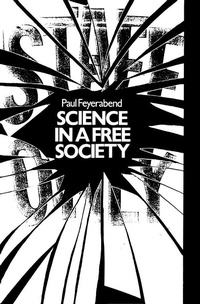
Science in a Free Society
Published on 10. November 2017
222 pages
978-1-78873-192-8 (ISBN)
Description

No study in the philosophy of science created such controversy in the seventies as Paul Feyerabend's Against Method. In this work, Feyerabend reviews that controversy, and extends his critique beyond the problem of scientific rules and methods, to the social function and direction of science today.
In the first part of the book, he launches a sustained and irreverent attack on the prestige of science in the West. The lofty authority of the "expert" claimed by scientists is, he argues, incompatible with any genuine democracy, and often merely serves to conceal entrenched prejudices and divided opinions with the scientific community itself. Feyerabend insists that these can and should be subjected to the arbitration of the lay population, whose closest interests they constantly affect-as struggles over atomic energy programs so powerfully attest.
Calling for far greater diversity in the content of education to facilitate democratic decisions over such issues, Feyerabend recounts the origin and development of his own ideas-successively engaged by Brecht, Ehrenhaft, Popper, Mill and Lakatos-in a spirited intellectual self-portrait.
Science in a Free Society is a striking intervention into one of the most topical debates in contemporary culture and politics.
In the first part of the book, he launches a sustained and irreverent attack on the prestige of science in the West. The lofty authority of the "expert" claimed by scientists is, he argues, incompatible with any genuine democracy, and often merely serves to conceal entrenched prejudices and divided opinions with the scientific community itself. Feyerabend insists that these can and should be subjected to the arbitration of the lay population, whose closest interests they constantly affect-as struggles over atomic energy programs so powerfully attest.
Calling for far greater diversity in the content of education to facilitate democratic decisions over such issues, Feyerabend recounts the origin and development of his own ideas-successively engaged by Brecht, Ehrenhaft, Popper, Mill and Lakatos-in a spirited intellectual self-portrait.
Science in a Free Society is a striking intervention into one of the most topical debates in contemporary culture and politics.
More details
Edition
Ebook UK & RoW
Language
English
Place of publication
London
United Kingdom
Target group
Professional and scholarly
Product notice
Reflowable
ISBN-13
978-1-78873-192-8 (9781788731928)
Copyright in bibliographic data and cover images is held by Nielsen Book Services Limited or by the publishers or by their respective licensors: all rights reserved.
Schweitzer Classification
Other editions
Additional editions
Person
Paul Feyerabend was Professor of Philosophy at UC Berkeley, and Professor of the Philosophy of Science at the Federal Institute of Technology at Zurich. He died in 1994. His books include Philosophical Papers, Farewell to Reason, and Against Method.
Content
- Intro
- Halftitle Page
- Title Page
- Copyright Page
- Contents
- Preface
- Part One: Reason and Practice
- 1. Against Method Revisited
- 2. Reason and Practice
- 3. On the Cosmological Criticism of Standards
- 4. 'Anything Goes'
- 5. The 'Copernican Revolution'
- 6. Aristotle not a Dead Dog
- 7. Incommensurability
- Part Two: Science in a Free Society
- 1. Two Questions
- 2. The Prevalence of Science a Threat to Democracy
- 3. The Spectre of Relativism
- 4. Democratic Judgement overrules 'Truth' and Expert Opinion
- 5. Expert Opinion often Prejudiced, Untrustworthy, and in Need of Outside Control
- 6. The Strange Case of Astrology
- 7. Laymen can and must supervise Science
- 8. Arguments from Methodology do not Establish the Excellence of Science
- 9. Nor is Science Preferable because of its Results
- 10. Science is one Ideology among many and should be separated from the State just as Religion is now separated from the State
- 11. Origin of the Ideas of this Essay
- Part Three: Conversations with Illiterates
- Chapter 1: Reply to Professor Agassi: with a footnote for Rom Harré and a postscript
- Chapter 2: Logic, Literacy and Professor Gellner
- Chapter 3: Marxist Fairytales from Australia
- Chapter 4: From Incompetent Professionalism to Professionalized Incompetence - the Rise of a New Breed of Intellectuals
- Chapter 5: Life at the LSE?
- Notes
- Index
