

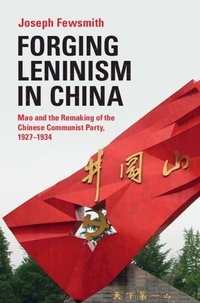
Forging Leninism in China
Mao and the Remaking of the Chinese Communist Party, 1927-1934
Published on 9. February 2022
978-1-009-08198-6 (ISBN)
Description

Forging Leninism in China is a re-examination of the events of the Chinese revolution and the transformation of the Chinese Communist Party from the years 1927 to 1934. Describing the transformation of the party as 'the forging of Leninism', Joseph Fewsmith offers a clear analysis of the development of the party. Drawing on supporting statements of party leaders and a wealth of historical material, he demonstrates how the Chinese Communist Party reshaped itself to become far more violent, more hierarchical, and more militarized during this time. He highlights the role of local educated youth in organizing the Chinese revolution, arguing that it was these local organizations, rather than Mao, who introduced Marxism into the countryside. Fewsmith presents a vivid story of local social history and conflict between Mao's revolutionaries and local Communists.
Reviews / Votes
'Forging Leninism reveals the critical development that shapes the Party that rules China today - the replacement of intellectual cliques and local networks with a fearsome military-political organization. In this theoretically informed and historically grounded narrative, Fewsmith shows how this happened and, amazingly, that it did not have to happen.' Timothy Cheek, The University of British Columbia 'That Mao Zedong's revolution is a modern peasant uprising that aims for self-emancipation from the brutal tyranny and exploitation of landlord class is a historical myth that dies hard. Fewsmith debunks it with a convincing account that argues for the importance of foreign ideology and Leninist leadership with which Mao mobilized peasants and imposed disciplines from outside the villages. Informing, interesting and enlightening, this book makes a rewarding read.' Yung-fa Chen, Academic Sinica, Taiwan 'Joseph Fewsmith has written a powerful, revisionist work on the origins of the communist revolution in China. Using new sources, he demonstrates that there was no inevitable path to national revolution; instead, local identity, violent encounters, and ideological dissent were volatile elements in a story that could have ended in the party's destruction rather than its rebirth. This will be key reading for all scholars of CCP history.' Rana Mitter, University of Oxford 'By entwining theoretical and historical analyses, this book deftly shows how the CCP shaped Leninism to fit within the political realities of China. ... Highly recommended.' S. K. Ma, Choice 'Fewsmith's account of China's post-1927 revolutionary history is a valuable contribution to the literature on the CPC. His focus on the struggles between local revolutionaries and Mao's 'outside' forces, as well as the conflict between Mao and the Party Centre, provides a rigorous analysis of the building of the Leninist party organisation under Mao's leadership.' Emre Demir, Europe-Asia Studies 'This is a well-written and insightful book that is highly recommended for students and anyone who seeks an unvarnished account of how Mao approached the Communist movement when he first got an opportunity to do so in his first primary 'revolutionary base area.' Knowing this helps readers to gain a better perspective on how Mao could have done what he did to China and the CCP after winning power nationally in 1949.' Steve Tsang, The China QuarterlyMore details
Language
English
Place of publication
Cambridge
United Kingdom
Illustrations
Worked examples or Exercises
File size
6,91 MB
ISBN-13
978-1-009-08198-6 (9781009081986)
Copyright in bibliographic data and cover images is held by Nielsen Book Services Limited or by the publishers or by their respective licensors: all rights reserved.
Schweitzer Classification
Other editions
Additional editions
Joseph Fewsmith
Forging Leninism in China
Mao and the Remaking of the Chinese Communist Party, 1927-1934
Book
09/2024
Cambridge University Press
€33.10
Shipment within 15-20 days
Joseph Fewsmith
Forging Leninism in China
Mao and the Remaking of the Chinese Communist Party, 1927-1934
Book
02/2022
Cambridge University Press
€50.70
Shipment within 15-20 days
Person
Content
Introduction; 1. Disaster and Local Rebellion; 2. The Donggu Revolutionary Base Area; 3. A Different Approach to Revolution; 4. Mao Versus Local Elites; 5. The Logic of Sufan; Conclusion.
