

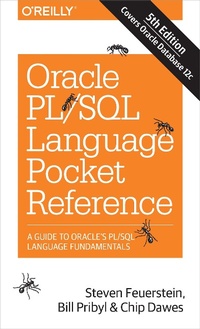
Oracle PL/SQL Language Pocket Reference
A Guide to Oracle''s PL/SQL Language Fundamentals
Published on 9. September 2015
190 pages
978-1-4919-1998-9 (ISBN)
Description

Be more productive with the Oracle PL/SQL language. The fifth edition of this popular pocket reference puts the syntax of specific PL/SQL language elements right at your fingertips, including features added in Oracle Database 12c.
Whether you're a developer or database administrator, when you need answers quickly, the Oracle PL/SQL Language Pocket Reference will save you hours of frustration with concise summaries of:
- Fundamental language elements, such as block structure, datatypes, and declarations
- Statements for program control, cursor management, and exception handling
- Records, procedures, functions, triggers, and packages
- Execution of PL/SQL functions in SQL
- Compilation options, object-oriented features, collections, and Java integration
This handy pocket reference is a perfect companion to Steven Feuerstein and Bill Pribyl's bestselling Oracle PL/SQL Programming.
More details
Other editions
Additional editions
Steven Feurstein | Bill Pribyl | Chip Dawes
Oracle PL/SQL Language Pocket Reference, 5E
A Guide to Oracle's PL/SQL Language Fundamentals
Book
10/2015
5th Edition
O'Reilly
€19.00
Shipment within 10-20 days
Content
- Intro
- Copyright
- Table of Contents
- Oracle PL/SQL Language Pocket Reference
- Introduction
- Acknowledgments
- Conventions
- PL/SQL Language Fundamentals
- PL/SQL Character Set
- Identifiers
- Boolean, Numeric, and String Literals
- Numeric Literals
- Datetime Interval Literals
- Delimiters
- Comments
- Pragmas
- Statements
- Block Structure
- Variables and Program Data
- Scalar Datatypes
- LOB Datatypes
- Implicit Datatype Conversions
- NULLs in PL/SQL
- Declaring Variables
- Anchored Declarations
- Programmer-Defined Subtypes
- Conditional and Sequential Control
- Conditional Control Statements
- Sequential Control Statements
- Loops
- Simple Loop
- Numeric FOR Loop
- Cursor FOR Loop
- WHILE Loop
- "Repeat Until" Loop Emulation
- EXIT Statement
- CONTINUE Statement
- Loop Labels
- Database Interaction
- Sequences in PL/SQL
- Transaction Management
- Autonomous Transactions
- Cursors in PL/SQL
- Explicit Cursors
- Implicit Cursors
- Native Dynamic SQL
- DBMS_SQL
- SQL Injection and Bind Variables
- Cursor Variables
- Cursor Expressions
- Exception Handling
- Declaring Exceptions
- Raising Exceptions
- Scope
- Propagation
- Records in PL/SQL
- Declaring Records
- Referencing a Record's Fields
- Assigning Records
- Records and DML
- Nested Records
- Collections in PL/SQL
- Declaring a Collection
- Initializing a Collection
- Adding and Removing Elements
- Nested Table Functions
- Collection Methods
- Collections and Privileges
- Nested Collections
- Bulk Binds
- Built-in Functions and Packages
- Built-in Functions
- Built-in Regular Expression Functions
- Stored Procedures and Functions
- Procedures
- Functions
- Parameters
- Local Programs
- Program Overloading
- Forward Declarations
- Table Functions
- Function Result Cache
- Privileges and Stored PL/SQL
- Triggers
- Creating Triggers
- Trigger Predicates
- DML Events
- Compound DML Triggers
- DDL Events
- Database Events
- Packages
- Package Structure
- Referencing Package Elements
- Package Data
- SERIALLY_REUSABLE Pragma
- Package Initialization
- Calling PL/SQL Functions in SQL
- Calling a Function
- Improving Performance of Calling PL/SQL Functions from SQL
- Column Name Versus Function Name Precedence
- Object-Oriented Features
- Object Types
- Type Inheritance
- Methods
- Methods in Subtypes
- Manipulating Objects in PL/SQL and SQL
- Upcasting and Downcasting
- Changing Object Types
- Compilation
- Compiling Stored PL/SQL Programs
- Conditional Compilation
- Compiler Warnings
- Optimizing Compiler
- Performing Native Compilation of PL/SQL
- Java Language Integration
- Example
- Publishing Java to PL/SQL
- Data Dictionary
- Index
