

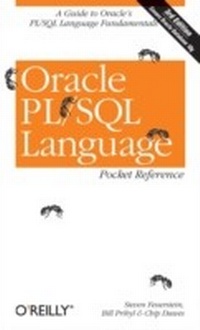
Oracle PL/SQL Language Pocket Reference
A guide to Oracle's PL/SQL language fundamentals
1st Edition
Published on 6. April 2004
160 pages
978-0-596-52886-7 (ISBN)
Description

While it's good to have a book with all the answers--like your trusty copy of Oracle PL/SQL Programming-- how often do you need all the answers? More likely, you just need a reminder, a quick answer to a problem you're up against. For these times, nothing's handier than the new edition of the Oracle PL/SQL Language Pocket Reference by PL/SQL experts Stephen Feuerstein, Bill Pribyl, and Chip Dawes. Newly updated for Oracle10g, this little book is always at the ready for the quick problem solving you need.The 3rd edition of this popular mini-reference boils down the most vital information from Oracle PL/SQL Programming into a handy guide to PL/SQL basics. The book includes fundamental language elements, such as block structure, identifiers, variables, datatypes, ad declarations; statements for program control, cursor management, and exception handling; the basics of records, procedures, functions, triggers, and packages; and the calling of PL/QL functions in SQL.And there's more. This concise guide also covers Oracle objects, collections, external procedures, Java integration, and new Oracle 10g elements like regular expressions, compile-time warnings, more implicit conversion, FORALL support for non-consecutive indexes, and more. The amount of valuable information packed into this slim volume--intelligently arranged for quick accessibility--make this an indispensable reference for new and seasoned Oracle database developers alike.O'Reilly's Pocket References have become a favorite among developers and database administrators everywhere. By providing a wealth of important details in a concise, well-organized format, these handy books deliver just what you need to complete the task at hand. When you've reached a sticking point in your work and need to get to a solution quickly, the 3rd edition of Oracle PL/SQL Language Pocket Reference is the book you'll want to have.
More details
Other editions
Additional editions
Steven Feuerstein | Bill Pribyl | Chip Dawes
Oracle PL/SQL Language Pocket Reference
Book
05/2004
3rd Edition
O'Reilly
€8.50
Article exhausted; check for reprint
Content
- Intro
- Contents
- Oracle PL/SQL Language Pocket Reference
- Introduction
- Acknowledgments
- Conventions
- PL/SQL Language Fundamentals
- PL/SQL Character Set
- Identifiers
- Boolean, Numeric, and String Literals
- Numeric Literals
- Datetime Interval Literals
- Delimiters
- Comments
- Pragmas
- Statements
- Block Structure
- Variables and Program Data
- Scalar Datatypes
- Numeric datatypes
- Character datatypes
- Datetime datatypes
- BOOLEAN datatype
- NLS Character Datatypes
- LOB Datatypes
- Implicit Datatype Conversions
- NULLs in PL/SQL
- Declaring Variables
- Constrained declarations
- Constants
- Default values
- Anchored Declarations
- Programmer-Defined Subtypes
- Conditional and Sequential Control
- Conditional Control Statements
- IF-THEN combination
- IF-THEN-ELSE combination
- IF-THEN-ELSIF combination
- CASE statement
- CASE expression
- Sequential Control Statements
- GOTO
- NULL
- Loops
- Simple Loop
- Numeric FOR Loop
- Cursor FOR Loop
- WHILE Loop
- REPEAT UNTIL Loop Emulation
- EXIT Statement
- Loop Labels
- Database Interaction
- Transaction Management
- COMMIT
- ROLLBACK
- SAVEPOINT
- SET TRANSACTION
- LOCK TABLE
- Autonomous Transactions
- Cursors in PL/SQL
- Explicit Cursors
- Declaring explicit cursors
- Opening explicit cursors
- Fetching from explicit cursors
- Closing explicit cursors
- Explicit cursor attributes
- Implicit Cursors
- SELECT FOR UPDATE clause
- WHERE CURRENT OF clause
- Dynamic Cursors
- Cursor Variables
- Cursor Expressions
- Exception Handling
- Declaring Exceptions
- Raising Exceptions
- Scope
- Propagation
- WHEN OTHERS clause
- SQLCODE and SQLERRM
- Exceptions and DML
- Records in PL/SQL
- Declaring Records
- Referencing Fields of Records
- Assigning Records
- DML and Records
- Nested Records
- Named Program Units
- Procedures
- Functions
- Parameters
- Datatype
- Mode
- Default values
- Parameter-passing notations
- Local programs
- Program overloading
- Forward declarations
- Table functions
- Compiling stored PL/SQL programs
- Compiler warnings (Oracle Database 10g)
- The optimizing compiler (Oracle Database 10g)
- Performing native compilation of PL/SQL
- Privileges and stored PL/SQL
- Triggers
- Creating Triggers
- Trigger Predicates
- DML Events
- DDL Events
- Database Events
- Packages
- Package Structure
- Referencing Package Elements
- Package Data
- SERIALLY_REUSABLE Pragma
- Package Initialization
- Calling PL/SQL Functions in SQL
- Calling a Function
- Requirements and Restrictions
- Calling Packaged Functions in SQL
- Column/Function Name Precedence
- Oracle's Object-Oriented Features
- Object Types
- Type Inheritance
- Methods
- Member methods
- Static methods
- Constructor methods
- Comparison methods
- Methods in Subtypes
- Manipulating Objects in PL/SQL and SQL
- Upcasting and Downcasting
- REF operator
- VALUE operator
- DEREF operator
- Changing Object Types
- Collections
- Declaring a Collection
- Initializing a Collection
- Adding and Removing Elements
- Nested Table Functions
- Collection Methods
- Collections and Privileges
- Nested Collections
- Bulk Binds
- External Procedures
- Creating an External Procedure
- Set up the listener
- Identify or create the shared library or DLL
- Create the library in the database
- Create the PL/SQL wrapper for the external procedure
- Parameters
- Java Language Integration
- Example
- Publishing Java to PL/SQL
- Data Dictionary
- Regular Expressions (Oracle Database 10g)
- Metacharacters
- REGEXP_LIKE
- REGEXP_INSTR
- REGEXP_SUBSTR
- REGEXP_REPLACE
- Match Modifiers
- Reserved Words
- Index
