

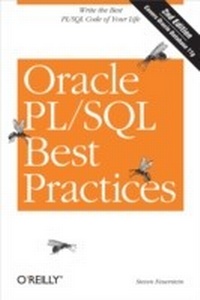
Oracle PL/SQL Best Practices
Write the Best PL/SQL Code of Your Life
1st Edition
Published on 22. October 2007
294 pages
978-0-596-55152-0 (ISBN)
Description

In this compact book, Steven Feuerstein, widely recognized as one of the world's leading experts on the Oracle PL/SQL language, distills his many years of programming, teaching, and writing about PL/SQL into a set of best practices-recommendations for developing successful applications. Covering the latest Oracle release, Oracle Database 11gR2, Feuerstein has rewritten this new edition in the style of his bestselling Oracle PL/SQL Programming. The text is organized in a problem/solution format, and chronicles the programming exploits of developers at a mythical company called My Flimsy Excuse, Inc., as they write code, make mistakes, and learn from those mistakes-and each other.This book offers practical answers to some of the hardest questions faced by PL/SQL developers, including:What is the best way to write the SQL logic in my application code?How should I write my packages so they can be leveraged by my entire team of developers?How can I make sure that all my team's programs handle and record errors consistently?Oracle PL/SQL Best Practices summarizes PL/SQL best practices in nine major categories: overall PL/SQL application development; programming standards; program testing, tracing, and debugging; variables and data structures; control logic; error handling; the use of SQL in PL/SQL; building procedures, functions, packages, and triggers; and overall program performance.This book is a concise and entertaining guide that PL/SQL developers will turn to again and again as they seek out ways to write higher quality code and more successful applications."e;This book presents ideas that make the difference between a successful project and one that never gets off the ground. It goes beyond just listing a set of rules, and provides realistic scenarios that help the reader understand where the rules come from. This book should be required reading for any team of Oracle database professionals."e;--Dwayne King, President, KRIDAN Consulting
More details
Other editions
Additional editions
Book
11/2007
2nd Edition
O'Reilly
€28.50
Shipment within 10-20 days
Previous edition
E-Book
04/2001
1st Edition
O'Reilly
€14.49
Available for download
Content
- Intro
- Table of Contents
- Preface
- Why Best Practices?
- Best Practices and the Real World
- They Call This "Work"?
- The Cast of Characters
- Structure of This Book
- How to Use This Book
- Conventions Used in This Book
- About the Code
- Comments and Questions
- Safari Books Online
- Acknowledgments
- The Big Picture
- Successful Applications Are Never an Accident
- Successful Applications Meet User Requirements
- Successful Applications Are Maintainable
- Successful Applications Run Fast Enough
- Best Practices for Successful Applications
- Problem: In software, the ends (production code) are inseparable from the means (the build process).
- Solution: Agree on a common development workflow built around standards, testing, and reviews.
- Application-level workflow
- Single-program construction workflow
- Step 1. Validate program requirements
- Step 2. Implement just the header of the program
- Step 3. Define the tests that must be run
- Step 4. Build your test code
- Problem: What is never discussed is never agreed upon.
- Solution: Contracts capture agreements.
- Problem: Steven is a hypocritical programmer.
- Solution: Give your brain a break, and ask others for help.
- Problem: Sunita spent six months developing comprehensive coding standards for her group.
- Solution: Move beyond documents to a review process that directly engages the development team.
- Resources
- Problem: Jasper is starting to feel more like a robot than a human being.
- Solution: If you can recognize a pattern in what you are writing, generate code from that pattern.
- Real Developers Follow Standards
- Best Practices for Developing and Using Standards
- Problem: Delaware writes code that no one else can read.
- Solution: Use the built-in functionality of your IDE to automatically format your code.
- Problem: Jasper's eagerness to help is overwhelmed by his hurry to get it done.
- Solution: Rely on naming conventions that are intuitive and easy to apply.
- Problem: Badly formed or inaccurate names can greatly reduce usability of programs.
- Solution: Construct subprogram names so they reflect both what they are and what they do.
- Problem: Checklists on paper rarely translate into changes in the way we write our code.
- Solution: Make your checklists active and directly involved in development.
- Resources
- Problem: One person's clarity is another person's bewilderment.
- Solution: Sometimes you really do need to add comments.
- Life After Compilation
- Testing, Tracing, and Debugging
- Testing
- Tracing
- Debugging
- Best Practices for Testing, Tracing, and Debugging
- Problem: DBMS_OUTPUT.PUT_LINE is inadequate for tracing.
- Solution: Build a layer of code over DBMS_OUTPUT.PUT_LINE.
- Problem: We live in the moment, and don't think about what it will take to maintain our code.
- General Solution: Build instrumentation (tracing) into your application from the start.
- Specific Solution 1: Embed trace calls in Boolean expressions to minimize overhead.
- Specific Solution 2: Include standardized modules in packages to dump package state when errors o...
- Specific Solution 3: Build trace "windows" into your packages using standardized programs.
- Problem: Sunita's team is dragged down off its pedestal of semi-godliness.
- General Solution: Don't make testing an option, and don't just "try" a few things.
- Specific Solution 1: A brief introduction to utPLSQL.
- Specific Solution 2: A brief introduction to Quest Code Tester for Oracle.
- Resources
- Problem: We cannot trust our own minds to fully and objectively test our code.
- Solution: Decide before you implement your program how you will know when it works correctly.
- Resources
- Problem: Lizbeth has entered a medical condition called the Test-By-Hand Coma State.
- Solution: When it comes to testing, be happy with getting started and with steady progress.
- Problem: Jasper writes some complicated code and has no idea what it is doing.
- Solution: Use the built-in, interactive source debuggers available in almost every PL/SQL IDE.
- What's Code Without Variables?
- Best Practices for Declaring Variables and Data Structures
- Problem: Lizbeth writes a "quick-and-dirty" program.
- Solution: Assume that everything will change and that any program you write could be around for d...
- Problem: Lizbeth learns her lesson but then cannot apply it.
- Solution: Create a new datatype with SUBTYPE and anchor to that.
- Problem: The exception section of a block can only trap errors raised in the execution section.
- Solution: Don't trust the declaration section to assign default values.
- Best Practices for Using Variables and Data Structures
- Problem: Business rules can be complicated, and it's hard to keep them straight.
- Solution: Simplify code to make the criteria for the business rules more obvious.
- Problem: World weariness infects Lizbeth's code.
- Solution: Don't let your weariness show in your code-and don't recycle!
- Problem: Sometimes you really do need to clean up in a PL/SQL block.
- Resources
- Problem: PL/SQL performs implicit conversions-but they're not always what you want.
- Solution: Perform explicit conversions rather than relying on implicit conversions.
- Resources
- Best Practices for Declaring and Using Package Variables
- Problem: Jasper needs Lizbeth's program data. Delaware needs Jasper's program data.
- Solution: Don't expose program data in package specifications, letting everyone see and change it.
- Problem: Data structures declared in a package specification may end up bypassing business rules.
- Solution: Declare data in the package body, and hide the data structures via functions in the pac...
- Developer As Traffic Cop
- Best Practices for Conditional and Boolean Logic
- Problem: IF-statement logic can become complex and confusing.
- Solution: Simplify by specifying clauses at multiple levels.
- Problem: Lizbeth needs to construct a string conditionally from a number of pieces.
- Solution: CASE will greatly simplify the code.
- Solution: Don't forget the ELSE in the CASE!
- Problem: Why is Lizbeth's IF statement doing that?
- Solution: Remember that a NULL is not equal to anything else, even another NULL, and code explici...
- Best Practices for Loop Processing
- Problem: Jasper writes a loop that offers many exit paths.
- Solution: One way in, one way out.
- Problem: The previous developer wrote some code just in case.
- Solution: Cyberspace is a world of our making. Remove all uncertainty from your code.
- Problem: It's so hard to write code without making assumptions!
- Solution: Write "full collection scans" so that there is no assumption about how the collection i...
- Best Practices for Branching Logic
- Resources
- Doing the Right Thing When Stuff Goes Wrong
- Best Practices for Understanding Error Handling
- Problem: Know-it-alls don't know the most important thing: they're wrong!
- Solution: Take some time to familiarize yourself with how PL/SQL exception management works and w...
- Resources
- Deliberate exceptions
- Unfortunate and unexpected exceptions
- How to benefit from this categorization
- Problem: Application logic in the exception is hard to find and maintain.
- Solution: Avoid application logic in the exception section.
- Problem: Unhandled unfortunate exceptions make your code less flexible and more difficult to reuse.
- Solution: Transform the exception to a status indicator that can be interpreted by the user of th...
- Problem: Unhandled unexpected errors cause a loss of information about the cause of the error.
- Solution: Handle those unexpected, "hard" errors and then re-raise the exception.
- In conclusion . . .
- General Problem: Chaos reigns!
- Specific Problem 1: Get word back to the users.
- Specific Problem 2: How do I log my error? Let me count the ways . . .
- General Solution: One component, under source control, for all to use.
- Specific Solution 1: No more RAISE_APPLICATION_ERROR.
- Specific Solution 2: Use declarative error handler routines.
- Resources
- Best Practices for Nitty-Gritty, Everyday Exception Programming
- Problem: A little bit of laziness and a slight dose of advanced features can ruin a good program.
- Solution: Avoid writing "clever" code that shows just how much you know and how smart you are.
- Problem: The "I don't care" exception handler can cover up problems too indiscriminately.
- Solution: Add value in WHEN OTHERS: log information and re-raise some exception or other!
- Best Practices for Coding Defensively
- Problem: Delaware expects everyone to be a know-it-all like him.
- Solution: Assume nothing! Make all assumptions explicit, and then validate them.
- Resources
- Break Your Addiction to SQL
- SQL Is Bad!
- Step 1. Hardcoding is bad.
- Step 2: Every SQL statement you write is a hardcoding.
- Step 3. Draw the logical conclusion.
- General SQL Best Practices
- Problem: PL/SQL developers are addicted to SQL!
- Solution: Never repeat a SQL statement
- instead, implement SQL behind procedures and functions.
- Problem: Global search-and-replace to the rescue!
- Solution: Always check after global search-and-replace, and qualify all variable references.
- Problem: Your error log entries have disappeared!
- Solution: Save your log information separately from your business transaction logic.
- Problem: Is everything Lizbeth does in her programs some kind of hardcoding?
- Solution: Call your own program to do the commit (or rollback), and make it more flexible.
- Resources
- Best Practices for Querying Data from PL/SQL
- Problem: A change in one place affects many others-never a good idea.
- Solution: Skip all those declarations and replace them with a single record.
- Problem: Delaware is not a good listener.
- Solution: Use COUNT only when you need to know "How many rows?"
- Problem: Jasper chooses the wrong time to be lazy.
- Solution: Use the cursor FOR loop only when fetching multiple rows.
- Best Practices for Changing Data from PL/SQL
- Problem: Jasper knows what he's supposed to do. He just can't bring himself to do it.
- Solution: Make sure that any errors that can be anticipated are logged and communicated to the user.
- Problem: It's hard to think about what a table will be like in the future.
- Solution: Always explicitly list the columns that are part of the INSERT statement.
- Problem: I check the contents of the SQL%ROWCOUNT too late in the game.
- Solution: Remember that SQL% attributes always refer to the most recently executed implicit curso...
- Best Practices for Dynamic SQL
- Problem: There's something wrong with Lizbeth's dynamic SQL, but she can't figure it out.
- Solution: Make sure your exception section can display the string that failed to parse.
- Problem: You have lots of dynamic SQL updates, with different values each time.
- Solution: Bind, don't concatenate, to optimize performance and simplify dynamic string construction.
- Problem: So many teenagers, so many ways to enter data at the web site.
- Solution: Avoid concatenation of SQL text, rely on bind variables, and secure your schemas.
- Problem: A seemingly handy utility goes badly wrong.
- Solution: Make sure your dynamic SQL programs run under the invoker's authority.
- Resources
- Playing with Blocks (of Code)
- Best Practices for Parameters
- Problem: Lizbeth's program needs to do more, and do it differently.
- Solution: Make sure all new IN arguments have defaults, or add an overloading.
- Problem: What seems obvious at the moment of writing is far less clear months or years later.
- Solution: Use named notation to make everything clear.
- Problem: Jasper returns data in a very confusing manner.
- Solution: Return multiple values through a single, composite structure or with a procedure.
- Best Practices for Procedures and Functions
- Problem: Lengthy blobs of spaghetti code are unmanageable.
- Solution: Use step-wise refinement and local subprograms to make code transparent in purpose and ...
- There's more to tiny chunks than just local subprograms.
- Resources
- Problem: Delaware packs it all in and no one wants to use it.
- Solution: Write programs with very specific purposes and avoid hidden (a.k.a. global) dependencies.
- Problem: Jasper actually thinks a rule will never change!
- Solution: Wrap or hide all business rules and formulas inside functions.
- Problem: Sunita tosses off "quick-and-dirty" code in a function lookup routine.
- Problem: Sure, the program works-but only if you assume a perfect world.
- Solution: Don't allow multiple exit points from the function.
- Problem: Jasper gets really confused with a Boolean function returning a NULL.
- Solution: Ensure that a Boolean function returns only TRUE or FALSE.
- Best Practices for Packages
- Problem: It seemed that there would be only one program-now there are many.
- Solution: Put in the dot from the start: package.subprogram.
- Problem: Some of Oracle's supplied packages are harder to use than they should be.
- Solution: Create multiple programs with the same name (overloading) that anticipate user needs.
- Best Practices for Triggers
- Problem: Seemingly random trigger behavior is driving Jasper nuts.
- Solution: Consolidate "same event" triggers or use the FOLLOWS clause.
- Resources
- Problem: Lizbeth has created a dozen triggers and a support package on a critical database table.
- Solution: Consolidate all logic into a compound trigger, and lose the package if it is present on...
- Problem: There's more than one way to make an excuse.
- Solution 1: Apply the business rule at the lowest level possible, to ensure that it cannot be avo...
- Solution 2: Populate columns of derived values with triggers.
- My Code Runs Faster Than Your Code
- Best Practices for Finding Slow Code
- PL/SQL Profiler (DBMS_PROFILER)
- PL/SQL Trace (DBMS_TRACE)
- PL/SQL Hierarchical Profiler (DBMS_HPROF)
- Application Data Profiler (DBMS_APPLICATION_INFO)
- Problem: There are hundreds of ways to implement a requirement. How can Lizbeth find the fastest ...
- Solution: Use DBMS_UTILITY.GET_TIME and GET_CPU_TIME for very granular analysis.
- Resources
- Best Practices for High-Impact Tuning
- Problem: It worked so quickly in SQL*Plus. Why is it so slow in PL/SQL?
- Solution: Sometimes you have to help PL/SQL integrate with SQL.
- Problem: Jasper queries the same, unchanging data over and over and over again.
- Solution: If the normal SGA cache doesn't the trick, look for other ways to cache.
- Problem: Users hate to wait.
- Solution: Design your function to return data while it is still running!
- And that's not all!
- Best Practices for Other Tuning
- Problem: Delaware wants to use collections as parameters, but they are causing a bottleneck.
- Solution: Turn off the default copying that comes with IN OUT arguments.
- Problem: Lizbeth lost her focus as she wrote her loop.
- Solution: Avoid executing anything inside a loop that doesn't change in that loop.
- Problem: Oracle goes out of its way to make it easy for us to write PL/SQL programs.
- Solution: Avoid implicit conversions and choose your datatypes carefully.
- Best Practices Quick Reference
- Resources for PL/SQL Developers
- Book Example Files
- Books and Other Content
- Oracle PL/SQL Books
- Other Helpful Books
- Online Content
- Free Software
- Index
