

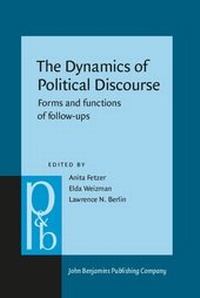
The Dynamics of Political Discourse
Forms and functions of follow-ups
1st Edition
Published on 27. August 2015
VI, 278 pages
978-90-272-6824-2 (ISBN)
Description

Rethinking Sinclair and Coulthard's sequentiality-based notion of the follow-up, this volume explores its forms and communicative functions in traditional and contemporary modes of communication (parliamentary sessions, interviews, debates, speeches, op-eds, discussion forums and Twitter) wherein political actors address challenges to their political agenda and to their political face. In so doing, the volume achieves two major advances. First, its contributions expand the understanding of follow-ups beyond the traditional focus on structural sequentiality, considering communicative function as a defining feature of a follow-up. Second, it broadens the understanding of what constitutes political discourse, as not being limited to a single discourse, but also being able to span multiple discourses of different forms and speech events over time.
More details
Other editions
Additional editions
Anita Fetzer | Elda Weizman | Lawrence N. Berlin
The Dynamics of Political Discourse
Forms and functions of follow-ups
Book
08/2015
John Benjamins Publishing Co
€100.70
Shipment within 10-15 days
Persons
Content
- The Dynamics of Political Discourse
- Editorial page
- Title page
- LCC data
- Table of contents
- Introduction
- 1. Setting the stage
- 2. Approaching follow-ups
- 3. This volume
- References
- Part I. Approaching follow-ups
- Sequentiality and follow-ups
- 1. Introduction: Problems with speech acts
- 2. Rethinking context: 'Land-borne situated discourse' (LBSD)
- 3. Context and situation
- 4. Situated acts and directionality
- 5. Sequential dynamics and sequentiality
- 6. Conversation and follow-up
- 7. Follow-ups and the time dimension
- 8. A Japanese example
- 9. Consecutive uptake and the space-time dimension: Dell Hymes' 'speech event'
- 10. Sequencing pilots: Beyond banal conversation
- 11. Sequencing an 'affair': An ambiguous question
- 12. Conclusions
- 13. Last word: A more natural pragmatics?
- References
- Follow-ups as speech acts in mediated political discourse
- 1. Illocutionary acts sequences
- 2. Austin's (1975) category of expositives and their illocutionary effects in discourse
- 3. President Obama's follow-up utterance at the 2012 Presidential Debate
- 4. Interdiscursiveness and intersubjectivity
- References
- Monologic follow-ups in political macro-discourse: The US anti-terrorist discourse as a case in poin
- 1. Introduction
- 2. Follow-ups: From dialogue to monologue
- 3. Political (legitimization) macro-discourses as follow-up venues
- 4. Follow-ups in the discourse of the Iraq War: A view from proximization theory
- 5. Conclusion
- References
- Part II. Follow-ups across genres
- Pragmatic strategies for follow-ups in US political debates
- 1. Introduction
- 2. Conceptual framework: Multilayered Model of Context
- 3. Methodology
- 4. Discussion
- 5. Conclusions
- References
- Follow-ups and dialogue in online discussions on French politics: From Internet forums to social TV
- 1. Introduction
- 2. Context and conceptual background
- 3. Follow-ups and dialogue in online political discussions: A comparative perspective
- 4. Follow-ups and dialogue in social TV
- 5. Conclusion
- References
- Online follow-ups as evaluative reactions to two visits of the Argentinian President to the United S
- 1. Introduction
- 2. Evaluation and interpersonal meaning in discourse
- 3. The communicative situation
- 4. Expressing evaluative meaning in online follow-ups
- 5. Conclusion
- References
- Part III. The perlocutionary potential of follow-ups as objects of talk
- Irony in and through follow-ups: Talk and meta-talk in online commenting in the Israeli context
- 1. Introduction
- 2. Readers' comments as follow-ups
- 3. Why study irony in and through readers' comments?
- 4. Irony through readers' comments: The perception of irony in op-eds
- 5. Cues for irony as follow-ups
- 6. Irony in readers' comments: Affiliative reciprocation of irony
- 7. Conclusion
- References
- Follow-ups as multifunctional questioning and answering strategies in Prime Minister's Questions
- 1. Introduction
- 2. Parliamentary questioning practices
- 3. Question design and parliamentary goals
- 4. Forms and functions of parliamentary follow-ups in PMQs
- 5. Concluding remarks
- References
- If I am elected President Other-quotations in French presidential debates
- 1. Introduction
- 2. Presidential debates
- 3. Quotations as follow-ups
- 4. Data and methodology
- 5. Sociopolitical topics
- 6. Discursive identity of the politician
- 7. Force and nature of communicative acts
- 8. Conclusion
- Materials
- References
- Appendix 1
- Appendix 2
- 'When you came into office you said that your government would be different': Forms and functions of
- 1. Introduction
- 2. Quotation: Forms and functions
- 3. Quotations in political discourse
- 4. Conclusion
- Acknowledgement
- References
- Appendix
- Subject index
