

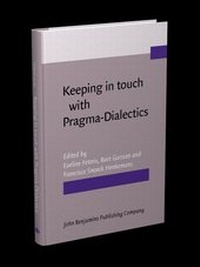
Keeping in touch with Pragma-Dialectics
In honor of Frans H. van Eemeren
1st Edition
Published in 2011
VI, 283 pages
978-90-272-8703-8 (ISBN)
Description

Keeping in touch with Pragma-Dialectics is written to honor Frans van Eemeren and his work in the field of argumentation theory on the occasion of his retirement. The volume contains 17 contributions from teams of authors consisting of a combination of a pragma-dialectician and one or two researchers with a different background in the field of argumentation. In this volume, comparisons between the pragma-dialectical approach and other approaches are made, aspects of strategic maneuvering such as the use of presentational techniques, adaptation to the audience and the selection of topics are dealt with and the influence of specific institutional contexts such as politics, medicine and internet forums on strategic maneuvering are discussed.
More details
Other editions
Additional editions
Eveline T. Feteris | Bart Garssen | Francisca Snoeck Henkemans
Keeping in touch with Pragma-Dialectics
In honor of Frans H. van Eemeren
Book
05/2011
John Benjamins Publishing Co
€100.70
Shipment within 10-15 days
Persons
Content
- Keeping in touch with Pragma-Dialectics
- Title page
- LCC data
- Table of contents
- Introduction
- Maneuvering strategically with dissociation in a political interview
- 1. Introduction
- 2. Dissociation in an argumentative confrontation
- 3. Institutional preconditions for confrontational strategic maneuvering in a political interview
- 4. Dissociation at work - a sample analysis
- 5. Conclusion
- Notes
- References
- Strategic maneuvering in critical reactions to pragmatic argumentation
- 1. Introduction
- 2. Pragmatic argumentation and criticism
- 3. Strategic maneuvering in critical responses to pragmatic argumentation: A case study
- 3.1 Porters' selection of the topical potential
- 3.2 Porter's adaption to the audience
- 3.3 Porter's use of presentational devices
- 4. Discussion
- Notes
- References
- Figurative analogy in political argumentation
- 1. Introduction
- 2. The structure of figurative analogies
- 3. Figurative analogies within the political discourse of Austria and The Netherlands
- 4. Conclusion
- Notes
- References
- Anecdotes and arguments
- 1. Introduction
- 2. An anecdote as told by Bush
- 2.1 The anecdote's function
- 2.2 Bush's anecdote as a strategic maneuver
- 3. Three anecdotes as told by Hilary Clinton
- 4. Conclusion
- Notes
- References
- Pragma-dialectical analysis of rhetorical texts
- 1. The analytical problem
- 2. The case study: Obama in Cairo, June 2009
- 3. Analysis
- 3.1 Audiences and their commitments
- 3.2 Reconstructing the discourse: Standpoint analysis
- 3.3 Strategic maneuvering
- 4. Conclusion
- Notes
- References
- Amplification in strategic maneuvering
- 1. Introduction
- 2. Presentational devices in strategic maneuvering
- 3. Amplification in the rhetorical tradition
- 4. Cases of amplification
- 5. Amplification as an aspect of strategic maneuvering
- 6. Conclusion
- Notes
- References
- Breast cancer screening
- 1. Introduction
- 2. Breast cancer in Holland
- 3. Reconstructing health communication leaflets as implicit dialogues
- 4. Research question
- 5. Experiment 1: Anecdotal versus statistical presentation
- 5.1 Method
- 5.1.1 Material
- 5.1.2 Participants/Procedure
- 5.2 Results
- 6. Experiment 2: Anecdotal presentation and framing
- 6.1 Method
- 6.1.1 The material
- 6.2 Results
- 7. Experiment 3: Statistical presentation and framing
- 8. A comparison between statistical and anecdotal presentation
- 9. Post-experimental responses
- Notes
- References
- A doctor's ethos enhancing maneuvers in medical consultation
- 1. Introduction
- 2. Health care in the Netherlands
- 3. Argumentative discourse in medical consultation
- 4. Ethos enhancing strategic maneuvers in medical consultation
- 5. A doctor's ethos enhancing maneuvers to built trust and stress expertise
- 6. Conclusion
- Notes
- Literature
- "Try the smarter way"
- 1. Introduction
- 2. Assessing the quality of argumentation in advertising
- 3. Requirements for the quality of argumentation on the effects of medicines
- 4. The analysis
- 4.1 Remdex
- 4.2 BenzaClin
- 5. Discussion
- 6. Conclusion
- Notes
- References
- Argument analysis in large scale deliberation
- 1. Introduction
- 2. Large-scale deliberation: Current practice and classic theory
- 3. The classic puzzle of deliberation
- 4. Argumentative grounds for analyzing large-scale deliberation
- 5. Classic puzzle of deliberation as a dialectical trade-off
- 6. Analysis of large-scale deliberation as a challenge to argumentation theory
- 7. Conclusion
- Notes
- References
- The pragma-dialectical account of argument schemes
- 1. Introduction
- 2. The pragma-dialectical typology
- 2.1 The main types
- 2.2 Variants and sub-types
- 2.3 Evaluating the use of argument schemes
- 3. Problems
- 3.1 Ordering principle of the typology
- 3.2 Exhaustiveness of the types
- 3.3 Mutual exclusiveness of the types
- 3.4 Relation between critical questions of a main type and of a sub-type
- 3.5 Relevance and completeness of the critical questions
- 3.6 Status of the preliminary questions for some sub-types
- 4. A proposed revision
- 5. Summary
- Notes
- References
- The analysis of the strategic function of presentational techniques
- 1. Introduction
- 2. The strategic function of presentational techniques
- 3. The argumentative situation and the strategic function of dissociation
- 3.1 Dissociation as opposition
- 3.2 Dissociation as a way of denying the undeniable
- 3.3 Dissociation as values-utilizing
- 4. Conclusion
- Notes
- References
- Handling counterarguments
- 1. The pragma-dialectical normative analysis of handling counterarguments
- 2. Social-scientific research findings concerning handling counterarguments
- 3. Convergences and divergences in normative and descriptive analyses of handling counterarguments
- 4. Conclusion
- Notes
- References
- On Combining Pragma-Dialectics with Critical Discourse Analysis
- 1. Introduction
- 2. Two approaches to (argumentative) discourse
- 3. Prospects for a dialogue between Pragma-dialectics and CDA
- 4. Towards an integrated approach to argumentation analysis
- Notes
- References
- Formal dialectical systems and their uses in the study of argumentation
- 1. Introduction
- 2. Examples
- 2.1 System H
- 2.2 System CND
- 2.3 Comparing the two systems
- 3. A Laboratory of Rules
- 4. The pluralism of the formal dialectical approach
- 5. Conclusion
- Notes
- References
- The pragma-dialectical approach to circularity in argumentation
- 1. Introduction
- 2. Theoretical overview
- 2.1 Aristotle
- 2.2 Logical approaches
- 2.3 Doxastic approaches
- 2.4 Epistemic approaches
- 2.5 The shift to the dialectical
- 2.6 Desiderata for theories of question-begging
- 3. The pragma-dialectical account of the fallacy of question-begging
- 4. Some issues of interpretation
- 4.1 How are A and A* to be connected?
- 4.2 Is there a requirement of conclusiveness?
- 4.3 Four criteria for question begging arguments
- 5. Conclusion
- Acknowledgments
- Notes
- References
- Index
