

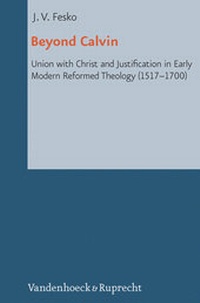
Beyond Calvin
Union with Christ and Justification in Early Modern Reformed Theology (1517-1700)
1st Edition
Published on 13. June 2012
416 pages
978-3-647-57022-8 (ISBN)
Description

The investigation of union with Christ and justification has been dominated by the figure of John Calvin. Calvin's influence, however, has been exaggerated in our own day. Theologians within the Early Modern Reformed tradition contributed to the development of these doctrines and did not view Calvin as the normative theologian of the tradition. John V. Fesko, therefore, goes beyond Calvin and explores union with Christ and justification in the Reformation, Early Orthodox, and High Orthodox periods of the Reformed tradition and covers lesser known but equally important figures such as Juan de Valdes, Peter Martyr Vermigli, Girolamo Zanchi, William Perkins, John Owen, Francis Turretin, and Herman Witsius. The study also covers theologians that either lie outside or transgress the Reformed tradition, such as Martin Luther, Philip Melanchthon, Faustus Socinus, Jacob Arminius, and Richard Baxter. By treating this diverse body of figures the study reveals areas of agreement and diversity on these two doctrines. The author demonstrates that among the diverse formulations, all surveyed Reformed theologians accord justification priority over sanctification within the broader rubric of union with Christ. Fesko shows that Reformed theologians affirm both union with Christ and the golden chain of salvation, ideas that moderns find incompatible. In sum, rather than reading an individual theologian isolated from his context, this study provides a contextual reading of union with Christ and justification in the Early Modern Reformed context.
More details
Other editions
Additional editions
John V. Fesko
Beyond Calvin
Union with Christ and Justification in Early Modern Reformed Theology (1517-1700)
Book
06/2012
1st Edition
Vandenhoeck & Ruprecht
from
€140.00
Shipment within 5-7 days
Person
Content
- Cover
- Title Page
- Copyright
- Table of Contents
- Abbreviations
- Preface
- 1. State of the question
- 1.1 Introduction
- 1.2 Calvin and the centrality of union with Christ
- 1.3 The Gaffin-school on Calvin and union
- 1.4 Analysis of the recent claims
- 1.5 Argument of the present essay
- 1.6 Plan of the present essay
- 1.7 Conclusion
- 2. Metaphysics and Justification
- 2.1 Introduction
- 2.2 Metaphysics in Calvin's doctrine of justification
- 2.3 Other Reformed witnesses
- 2.4 Why was Aristotelian metaphysics so prominent?
- 2.5 Conclusion
- 3. Rejection and Criticism of the Ordo Salutis
- 3.1 Introduction
- 3.2 Critics of the ordo salutis
- 3.3 Methodological Analysis
- 3.4 Summary and Conclusion
- 4. The Development and Use of the Ordo Salutis
- 4.1 Introduction
- 4.2 The Rise of the concept
- 4.3 The terminology of the ordo salutis
- 4.4 The exegetical support of the ordo salutis
- 4.5 The eschatological nature of the ordo salutis
- 4.6 Conclusion
- 5. Union with Christ and Justification Before the Reformation
- 5.1 Introduction
- 5.2 Augustine
- 5.3 Bernard of Clairvaux
- 5.4 Thomas Aquinas
- 5.5 Jean Gerson
- 5.6 Johann von Staupitz
- 5.7 Conclusion
- 6. Martin Luther
- 6.1 Introduction
- 6.2 The claimed Lutheran-Reformed divide
- 6.3 Union with Christ
- 6.4 Justification and sanctification
- 6.5 Conclusion
- 7. Philip Melanchthon
- 7.1 Introduction
- 7.2 Justification
- 7.3 Sanctification and union with Christ
- 7.4 Melanchthon and Osiander
- 7.5 Implications of Melanchthon's views
- 7.6 Conclusions
- 8. Juán de Valdés
- 8.1 Introduction
- 8.2 Union with Christ
- 8.3 Justification
- 8.4 Sanctification
- 8.5 Conclusion
- 9. Heinrich Bullinger
- 9.1 Introduction
- 9.2 Biographical and bibliographical sketch
- 9.3 Union with Christ and the ordo salutis
- 9.4 Justification and sanctification
- 9.5 Conclusion
- 10. Peter Martyr Vermigli
- 10.1 Introduction
- 10.2 Rankin and Garcia on Vermigli's doctrine of union
- 10.3 Vermigli on union with Christ
- 10.4 Union with Christ dissected
- 10.5 Conclusion
- 11. Girolamo Zanchi
- 11.1 Introduction
- 11.2 Biographical sketch
- 11.3 Zanchi's doctrine of union with Christ
- 11.4 Union with Christ dissected
- 11.5 Eschatology
- 11.6 Conclusion
- 12. Faustus Socinus
- 12.1 Introduction
- 12.2 Biographical Sketch
- 12.3 Justification
- 12.4 Union with Christ
- 12.5 The Reformed response
- 12.6 Conclusion
- 13. William Perkins
- 13.1 Introduction
- 13.2 Biographical and bibliographic sketch
- 13.3 Union with Christ
- 13.4 The ordo salutis: justification and sanctification
- 13.5 Conclusion
- 14. Jacob Arminius
- 14.1 Introduction
- 14.2 Arminius on union
- 14.3 Union and redemption
- 14.4 Justification and sanctification
- 14.5 Conclusion
- 15. John Owen
- 15.1 Introduction
- 15.2 The pactum salutis
- 15.3 Union with Christ and the ordo salutis
- 15.4 Justification and sanctification
- 15.5 Relating the parts to the whole
- 15.6 Conclusion
- 16. Richard Baxter
- 16.1 Introduction
- 16.2 Law and covenant in Baxter's theology
- 16.3 Justification
- 16.4 Union with Christ
- 16.5 Conclusion
- 17. Francis Turretin
- 17.1 Introduction
- 17.2 Methodological issues
- 17.3 The pactum salutis
- 17.4 Justification in the context of union with Christ
- 17.5 Sanctification
- 17.6 Justification from eternity?
- 17.7 Conclusion
- 18. Herman Witsius
- 18.1 Introduction
- 18.2 Historical Background
- 18.3 Union with Christ and the pactum salutis
- 18.4 Justification
- 18.5 Sanctification
- 18.6 Conclusion
- 19. Conclusion
- 19.1 Summary
- 19.2 Contemporary relevance
- 20. Bibliography
- 20.1 Primary Sources
- 20.2 Secondary Sources
- Index
- Back Cover
